Dumfries at a glance
- Postcode districts
- DG1
- Population
- about 46,500 (GeoNames)
- Council area
- Dumfries and Galloway Council
- Building approval
- Dumfries and Galloway Council building standards
- Guide price region
- Scotland (−5% on West Midlands rates)
What does a balcony or terrace in Dumfries need?
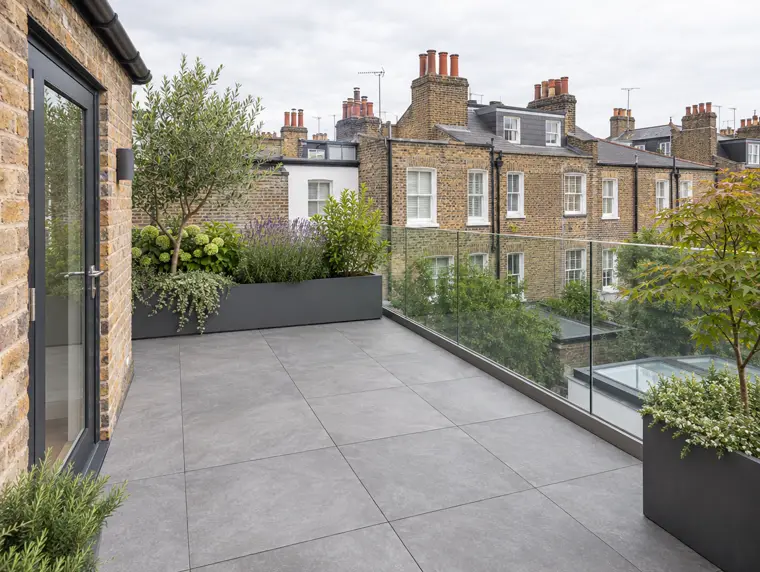
A roof terrace in Dumfries may be re-waterproofed when the owners want to change the finish, swapping old tiles for decking or porcelain on pedestals. Lifting the surface exposes the membrane, and replacing it then avoids having to lift the new finish again later.
Around Dumfries, flat roofs are common on low-rise post-war blocks of flats and on bungalows with flat-roofed side extensions and dormers. Scotland averages roughly 1,570 mm of rain a year, with the west far wetter than the east, so drainage, falls and wind uplift are part of every specification we write.
How much does balcony or terrace waterproofing cost in Dumfries?
For Dumfries we use Scotland rates: £1,800–£3,100 is the guide for a 12 m² balcony in a liquid-applied system including scaffold, VAT included. The fixed price comes after a free survey for new and replacement roofs.
| Job | Guide price inc VAT |
|---|---|
| Balcony (12 m²), liquid-applied, scaffold | £1,800–£3,100 |
| Single garage (18 m²), EPDM rubber | £1,500–£2,650 |
| Extension (20 m²), GRP, new deck + insulation | £2,850–£5,100 |
Which waterproofing system is best for a balcony?
For most small balconies, a liquid-applied membrane is the practical choice, because it is brushed or rolled on and forms one continuous layer around posts, door frames and outlets with no seams to fail. Many systems include a hard-wearing, anti-slip topcoat.
GRP fibreglass gives a rigid, walkable surface and suits balconies left exposed rather than paved. On larger roof terraces under paving or decking, single-ply membranes are common, and mastic asphalt has a long record on concrete terraces and blocks of flats.
The choice also depends on what goes on top. Paving on pedestals protects the membrane, while an exposed balcony needs a system rated for foot traffic in its own right. We specify the build-up at survey.
What's included?
- Free survey of the deck, falls, outlets and door thresholds
- Strip-out of the failed membrane and deck repairs
- Lifting and setting aside of existing paving or decking
- New liquid, GRP, single-ply or asphalt waterproofing
Building standards in Scotland
In Scotland the building standards technical handbooks (Section 6 for energy) apply, and the council's building standards service decides whether a building warrant is needed. Like-for-like repairs to a roof covering can be exempt; alterations, structural work and new roofs usually need a warrant before work starts. The domestic roof benchmark is 0.12 W/m²K, applied as far as reasonably practicable on an existing roof. More on the rules.
Which nearby areas do we also cover?
Balconies and roof terraces in Dumfries: questions
Do you cover Dumfries?
Yes. Dumfries is part of our Dumfries and Galloway coverage, including postcode districts DG1. Surveys and roofs are carried out by vetted roofing teams working under S&K Property Investments and Improvement Ltd.
Who checks building standards for a flat roof in Dumfries?
Where the work needs approval it goes to Dumfries and Galloway Council building standards. We tell you at the survey whether your job needs it and deal with the paperwork as part of the quote.
How much does balcony or terrace waterproofing cost in Dumfries?
£1,800–£3,100 for a 12 m² balcony in a liquid-applied system including scaffold, at Scotland guide rates including VAT. The fixed price comes after a free survey for new and replacement roofs.
How long does balcony waterproofing last?
It depends on the system and how well it is protected. As indicative ranges, liquid-applied systems last 10–25+ years by product and mastic asphalt 30–60, with good maintenance.
Why is water coming through the ceiling below my balcony?
The usual causes are a failed door threshold, a blocked or poorly sealed outlet, or a fixing through the membrane. A survey, sometimes lifting paving, finds the source.