- Price per m²
- £65–£115
- Typical life
- 25–50 years
- Manufacturer guarantees
- 20-year material warranties are common
- Typical garage roof
- £1,600–£2,800
What is an EPDM rubber roof and how is it fitted?
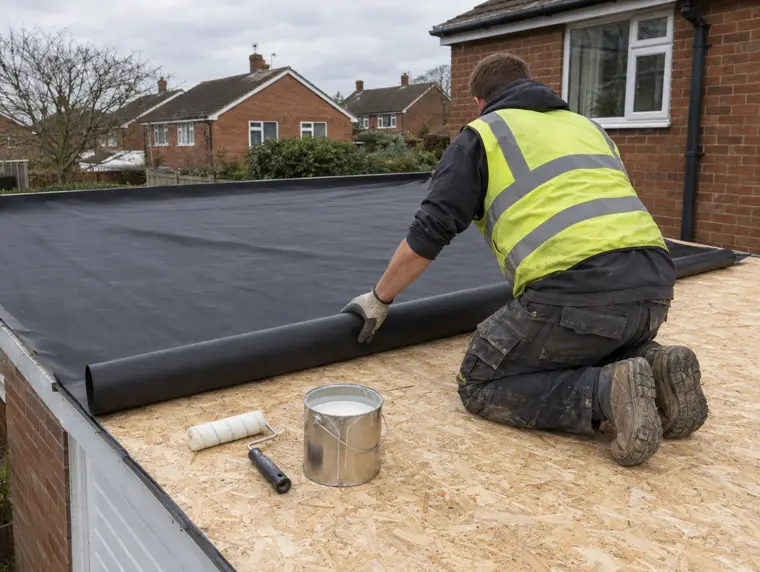
An EPDM roof is a sheet of synthetic rubber (ethylene propylene diene monomer), typically 1.1 to 1.5 mm thick, glued to a timber deck and finished with trims at the edges. On most domestic roofs it goes down as one piece, so the open area of the roof has no joins at all.
A typical replacement build-up, from the joists upwards, looks like this:
- Deck: existing boards checked, with soft or rotten sections replaced in OSB3 or plywood.
- Vapour control layer: stops warm, moist air from the room reaching the insulation.
- Insulation: rigid PIR boards on a warm roof, with a further deck board on top where the system needs one.
- Membrane: laid out to relax, then bonded with water-based adhesive across the main area and contact adhesive at the perimeter and upstands.
- Trims and details: drip trims, kerb trims, outlets and wall upstands finished last.
Because the system is cold-applied, there is no torch on the roof, which matters near timber fascias and on homes that stay occupied during the work.
How much does an EPDM roof cost?
As a guide, EPDM costs £65–£115 per m² to re-cover a sound deck, including stripping one existing layer. Whole jobs usually fall in these ranges, all including VAT:
| Typical job | Guide price |
|---|---|
| Single garage, about 18 m², sound deck | £1,600–£2,800 |
| Extension roof, about 20 m², new deck and warm-roof insulation | £2,800–£4,900 |
| The same extension with one rooflight upstand | £3,000–£5,250 |
| Porch or bay, about 4 m² | £750–£1,250 |
| Extension with a sedum green roof on top | £4,400–£8,100 |
The figure moves with the condition of the deck (£20–£35 per m² where boards need replacing), insulation (£35–£60 per m²), new trims (£12–£22 per metre), and access, including scaffold at £450–£950 for a two-storey or dormer roof. A full re-roof carries a minimum charge of £750–£1,250.
These are guide prices only. Your fixed price comes in writing after a free survey, and you can get a starting figure now from the guide-price tool or read the full cost guide.
How long does an EPDM roof last, and what guarantees come with it?
A well-specified EPDM roof typically lasts 25 to 50 years, and one BBA assessment of an EPDM membrane puts its expected life at 35 years or more. Problems usually come from poorly bonded upstands, damaged trims or ponding, rather than the rubber itself.
Three separate documents can sit behind an EPDM roof:
- Manufacturer material guarantee: covers the membrane and, on some systems, the wider build-up. Many need registration and a specified build-up, so we register it for you where the system allows.
- Our written workmanship guarantee: given on every re-roof, with the length set out in your quote.
- Insurance-backed guarantee: an option worth asking about if you want cover that does not depend on the contractor still trading.
A BBA certificate is an assessment of the product, not a guarantee. Our guide to flat roof guarantees explains the differences, and the lifespan guide compares EPDM with the other systems.
When is EPDM the right choice, and when is another system better?
EPDM is a strong choice for simple domestic roofs that people do not walk on, such as garages, single-storey extensions, porches and dormers. It is less suited to roofs with regular foot traffic or many pipes and vents.
Where it does well: few or no joins on small roofs, flexible in cold weather, tolerant of minor building movement, and laid without a flame.
Where it falls short: the finish is plain dark rubber, it can be punctured by dropped tools or sharp debris, and it is not designed as a walking surface without added protection. Roofs with many penetrations take a lot of careful detailing.
If you want a hard, walkable finish or a complex shape, GRP fibreglass often suits better. On a tight budget, or a larger roof where a layered system is preferred, torch-on felt is worth pricing. Liquid-applied roofing handles awkward details and overlays, single-ply membranes are built for larger commercial roofs, and mastic asphalt belongs on older and heritage buildings. Our EPDM vs GRP vs felt guide sets them side by side.
Do I need building regulations approval to replace a roof with EPDM?
Often, yes. In England, Wales and Northern Ireland, re-covering more than half of a flat roof over a heated room usually counts as renovating a thermal element, so the roof should be insulated towards the renovation standard where that is feasible; in Scotland, the council's building standards service decides whether a building warrant is needed.
An unheated detached garage normally falls outside these rules, and a patch repair is treated differently from a full re-cover.
In practice that means a warm roof: insulation above the deck, a vapour control layer beneath it and the EPDM on top. The extra thickness lifts the finished roof, so at survey we check door thresholds, window cills, wall flashings and upstand heights, aiming for an upstand of about 150 mm above the finished surface. Where approval is needed, we deal with building control or building standards for you. The building regulations page and our warm vs cold roof guide go into more detail.
How are the joins, edges and upstands made watertight on an EPDM roof?
They are bonded with contact adhesive and sealed with purpose-made EPDM tapes and pre-formed pieces, because the edges and details are where most rubber roof leaks start.
- Wall upstands: the rubber is turned up the wall, usually to about 150 mm above the finished roof, fully bonded, then finished with a termination bar or a cover flashing chased into the masonry.
- Corners: folded rather than cut where possible, or finished with pre-formed pieces.
- Joins: on roofs wider than one sheet, the laps are cleaned, primed and joined with splice tape, then rolled firmly.
- Pipes and vents: sealed with pre-formed pipe boots rather than relying on mastic.
- Edges and outlets: drip and kerb trims are fixed and the junction with the membrane is sealed with cover tape; outlets are bonded into the membrane at the lowest point.
We also check the falls before laying, because standing water around an outlet shortens the life of any detail. There is more on this in our pages on edges and drainage and rooflight upstands.
What's included when we do the work?
- Strip-out of the old covering, with waste taken away
- Deck check and replacement of soft or rotten boards
- Warm-roof insulation and vapour control layer where required
- EPDM membrane fully bonded, in one sheet where the roof size allows
- New drip and kerb trims, outlets and upstand details
- Written workmanship guarantee, plus manufacturer guarantee registration where available
What do guide prices look like?
Guide prices including VAT at West Midlands rates; regional pages adjust these for your area. The fixed price comes after a free survey for new and replacement roofs.
| Job | Guide price inc VAT |
|---|---|
| Single garage (18 m²), EPDM rubber | £1,600–£2,800 |
| Extension (20 m²), EPDM, new deck + insulation | £2,800–£4,900 |
| Porch or bay (4 m²), EPDM | £750–£1,250 |
Does anything differ outside England?
- Wales: In Wales most re-roofing needs building regulations approval, and replacing or repairing more than 25% of the roof is the point to check. Insulation under a new EPDM roof over a heated room should aim for the 0.16 W/m²K renovation standard where feasible.
- Scotland: Scotland's building standards set a tougher roof benchmark of 0.12 W/m²K for homes, pursued as far as reasonably practicable, so an EPDM re-roof over a heated room may need a thicker insulation build-up. Check with the council's building standards service whether a building warrant is needed before work starts.
- Northern Ireland: In Northern Ireland, contact the district council's building control before starting an EPDM re-roof over a heated room; Technical Booklets F1 and F2 use 0.18 W/m²K for roofs. CDM (NI) 2016 applies to the work rather than the Great Britain regulations.
How does the job run from start to finish?
Free survey
A surveyor measures the roof, checks the deck and joists, and notes falls, outlets and upstands. You hear plainly whether EPDM suits the roof.
Fixed written quote
You receive a fixed price in writing with the build-up, guarantee terms and any building control or building standards steps set out.
Strip and install
The team strips the old roof, repairs the deck, fits insulation where needed and bonds the EPDM, keeping the roof weathertight overnight.
Sign-off
We walk the finished roof with you, check trims, upstands and outlets, and issue the workmanship guarantee and any manufacturer registration.
Questions about EPDM rubber roofing
Can you walk on an EPDM roof?
Occasionally, for maintenance, yes, but EPDM is not designed as a regular walking surface. Where you need a route to plant or windows, walkway pads can be bonded on, or GRP may be a better fit.
Can EPDM be laid over an old felt roof?
Sometimes, but we usually recommend stripping old felt first. Overlaying hides any rot or wet insulation underneath, and over a heated room a full replacement is often when insulation has to be added anyway.
Can an EPDM roof be fitted in winter?
Yes, as long as the deck is dry. The adhesives are affected by cold and damp, so very cold or wet days can delay bonding, and the roof is kept temporarily weathertight between dry spells.
How long does it take to fit an EPDM roof?
A single garage typically takes one to two days and an insulated extension roof two to three, weather permitting. Larger roofs, scaffold and complex details add time.
Can a punctured EPDM roof be repaired?
Usually, yes. The area is cleaned and primed, then an EPDM patch or cover tape is bonded over the damage. If water has reached the deck, a survey first is sensible.
Can you put a green roof on top of EPDM?
Yes. EPDM is often used under sedum, with a protection layer, drainage and growing medium laid on top. The structure must be able to carry the extra weight, which we check before quoting.
Does an EPDM roof need maintenance?
Very little. Clear leaves from outlets and gutters, look over trims and upstands once or twice a year and after storms, and keep foot traffic to a minimum.
Related services
GRP fibreglass roofing
Hard-wearing laminated fibreglass with moulded trims, for dormers, extensions and garages
Garage roofs
Garage roof replacement in EPDM, GRP or felt, for single, double, attached and lock-up garages
Extension and kitchen roofs
Warm-roof replacement for kitchen and rear extensions, with sound abutments and rooflight kerbs
Green and sedum roofs
Sedum and extensive green roofs built over new waterproofing, after a structural check.
Where do you offer EPDM rubber roofing?
- Bedfordshire
- Berkshire
- Bristol
- Buckinghamshire
- Cambridgeshire
- Cheshire
- Cornwall
- County Durham
- Cumbria
- Derbyshire
- Devon
- Dorset
- East Riding of Yorkshire
- East Sussex
- Essex
- Gloucestershire
- Greater Manchester
- Hampshire
- Herefordshire
- Hertfordshire
- Isle of Wight
- Kent
- Lancashire
- Leicestershire
- Lincolnshire
- London
- Merseyside
- Norfolk
- North Yorkshire
- Northamptonshire
- Northumberland
- Nottinghamshire
- Oxfordshire
- Shropshire
- Somerset
- South Yorkshire
- Staffordshire
- Suffolk
- Surrey
- Tyne and Wear
- Warwickshire
- West Midlands
- West Sussex
- West Yorkshire
- Wiltshire
- Worcestershire
- Blaenau Gwent
- Bridgend
- Caerphilly
- Cardiff
- Carmarthenshire
- Ceredigion
- Conwy
- Denbighshire
- Flintshire
- Gwynedd
- Isle of Anglesey
- Merthyr Tydfil
- Monmouthshire
- Neath Port Talbot
- Newport
- Pembrokeshire
- Powys
- Rhondda Cynon Taf
- Swansea
- Torfaen
- Vale of Glamorgan
- Wrexham
- Aberdeen City
- Aberdeenshire
- Angus
- Argyll and Bute
- City of Edinburgh
- Clackmannanshire
- Dumfries and Galloway
- Dundee City
- East Ayrshire
- East Dunbartonshire
- East Lothian
- East Renfrewshire
- Falkirk
- Fife
- Glasgow City
- Highland
- Inverclyde
- Midlothian
- Moray
- North Ayrshire
- North Lanarkshire
- Perth and Kinross
- Renfrewshire
- Scottish Borders
- South Ayrshire
- South Lanarkshire
- Stirling
- West Dunbartonshire
- West Lothian
- Belfast
- County Antrim
- County Armagh
- County Down
- County Fermanagh
- County Londonderry
- County Tyrone