- Guide price
- £120–£350
- Repair price
- Confirmed once the leak or damage is found
- Condition survey report
- £150–£300
- Coverage
- England, Wales, Scotland, NI
What do flat roof edge trims and drip trims do?
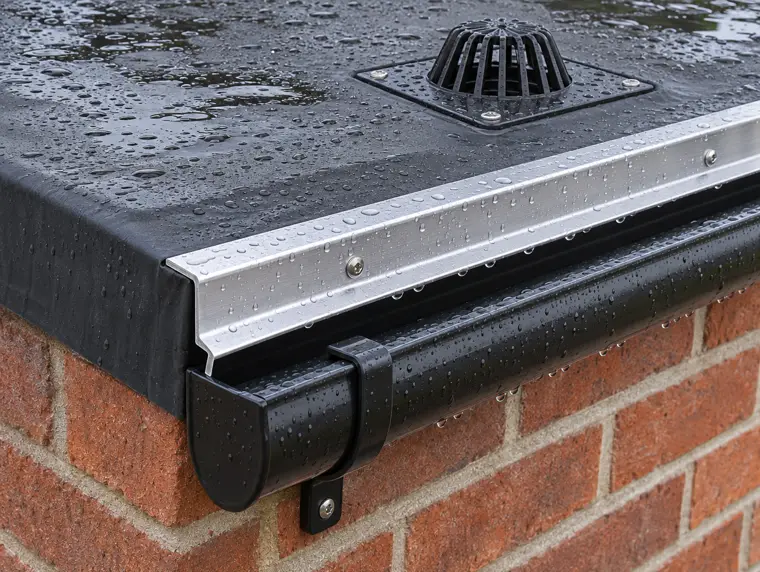
Edge trims finish the perimeter of the roof and hold the waterproofing down at the edge. Drip trims throw water clear of the fascia and into the gutter, so it doesn't run back down the wall or behind the gutter.
On most modern systems, the trims are made of GRP or aluminium and are fixed to the deck before the waterproofing is dressed over or into them. Where a roof finishes against a wall or parapet, a raised kerb or upstand is used instead, usually at least 150 mm above the finished roof surface, with a flashing or cover above to stop water getting in behind it.
Loose, split or badly lapped trims are a common source of leaks and of rot in fascias and the deck edge. Wind can also catch a lifted trim and start peeling the covering back. Replacing failed trims is a contained job, provided the deck edge beneath is sound.
How much do new trims, outlets and gutters cost?
New edge and drip trims cost £12–£22 per metre as a guide, and a new outlet or gutter run is £120–£280. Repairs to an existing outlet or drainage detail are usually cheaper.
| Work | Guide price |
|---|---|
| New edge and drip trims | £12–£22 per metre |
| New outlet or gutter run | £120–£280 |
| Outlet or drainage repair | £120–£350 |
| Upstand, flashing or abutment repair | £250–£650 |
These are guide prices including VAT at 20%. The fixed price comes after we have inspected the roof, because the condition of the deck edge and fascia, the height of the roof and how the outlet connects to the downpipe all affect the work. Scaffold for a two-storey roof adds £450–£950. When trims and outlets are replaced as part of a new roof, they are included in the replacement quote, which is free. See the cost guide for whole-roof prices.
Why does water sit on my flat roof?
Water sits on a flat roof because it can't drain off fast enough: the falls are too shallow, part of the roof slopes the wrong way, the deck has sagged between joists, or an outlet is blocked or set too high.
Current guidance on flat roof design (BS 6229) means most roofs need to achieve a finished fall of at least 1:80, and roofs are commonly designed with a steeper fall, such as 1:60, so that building tolerances and deck deflection still leave enough slope. Many older roofs were built with less, or have settled over time.
A small amount of water that clears within a day or two of rain is often tolerable. Deeper ponding that lingers adds weight, holds dirt and debris, can shorten the life of some coverings and turns any small defect into a leak. A patch won't fix it, because the problem is the shape of the roof. The fix is to correct the falls, either with firring pieces under a new deck or with tapered insulation in a warm roof, or to add or lower outlets so water has somewhere to go. Our ponding water guide explains this in more detail.
Do flat roofs need overflows?
Roofs that drain to internal outlets or behind parapets should normally have an overflow, so that if an outlet blocks, water spills somewhere visible instead of rising over the upstands and into the building.
An overflow is usually a spout or weir set through the parapet or kerb at a level below the top of the upstands. When water runs from it, that is a sign the main outlet is blocked or overloaded. On a simple roof that drains over a drip trim into an external gutter, the open edge itself does the same job.
We look at where the water goes in heavy rain, how many outlets the roof has for its size, and whether the outlets, hoppers and downpipes are clear and properly connected. Leaf guards on outlets help on roofs near trees, as long as they are cleared regularly.
Should I fix the edges and drainage or replace the whole roof?
Fix the edges and drainage on their own if the covering is in good condition and the deck is sound. If the covering is near the end of its life or the falls need correcting across the whole roof, it is usually better value to do everything together as part of a replacement.
Trims and outlets are bonded into the waterproofing, so replacing them means cutting into the covering around the edge. On a roof with plenty of life left, that is a worthwhile repair. On an old, brittle covering, the new detail can end up stronger than the roof around it, and correcting falls means taking the covering off anyway. Our repair or replace guide sets out how to decide.
How long do flat roof trims and outlets last?
Properly fixed GRP or aluminium trims and well-installed outlets should last about as long as the waterproofing they are part of. What shortens their life is poor fixing, movement in a rotten deck edge and blockages that are never cleared.
A quick check of outlets and gutters each autumn, and again after storms, prevents most drainage problems. Look for leaves and silt in outlets, gutters pulling away from the fascia, trims that have lifted or split at joints and staining on the wall below the edge. The maintenance guide lists what to check and when. Only check what you can see safely from the ground, a window or a ladder at the edge, and never walk on a roof that isn't designed for it.
What's included when we do the work?
- New GRP or aluminium edge and drip trims
- Raised kerbs and upstands where the roof meets a wall
- New, repaired or relocated outlets and gutter runs
- Overflows on parapet and internal-outlet roofs
- Ponding diagnosed and falls corrected where needed
- Outlets, hoppers and downpipes checked and cleared
What do guide prices look like?
Guide prices including VAT at West Midlands rates; regional pages adjust these for your area. We confirm the price once we've traced the leak or seen the damage.
| Job | Guide price inc VAT |
|---|---|
| Outlet or drainage repair | £120–£350 |
| Localised patch repair | £150–£500 |
| Upstand or flashing repair | £250–£650 |
| Emergency temporary weatherproofing visit | £180–£450 |
| Condition survey and leak investigation | £150–£300 |
Does anything differ outside England?
- Wales: Higher rainfall across much of Wales makes outlets, gutters and overflows work harder than in drier parts of England. Edge work on its own rarely needs approval, but a wider re-roof affecting more than about a quarter of the roof may.
- Scotland: Scotland's west and upland areas see much higher rainfall, so outlet capacity and overflows deserve extra care there. If drainage work forms part of a wider re-roof, check with the council's building standards team about a building warrant.
- Northern Ireland: In Northern Ireland, trims and outlets on their own rarely need approval, but contact the district council's building control if they form part of a re-roof. Exposed coastal sites need trims fixed to suit higher wind loads.
How does the job run from start to finish?
Look at the problem
Tell us what you have noticed: water sitting on the roof, staining below the edge, lifted trims or overflowing gutters. We arrange an inspection.
Inspect falls and drainage
We check the trims, kerbs, outlets and gutters and look at how water moves across the roof, including any backfalls or sagging.
Fixed written price
You get a fixed written price and an honest view of whether the work stands on its own or belongs with a replacement.
Fit and test
We fit or repair the trims, outlets and gutters with compatible materials and check that water runs where it should.
Questions about edge trims, outlets and drainage
Is some standing water on a flat roof normal?
A thin film that clears within a day or two of rain is common and usually harmless. Deeper water that lingers for days points to poor falls, a sagging deck or a blocked outlet and should be looked at.
Can you add a new outlet to an existing flat roof?
Usually, yes. The outlet is cut in at a low point, connected to a downpipe or gutter, and the waterproofing is dressed into it with compatible materials. Whether it solves ponding depends on whether water can actually reach it.
What's the difference between a drip trim and an edge trim?
An edge trim finishes the edge of the roof and holds the waterproofing down. A drip trim has a profile that throws water clear into the gutter. On many roofs a single trim does both jobs.
Why is my fascia rotting under a flat roof?
Usually because water is getting behind a loose or badly lapped trim, or running back under the edge because there is no proper drip. The fascia and deck edge are replaced and new trims are fitted to stop it happening again.
Can a flat roof be re-laid with better falls?
Yes, as part of a replacement. Falls are corrected with tapered firring pieces under a new deck or with tapered insulation in a warm roof build-up.
How often should flat roof outlets be cleared?
At least once a year, ideally in autumn after the leaves fall, and more often for roofs under trees. A quick check after heavy storms is also worthwhile.
Do new trims need building regulations approval?
Not usually on their own. Approval only becomes a question if the work is part of a larger re-roofing job or alters the structure.
Related services
Flat roof repairs
Patch, seam, upstand and outlet repairs on felt, EPDM, GRP, liquid and asphalt flat roofs.
Flat roof surveys and leak tracing
Condition surveys and leak tracing with moisture readings, core checks and a written report.
Flat roof replacement
Full strip and re-roof of tired flat roofs, with new deck, insulation and falls where needed
Warm roof insulation upgrades
Insulation laid above the deck during a re-roof, to cut heat loss and condensation risk.
Where do you offer edge trims, outlets and drainage?
- Bedfordshire
- Berkshire
- Bristol
- Buckinghamshire
- Cambridgeshire
- Cheshire
- Cornwall
- County Durham
- Cumbria
- Derbyshire
- Devon
- Dorset
- East Riding of Yorkshire
- East Sussex
- Essex
- Gloucestershire
- Greater Manchester
- Hampshire
- Herefordshire
- Hertfordshire
- Isle of Wight
- Kent
- Lancashire
- Leicestershire
- Lincolnshire
- London
- Merseyside
- Norfolk
- North Yorkshire
- Northamptonshire
- Northumberland
- Nottinghamshire
- Oxfordshire
- Shropshire
- Somerset
- South Yorkshire
- Staffordshire
- Suffolk
- Surrey
- Tyne and Wear
- Warwickshire
- West Midlands
- West Sussex
- West Yorkshire
- Wiltshire
- Worcestershire
- Blaenau Gwent
- Bridgend
- Caerphilly
- Cardiff
- Carmarthenshire
- Ceredigion
- Conwy
- Denbighshire
- Flintshire
- Gwynedd
- Isle of Anglesey
- Merthyr Tydfil
- Monmouthshire
- Neath Port Talbot
- Newport
- Pembrokeshire
- Powys
- Rhondda Cynon Taf
- Swansea
- Torfaen
- Vale of Glamorgan
- Wrexham
- Aberdeen City
- Aberdeenshire
- Angus
- Argyll and Bute
- City of Edinburgh
- Clackmannanshire
- Dumfries and Galloway
- Dundee City
- East Ayrshire
- East Dunbartonshire
- East Lothian
- East Renfrewshire
- Falkirk
- Fife
- Glasgow City
- Highland
- Inverclyde
- Midlothian
- Moray
- North Ayrshire
- North Lanarkshire
- Perth and Kinross
- Renfrewshire
- Scottish Borders
- South Ayrshire
- South Lanarkshire
- Stirling
- West Dunbartonshire
- West Lothian
- Belfast
- County Antrim
- County Armagh
- County Down
- County Fermanagh
- County Londonderry
- County Tyrone