- Price per m²
- £90–£145
- Typical life
- 25–35+ years
- Manufacturer guarantees
- 20–25 year guarantees on specified systems
- Typical garage roof
- £2,050–£3,350
What is a single-ply roof and how is it installed?
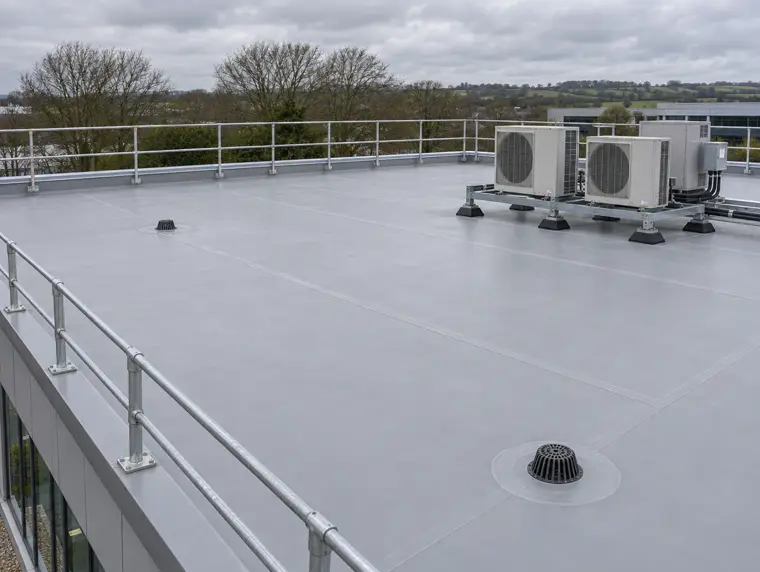
A single-ply roof is a thin, flexible thermoplastic sheet laid in wide rolls over insulation and fixed down, with the overlaps fused together by hot air so the seams become part of the membrane. Unlike felt, there is only one waterproof layer, so the quality of every weld matters.
A typical warm-roof build-up on a commercial roof:
- Deck: timber, concrete or profiled metal, checked and repaired.
- Vapour control layer: laid over the deck and sealed at the edges.
- Insulation: rigid boards, often tapered to create or improve falls to outlets.
- Separation layer where needed: some membranes, particularly PVC, must not touch bitumen or certain insulation types.
- Membrane: mechanically fixed, adhered or ballasted, depending on the roof.
- Details: upstands, outlets, rooflight kerbs and edges finished with membrane-coated metal trims and pre-formed corners, all welded.
How much does single-ply roofing cost?
Single-ply typically costs £90–£145 per m² as a guide, with larger roofs generally coming in at a lower rate per square metre because set-up and access costs are spread further. Typical jobs, including VAT:
| Typical job | Guide price |
|---|---|
| Single garage, about 18 m², sound deck | £2,050–£3,350 |
| Commercial roof, about 100 m², with insulation | £13,250–£21,800 |
Costs rise with insulation thickness (£35–£60 per m²), tapered schemes, the number of rooflights (£180–£350 per upstand) and outlets (£120–£280), height and access, scaffold or edge protection, and the wind exposure of the site, which sets how many fixings are needed.
These are guide prices. Commercial roofs especially vary, so the fixed price always follows a free survey and is set out in writing. You can get a starting figure from the guide-price tool, and the cost guide compares all six systems.
How long does a single-ply roof last, and what guarantee comes with it?
A well-installed single-ply roof typically lasts 25 to 35 years or more. Its life depends mostly on the quality of the welds, the fixing pattern, protection from foot traffic and keeping outlets clear.
Signs of trouble on an older single-ply roof include seams lifting at the edges, shrinkage pulling at upstands and corners, punctures near plant, and loose fixings under the membrane on windy sites.
Manufacturer guarantees are available on many specified single-ply systems, and they often depend on a registered build-up, an inspection and sometimes an approved installer. Where the system allows, we complete that registration on your behalf. On every re-roof you also receive our written workmanship guarantee, with the length set out in the quote, and you can ask about insurance-backed options. See the guarantees guide and maintenance guide for more.
Is single-ply the right system for my roof?
Single-ply is usually the right system for medium and large flat roofs, such as shops, offices, units, surgeries, clubs and blocks, where speed of installation, light weight and long life matter. On a small domestic roof it can work well, though it is not always the most economical choice.
In its favour: lightweight; quick to lay over large areas; flame-free, as the seams are welded with hot air; long typical life; welded details at rooflights and plant; lighter-coloured membranes reflect more sunlight.
Against it: only one waterproof layer, so welding quality is critical; can be punctured by foot traffic or dropped tools without walkway protection; PVC needs separating from bitumen; repairs need compatible material and welding equipment.
For a small garage or extension, EPDM is often simpler. Where people walk regularly, GRP or a liquid system may be tougher. A multi-layer torch-on felt roof gives built-in redundancy, and on older buildings mastic asphalt may be the original material. Our commercial flat roofing page covers larger jobs.
What insulation and approvals does a single-ply re-roof need?
On a heated building, a full single-ply re-roof usually triggers the thermal-element rules, so insulation should be brought towards the renovation standard where feasible. In England that is 0.18 W/m²K for non-domestic and 0.16 W/m²K for domestic roofs, with Wales and Northern Ireland setting their own figures; Scottish roofs follow Section 6 of the building standards, and the council confirms whether a building warrant is required.
Single-ply suits a warm roof well, and tapered insulation can correct poor falls at the same time. A thicker build-up raises the roof, so we check upstand heights, door thresholds and rooflight kerbs at survey. Near boundaries, the external fire classification of the tested build-up can matter. We handle building control or building standards where needed; see the building regulations page.
Should a single-ply roof be mechanically fixed or adhered, and how are the seams welded?
Most commercial single-ply roofs are mechanically fixed, while adhered systems suit decks that cannot take fixings or roofs where a smooth finish is wanted. The choice depends on the deck, the wind exposure of the site and the manufacturer's specification.
| Method | How it works | Typical use |
|---|---|---|
| Mechanically fixed | Fasteners and plates hold the membrane through the insulation into the deck, hidden under the lap of the next sheet | Metal, timber and concrete decks on commercial roofs |
| Adhered | Membrane bonded to the insulation or deck with adhesive | Domestic roofs, roofs where fixings are unsuitable |
| Ballasted | Loose-laid and held down by paving, gravel or a green roof | Inverted roofs, terraces, green roofs |
Fixing patterns are worked out for the site, with more fasteners at corners and perimeters, where wind uplift is strongest.
Seams are welded by hot-air machines and hand tools that melt the overlapping edges so they fuse. Each seam is then probed along its length to find any gaps, and test welds are made at the start of the day to set the machine for the weather. On commercial jobs we also check that walkways protect the membrane around plant.
What's included when we do the work?
- Strip-out or preparation of the existing roof, with waste removed
- Vapour control layer and warm-roof or tapered insulation as specified
- PVC, TPO or FPO membrane, mechanically fixed, adhered or ballasted
- Hot-air welded seams, each probed along its full length
- Welded details at upstands, outlets, rooflight kerbs and edge trims
- Edge protection on every job and walkway protection around plant
What do guide prices look like?
Guide prices including VAT at West Midlands rates; regional pages adjust these for your area. The fixed price comes after a free survey for new and replacement roofs.
| Job | Guide price inc VAT |
|---|---|
| Commercial roof (100 m²), single-ply + insulation | £13,250–£21,800 |
| Single garage (18 m²), single-ply | £2,050–£3,350 |
| Single garage (18 m²), EPDM rubber | £1,600–£2,800 |
| Extension (20 m²), EPDM, new deck + insulation | £2,800–£4,900 |
Does anything differ outside England?
- Wales: In Wales, most re-roofing needs building regulations approval, and replacing or repairing more than 25% of the roof is the point to check. A single-ply roof over a heated domestic space should aim for 0.16 W/m²K where feasible.
- Scotland: In Scotland, check with the council's building standards service whether a single-ply re-roof needs a building warrant; alterations and structural work usually do. Section 6 of the technical handbooks applies a different energy framework, with a domestic roof benchmark of 0.12 W/m²K pursued as far as reasonably practicable.
- Northern Ireland: In Northern Ireland, contact the district council's building control before starting a single-ply re-roof. Technical Booklets F1 and F2 set 0.18 W/m²K for roofs, and CDM (NI) 2016 applies to the work.
How does the job run from start to finish?
Survey
We inspect the deck, measure the roof, check falls, outlets, rooflights and plant, and note exposure and access.
Specification and quote
You receive a fixed written quote covering the membrane, fixing method, insulation, guarantee terms and any approvals needed.
Install and weld
The team lays insulation and membrane in sections, keeping each area weathertight, and welds and probes every seam.
Inspect and hand over
We walk the roof with you or your agent, check details and outlets, and hand over the workmanship guarantee and any manufacturer registration.
Questions about single-ply membrane roofing
What is the difference between PVC and TPO roofing?
Both are thermoplastic single-ply membranes welded with hot air. PVC contains plasticisers and usually needs separating from bitumen, while TPO and FPO are polyolefin-based; the right one depends on the roof and the system specified.
Can single-ply be used on a house?
Yes. It can be used on garages, extensions and dormers, usually adhered rather than mechanically fixed. On small domestic roofs, though, EPDM or GRP is often more economical.
Can single-ply roofing be laid over an existing roof?
Sometimes, if the existing roof and deck are dry and sound, often with a separation layer or new insulation on top. Wet insulation or a damaged deck means stripping first.
Is single-ply roofing noisy in the rain?
No more than other flat roofs. Noise depends far more on the deck and insulation than on the membrane, and an insulated warm roof dampens rain noise well.
Can a single-ply roof be repaired?
Yes. A compatible patch is cleaned and hot-air welded over the damage. Older membranes may need extra cleaning before they weld properly, which the team checks on site.
How long does a commercial single-ply roof take?
A roof of around 100 m² typically takes several days, depending on strip-out, insulation, details and weather. Work is phased so the building stays weathertight and occupied areas are protected.
Does single-ply work with solar panels or a green roof?
Usually, yes. Many systems can be specified for sedum or ballasted green roofs, and solar mounts can be welded or ballasted, though the structure and wind loads must be checked first.
Related services
Commercial flat roofing
Single-ply, felt and liquid roofs for shops, offices, units and clubs, planned around trading.
Flats, HMOs and block roofs
Flat roofs for blocks, HMOs and converted flats, with itemised quotes and phased work.
Warm roof insulation upgrades
Insulation laid above the deck during a re-roof, to cut heat loss and condensation risk.
Torch-on felt roofing
Layered bitumen membrane, heat-bonded on site, for houses, blocks of flats and commercial roofs
Where do you offer single-ply membrane roofing?
- Bedfordshire
- Berkshire
- Bristol
- Buckinghamshire
- Cambridgeshire
- Cheshire
- Cornwall
- County Durham
- Cumbria
- Derbyshire
- Devon
- Dorset
- East Riding of Yorkshire
- East Sussex
- Essex
- Gloucestershire
- Greater Manchester
- Hampshire
- Herefordshire
- Hertfordshire
- Isle of Wight
- Kent
- Lancashire
- Leicestershire
- Lincolnshire
- London
- Merseyside
- Norfolk
- North Yorkshire
- Northamptonshire
- Northumberland
- Nottinghamshire
- Oxfordshire
- Shropshire
- Somerset
- South Yorkshire
- Staffordshire
- Suffolk
- Surrey
- Tyne and Wear
- Warwickshire
- West Midlands
- West Sussex
- West Yorkshire
- Wiltshire
- Worcestershire
- Blaenau Gwent
- Bridgend
- Caerphilly
- Cardiff
- Carmarthenshire
- Ceredigion
- Conwy
- Denbighshire
- Flintshire
- Gwynedd
- Isle of Anglesey
- Merthyr Tydfil
- Monmouthshire
- Neath Port Talbot
- Newport
- Pembrokeshire
- Powys
- Rhondda Cynon Taf
- Swansea
- Torfaen
- Vale of Glamorgan
- Wrexham
- Aberdeen City
- Aberdeenshire
- Angus
- Argyll and Bute
- City of Edinburgh
- Clackmannanshire
- Dumfries and Galloway
- Dundee City
- East Ayrshire
- East Dunbartonshire
- East Lothian
- East Renfrewshire
- Falkirk
- Fife
- Glasgow City
- Highland
- Inverclyde
- Midlothian
- Moray
- North Ayrshire
- North Lanarkshire
- Perth and Kinross
- Renfrewshire
- Scottish Borders
- South Ayrshire
- South Lanarkshire
- Stirling
- West Dunbartonshire
- West Lothian
- Belfast
- County Antrim
- County Armagh
- County Down
- County Fermanagh
- County Londonderry
- County Tyrone