- Price per m²
- £90–£140
- Typical life
- 10–25+ years by product
- Manufacturer guarantees
- 10, 15 or 20-year guarantees by named system
- Typical garage roof
- £2,050–£3,250
What is a liquid-applied roof and how is it put on?
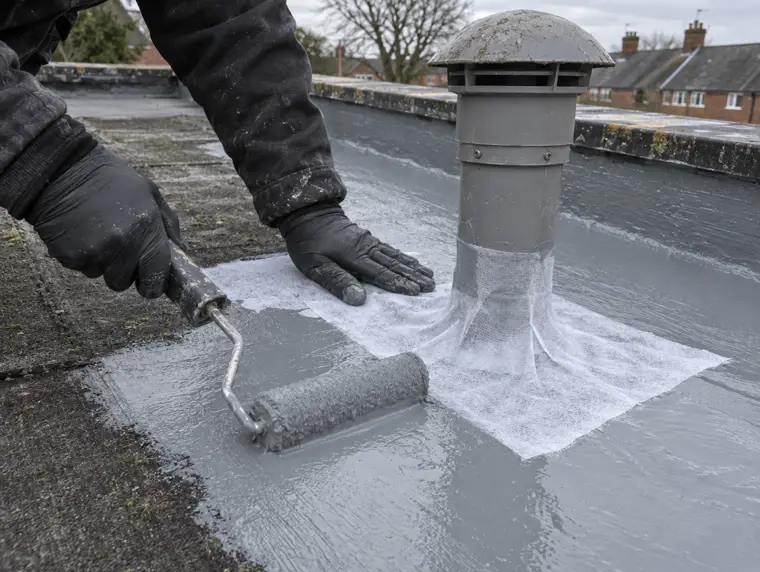
A liquid roof is a coating-based membrane, typically polyurethane, polymethyl methacrylate (PMMA) or a modified bitumen or polymer product, applied wet and reinforced with a polyester fleece. As it cures it bonds to the surface beneath, so there are no laps, seams or separate flashings.
The usual sequence on a reinforced system:
- Preparation: the surface is cleaned, loose material removed, defects repaired and the area dried.
- Primer: chosen to suit the substrate, whether felt, asphalt, concrete, timber or metal.
- Details first: upstands, outlets, pipes and corners are coated and reinforced before the main area.
- Base coat and fleece: resin is applied, the fleece is embedded with no creases or air, and more resin saturates it.
- Top coat: a second coat builds thickness, with an optional anti-slip or coloured finish.
Each system has a specified thickness and coverage rate, and the team checks these as it goes, because a membrane that is too thin will not achieve its stated life.
How much does a liquid roof cost?
Liquid-applied roofing typically costs £90–£140 per m² as a guide. It is not the cheapest system per square metre, but avoiding a full strip-out can lower the total on the right roof. Typical jobs, including VAT:
| Typical job | Guide price |
|---|---|
| Single garage, about 18 m², sound substrate | £2,050–£3,250 |
| Balcony, about 12 m², including scaffold | £1,900–£3,250 |
The total depends on the substrate and how much preparation it needs, the number of details such as pipes, outlets and upstands, the system and its thickness, and access. Where the old roof cannot be kept, add strip-out (£250–£400), a new deck (£20–£35 per m²) and any insulation (£35–£60 per m²); scaffold is £450–£950 where needed.
All figures are guide prices. The fixed price follows a free survey and is confirmed in writing. Use the guide-price tool for a starting figure, or compare systems in the cost guide.
How long does a liquid-applied roof last, and how is it guaranteed?
Cold liquid-applied roofs typically last 10 to 25 years or more, depending on the product and the thickness applied. One reinforced system has a BBA assessment of over 25 years, while lighter coatings designed to extend an existing roof sit at the lower end of the range.
Because life varies so much by product, it pays to know exactly what is being applied. Your quote should name the system, the reinforcement and the build-up.
Manufacturer guarantees are often tied to a named system, with lengths such as 10, 15 or 20 years depending on the specification, and some require registration or an approved applicator. We handle that registration where the system permits it. Every re-roof also carries our written workmanship guarantee, with the length set out in the quote, and you can ask about insurance-backed options. A BBA certificate is a product assessment, not a guarantee; our guarantees guide explains the difference.
When is a liquid roof the best option, and when is it not?
A liquid roof is often the best option for roofs crowded with pipes, vents and upstands, for balconies and walkways, and for overlaying a structurally sound roof that is starting to fail. It is the wrong choice when the deck is rotten, the insulation is wet or the falls are badly wrong.
Advantages: continuous finish with no laps; forms details around pipes and odd shapes easily; cold-applied with no flame; can often go over felt, asphalt or concrete; some systems take foot traffic.
Disadvantages: higher cost per square metre than felt or EPDM; needs dry weather and careful thickness control; only as good as the surface it is bonded to; product quality varies widely across the market.
For a straightforward re-roof on a fresh deck, EPDM or GRP may offer better value. Larger flat areas suit torch-on felt or single-ply. On a sound mastic asphalt roof, a compatible liquid system can sometimes be applied over it. See also our guide to overlay or strip.
Do building regulations apply if a liquid coating goes over my roof?
They can. In England, Wales and Northern Ireland, re-covering more than half of a roof over a heated room is usually renovation of a thermal element, even when the new membrane goes over the old, so the roof should be insulated towards the renovation standard where feasible; for a Scottish property, the local building standards team will confirm whether a warrant is required.
A minor coating repair to a small area is different from re-covering the whole roof. Where insulation is needed, an overlay is not always practical, because the insulation has to go under a new waterproof layer. In that case we may recommend stripping to the deck, fitting a warm roof and applying the liquid system on top. Where approval applies, we deal with the paperwork; details are on the building regulations page.
Can a liquid roof go over my existing roof, and what preparation is needed?
Yes, if the existing roof is dry, firmly bonded and sitting on a sound deck. A liquid membrane is only as good as what lies beneath it, so we test the old roof before agreeing to overlay it.
At survey we check for:
- Trapped moisture: soft spots, blisters or wet insulation mean the roof should be stripped, because water sealed in will cause new blisters and decay.
- Deck condition: any sponginess or deflection needs repair first.
- Adhesion: on felt and asphalt, loose areas are cut out and patched, and the existing surface must take the primer properly.
- Falls and ponding: a coating follows the roof as it is. If water ponds now, it will pond on the new surface too unless the falls are corrected.
Preparation then follows: loose chippings removed, the surface cleaned and left to dry, blisters cut back and repaired, cracks filled, and the right primer applied. On older felt, mineral surfaces may need extra cleaning to give a good bond. Where the tests fail, we say so plainly and quote for a strip and re-roof. Read more on ponding water.
What's included when we do the work?
- Survey of the existing roof, including moisture and adhesion checks
- Surface cleaning, repairs and removal of loose material
- Primer matched to the substrate
- Detailing of upstands, outlets, pipes and corners before the main area
- Fleece-reinforced liquid membrane applied to the specified thickness
- Top coat with optional anti-slip finish, and guarantee registration where available
What do guide prices look like?
Guide prices including VAT at West Midlands rates; regional pages adjust these for your area. The fixed price comes after a free survey for new and replacement roofs.
| Job | Guide price inc VAT |
|---|---|
| Single garage (18 m²), liquid-applied | £2,050–£3,250 |
| Balcony (12 m²), liquid-applied, scaffold | £1,900–£3,250 |
| Single garage (18 m²), EPDM rubber | £1,600–£2,800 |
| Extension (20 m²), EPDM, new deck + insulation | £2,800–£4,900 |
Does anything differ outside England?
- Wales: In Wales, most re-roofing needs building regulations approval, so check if more than 25% of the roof is being replaced or repaired, including by overlay. A roof over a heated space should be upgraded towards 0.16 W/m²K where feasible.
- Scotland: In Scotland, check with the council's building standards service whether a building warrant is needed before re-covering a roof in a liquid system; like-for-like covering repairs can be exempt. Where insulation is added over a heated room, the domestic benchmark is 0.12 W/m²K, pursued as far as reasonably practicable.
- Northern Ireland: In Northern Ireland, ask the district council's building control before applying a liquid re-cover to a roof over a heated space. Technical Booklets F1 and F2 use a 0.18 W/m²K standard for roofs.
How does the job run from start to finish?
Survey and tests
We check the deck, test for trapped moisture and adhesion, and decide whether the roof can be overlaid or needs stripping.
Fixed written quote
The quote names the system, reinforcement, preparation, thickness and guarantee terms, with any approval needed.
Prepare and apply
The team cleans and repairs the surface, primes it, forms the details and applies the reinforced membrane in dry weather.
Check and sign off
We check coverage, details and outlets with you once the membrane has cured, then hand over the guarantee paperwork.
Questions about liquid-applied roofing
Is liquid roofing the same as a roof paint?
No. A proper liquid-applied membrane is built to a specified thickness and usually reinforced with fleece, while roof paints and simple coatings are much thinner and mainly used to extend the life of an existing covering.
Can liquid roofing be applied in the rain?
No. The surface must be dry, and most systems need a dry window while they cure. Some fast-curing products shorten that window, but the team will not apply onto a damp roof.
Is liquid roofing good for balconies?
Often, yes. It forms neatly around railings, door thresholds and drains, and some systems take foot traffic. A new balcony or roof terrace generally needs planning permission, so check before converting a roof.
How long does a liquid roof take to cure?
That depends on the product and the weather. Some systems are rain-resistant within an hour or so, others take longer, and full cure can take a day or more in cool weather.
Can liquid roofing stop a leak on a flat roof?
It can, if the leak is at a detail or the membrane is worn but the roof beneath is sound. If water has soaked the insulation or deck, coating over it will not cure the problem.
What is a fleece-reinforced liquid roof?
It is a liquid membrane with a polyester fleece embedded between coats. The fleece adds strength, helps control thickness and resists cracking where the surface moves slightly.
Does a liquid roof smell when it is applied?
Some systems, particularly PMMA, have a strong odour during application, while many polyurethane and water-based products are milder. We tell you what to expect and plan around windows and vents.
Related services
Balconies and roof terraces
Balcony and roof terrace waterproofing, with thresholds, outlets and paving detailed properly
Flat roof repairs
Patch, seam, upstand and outlet repairs on felt, EPDM, GRP, liquid and asphalt flat roofs.
Commercial flat roofing
Single-ply, felt and liquid roofs for shops, offices, units and clubs, planned around trading.
GRP fibreglass roofing
Hard-wearing laminated fibreglass with moulded trims, for dormers, extensions and garages
Where do you offer liquid-applied roofing?
- Bedfordshire
- Berkshire
- Bristol
- Buckinghamshire
- Cambridgeshire
- Cheshire
- Cornwall
- County Durham
- Cumbria
- Derbyshire
- Devon
- Dorset
- East Riding of Yorkshire
- East Sussex
- Essex
- Gloucestershire
- Greater Manchester
- Hampshire
- Herefordshire
- Hertfordshire
- Isle of Wight
- Kent
- Lancashire
- Leicestershire
- Lincolnshire
- London
- Merseyside
- Norfolk
- North Yorkshire
- Northamptonshire
- Northumberland
- Nottinghamshire
- Oxfordshire
- Shropshire
- Somerset
- South Yorkshire
- Staffordshire
- Suffolk
- Surrey
- Tyne and Wear
- Warwickshire
- West Midlands
- West Sussex
- West Yorkshire
- Wiltshire
- Worcestershire
- Blaenau Gwent
- Bridgend
- Caerphilly
- Cardiff
- Carmarthenshire
- Ceredigion
- Conwy
- Denbighshire
- Flintshire
- Gwynedd
- Isle of Anglesey
- Merthyr Tydfil
- Monmouthshire
- Neath Port Talbot
- Newport
- Pembrokeshire
- Powys
- Rhondda Cynon Taf
- Swansea
- Torfaen
- Vale of Glamorgan
- Wrexham
- Aberdeen City
- Aberdeenshire
- Angus
- Argyll and Bute
- City of Edinburgh
- Clackmannanshire
- Dumfries and Galloway
- Dundee City
- East Ayrshire
- East Dunbartonshire
- East Lothian
- East Renfrewshire
- Falkirk
- Fife
- Glasgow City
- Highland
- Inverclyde
- Midlothian
- Moray
- North Ayrshire
- North Lanarkshire
- Perth and Kinross
- Renfrewshire
- Scottish Borders
- South Ayrshire
- South Lanarkshire
- Stirling
- West Dunbartonshire
- West Lothian
- Belfast
- County Antrim
- County Armagh
- County Down
- County Fermanagh
- County Londonderry
- County Tyrone