- Guide price
- £4,400–£8,100
- Survey
- Free for new and replacement roofs
- Quote
- Fixed, in writing
- Coverage
- England, Wales, Scotland, NI
What is the difference between an extensive and an intensive green roof?
An extensive green roof has a thin growing layer planted with hardy, low-growing species such as sedum, and needs little care. An intensive green roof has deeper soil for lawns, shrubs or planting beds, is much heavier and is maintained like a garden.
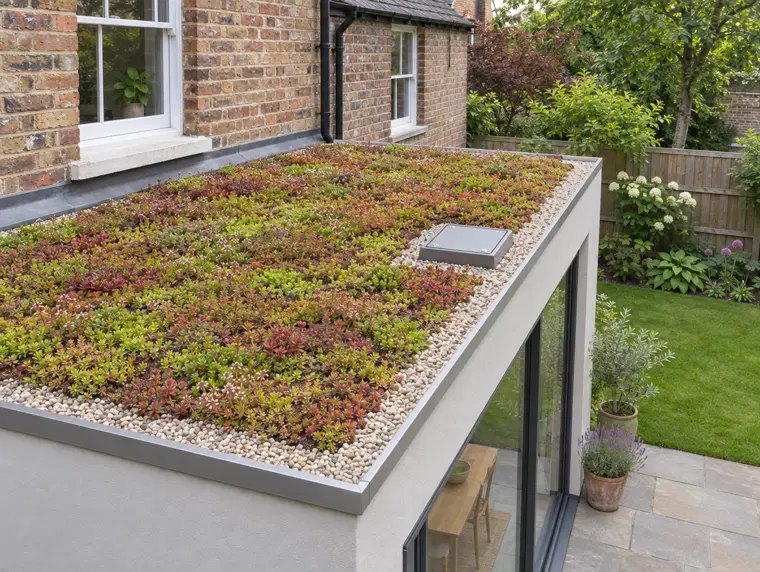
Almost all green roofs on homes, garages, extensions and outbuildings are extensive. Sedum suits a shallow, free-draining substrate, copes with dry spells and doesn't need regular mowing or watering once established. It is usually laid as pre-grown blankets, so the roof looks green from the day it is finished.
Intensive roofs and roof gardens are a different kind of project, with structural design, access, safety barriers and usually planning permission. We focus on extensive sedum and wildflower-style build-ups as part of a flat roof job, and we will tell you if your plans need a structural engineer or a landscape specialist.
Can my flat roof take the weight of a green roof?
Not every roof can, which is why we check the structure before quoting. A sedum roof is light compared with an intensive garden, but its growing medium holds water, and a saturated build-up adds significant weight to the roof.
We look at the joist sizes, spans and spacing, the condition of the deck and what the roof sits on. On a recently built extension with generously sized joists, an extensive green roof may be straightforward. On an older garage or a roof with undersized or rotten timbers, the structure may need strengthening, or a structural engineer's calculation may be needed before we can go ahead.
In England, a new roof covering that adds 15% or more to the weight of the roof triggers building control approval, and a green roof will often fall into that category. We handle building control where it is needed. The building regulations page covers the approval routes in each nation.
How much does a green roof cost?
A sedum green roof build-up costs £80–£160 per m² as a guide, on top of the cost of the waterproofed roof underneath. For a typical 20 m² extension with a new deck, warm-roof insulation, EPDM and sedum, the guide price is £4,400–£8,100.
| Item | Guide price |
|---|---|
| Sedum green roof build-up | £80–£160 per m² |
| 20 m² extension, EPDM, deck and insulation, without sedum | £2,800–£4,900 |
| 20 m² extension, EPDM, deck, insulation and sedum | £4,400–£8,100 |
These are guide prices including VAT at 20%. Structural strengthening, scaffold for higher roofs (£450–£950) and difficult access for lifting materials add to the cost. Your fixed price comes after the free survey and structural check. Compare other roof costs in the cost guide.
How is a green roof built on top of a flat roof?
From the bottom up, a green roof is a deck, a waterproofing system with root protection, then drainage, filter, growing medium and plants. The waterproofing does the job of keeping water out. The green layers sit above it.
- Warm roof build-up: vapour control layer, insulation and waterproof membrane on the deck, then the green layers on top. This is the usual choice on a home extension being re-roofed.
- Inverted build-up: waterproofing on the deck, then insulation boards designed to sit above it, then the green layers. This is common on terraces and some commercial roofs.
- Root barrier: roots will exploit any weakness, so the membrane needs to be root-resistant. Some membranes are tested as root-resistant; others need a separate root barrier laid on top.
- Drainage and edges: a drainage layer carries surplus water to outlets, and a gravel or pebble strip is usually left around edges, outlets, upstands and rooflights to keep them clear and accessible.
Upstands still need to rise around 150 mm above the finished surface, which on a green roof means above the top of the growing medium. We check that at the survey, alongside the external fire performance of the build-up where the roof is close to a boundary.
Can a green roof go on my existing flat roof?
Only if the existing waterproofing is sound, root-resistant or protected by a root barrier, and has plenty of life left. In most cases it makes more sense to lay a green roof as part of a replacement.
Once the sedum, substrate and drainage layers are down, the membrane underneath is hard to inspect and expensive to repair, because the green layers have to be lifted to get to it. Putting a green roof on an ageing covering risks paying for the greenery twice. Our repair or replace guide helps you judge whether your current roof is a sensible base.
As for planning, re-covering a house roof normally needs no application if its appearance doesn't change materially. Because a green roof does change how a roof looks, check with your council, especially for listed buildings, conservation areas and roofs that are easily seen. The planning guide has more.
How long does a green roof last and how much maintenance does it need?
A well-built extensive green roof needs one or two maintenance visits a year, and the plant layer can help protect the membrane from sunlight and temperature swings.
Typical maintenance means pulling out weeds and tree seedlings before they root, clearing outlets and the gravel strips around edges, filling in any bare patches, and adding a slow-release feed if the sedum looks thin. Sedum is drought-tolerant once established, but newly laid blankets may need watering in a long dry spell during the first season.
The waterproofing underneath has the same expected life as on any other roof of that system. A green roof also slows down rainwater run-off from the roof and, when sedum flowers, attracts bees and other insects. Some councils encourage green roofs for those reasons, so it is worth mentioning one in a planning application for a new extension. Our maintenance guide covers routine checks.
What's included when we do the work?
- Structural check of joists, deck and supports
- Root-resistant membrane or separate root barrier
- Warm or inverted build-up to suit the roof
- Drainage layer, filter and lightweight growing medium
- Pre-grown sedum blankets laid and watered in
- Gravel strips kept clear around edges and outlets
What do guide prices look like?
Guide prices including VAT at West Midlands rates; regional pages adjust these for your area. The fixed price comes after a free survey for new and replacement roofs.
| Job | Guide price inc VAT |
|---|---|
| Extension (20 m²), EPDM with sedum green roof | £4,400–£8,100 |
| Extension (20 m²), EPDM, new deck + insulation | £2,800–£4,900 |
Does anything differ outside England?
- Wales: Most re-roofing in Wales needs building regulations approval, and the extra weight of a green roof makes a structural check essential. Higher rainfall means drainage layers and outlets are sized with particular care.
- Scotland: In Scotland, check with the council's building standards team whether a green roof needs a building warrant, as added weight and structural changes usually do. Planting needs to suit local exposure, which is much greater in the wetter, windier west.
- Northern Ireland: In Northern Ireland, contact the district council's building control before adding a green roof, as the added weight can bring in structural requirements. Planning rules differ from England, so check with the council if the roof is visible.
How does the job run from start to finish?
Survey and structure check
We inspect the roof, joists and deck, and confirm whether the structure can carry a saturated green roof or needs strengthening or an engineer's input.
Design and fixed quote
We specify the build-up, from waterproofing and root protection to drainage and sedum, and send a fixed written quote.
Waterproof first
The roof is stripped, the deck repaired or replaced, and the insulation and root-resistant waterproofing installed and checked before any green layers go on.
Lay the green roof
Drainage, filter, growing medium and sedum blankets are laid, gravel strips are formed and outlets are checked. We explain the simple maintenance it will need.
Questions about green and sedum roofs
Can you put a sedum roof on a garage?
Often, yes, if the structure is strong enough. Many older garage roofs have light timbers, so a structural check comes first and strengthening may be needed.
Can you put a green roof on a pitched roof?
We install green roofs on flat roofs only. Sloping green roofs need extra restraint to stop the growing medium slipping, and they are a specialist job outside our work.
Does a green roof leak more than a normal flat roof?
No, as long as it is built correctly. The waterproofing beneath is what keeps water out, and the green layers protect it from sun and weather. The main risk is building it on a weak or ageing membrane.
Do I need to water a sedum roof?
Usually only in the first season, during long dry spells, while the blankets establish. After that, sedum copes with dry weather well.
Can I walk on a green roof?
Only for maintenance, and only where it is safe. Most extensive green roofs on homes aren't designed as roof terraces, and a terrace generally needs planning permission and edge protection.
Can a green roof have a rooflight in it?
Yes. The rooflight sits on a raised upstand with a gravel strip around it, so the planting stays clear of the glazing and the upstand stays visible and dry.
What happens if a green roof needs repairing?
The green layers are lifted around the problem area, the membrane is repaired, and the layers are relaid. Building on a sound, long-life membrane in the first place keeps that to a minimum.
Related services
Warm roof insulation upgrades
Insulation laid above the deck during a re-roof, to cut heat loss and condensation risk.
Extension and kitchen roofs
Warm-roof replacement for kitchen and rear extensions, with sound abutments and rooflight kerbs
EPDM rubber roofing
Single-sheet synthetic rubber for garages, extensions and porches, laid cold with no flame
Rooflights in flat roofs
Upstands formed, insulated and waterproofed for flat rooflights and lanterns on a roof job.
Where do you offer green and sedum roofs?
- Bedfordshire
- Berkshire
- Bristol
- Buckinghamshire
- Cambridgeshire
- Cheshire
- Cornwall
- County Durham
- Cumbria
- Derbyshire
- Devon
- Dorset
- East Riding of Yorkshire
- East Sussex
- Essex
- Gloucestershire
- Greater Manchester
- Hampshire
- Herefordshire
- Hertfordshire
- Isle of Wight
- Kent
- Lancashire
- Leicestershire
- Lincolnshire
- London
- Merseyside
- Norfolk
- North Yorkshire
- Northamptonshire
- Northumberland
- Nottinghamshire
- Oxfordshire
- Shropshire
- Somerset
- South Yorkshire
- Staffordshire
- Suffolk
- Surrey
- Tyne and Wear
- Warwickshire
- West Midlands
- West Sussex
- West Yorkshire
- Wiltshire
- Worcestershire
- Blaenau Gwent
- Bridgend
- Caerphilly
- Cardiff
- Carmarthenshire
- Ceredigion
- Conwy
- Denbighshire
- Flintshire
- Gwynedd
- Isle of Anglesey
- Merthyr Tydfil
- Monmouthshire
- Neath Port Talbot
- Newport
- Pembrokeshire
- Powys
- Rhondda Cynon Taf
- Swansea
- Torfaen
- Vale of Glamorgan
- Wrexham
- Aberdeen City
- Aberdeenshire
- Angus
- Argyll and Bute
- City of Edinburgh
- Clackmannanshire
- Dumfries and Galloway
- Dundee City
- East Ayrshire
- East Dunbartonshire
- East Lothian
- East Renfrewshire
- Falkirk
- Fife
- Glasgow City
- Highland
- Inverclyde
- Midlothian
- Moray
- North Ayrshire
- North Lanarkshire
- Perth and Kinross
- Renfrewshire
- Scottish Borders
- South Ayrshire
- South Lanarkshire
- Stirling
- West Dunbartonshire
- West Lothian
- Belfast
- County Antrim
- County Armagh
- County Down
- County Fermanagh
- County Londonderry
- County Tyrone