- Price per m²
- £85–£150
- Typical life
- 30–60 years
- Manufacturer guarantees
- 15-year material, up to 25-year system guarantees
- 30 m² roof
- £3,450–£6,250
What is a mastic asphalt roof and how is it laid?
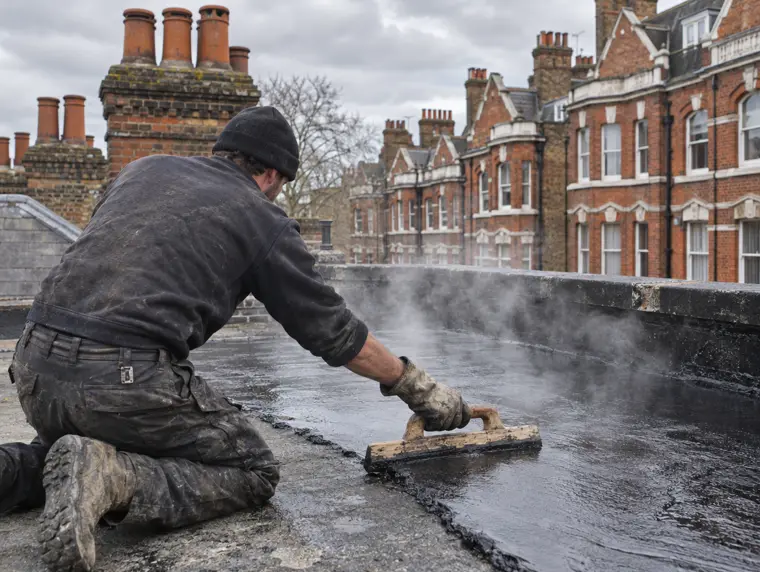
Mastic asphalt is a mix of bitumen and fine limestone aggregate, delivered as solid blocks, melted on site and spread hot with wooden floats. Once it cools it forms a hard, jointless and fully waterproof sheet that bonds to itself at every pour.
A traditional roof build-up looks like this:
- Deck: usually concrete or a strong timber deck able to carry the weight.
- Insulation and vapour control on a warm roof, chosen to suit hot-applied asphalt.
- Separating layer: a sheathing felt that lets the asphalt move independently of the deck.
- Two coats of asphalt: laid in bays and staggered so that joints in each coat do not coincide, typically to a total thickness of around 20 mm on roofs.
- Skirtings and aprons: asphalt turned up walls and parapets, tucked into chases and protected.
- Surface treatment: sand rubbed into the surface while warm, then usually a solar reflective paint or chippings to limit heat and UV damage.
How much does a mastic asphalt roof cost?
Mastic asphalt typically costs £85–£150 per m² as a guide, which places it among the more expensive flat roof systems because it is labour-intensive and needs specialist equipment. A typical job, including VAT:
| Typical job | Guide price |
|---|---|
| Mastic asphalt roof, about 30 m², including scaffold | £3,450–£6,250 |
| Local asphalt repair, such as a blister or crack | £150–£500 |
| Skirting or upstand repair | £250–£650 |
| Survey or leak trace | £150–£300 |
Prices move with access and height, the condition of the deck, the length of skirtings and parapets, insulation (£35–£60 per m²), waste disposal (£250–£400), and whether the asphalt is being repaired, overlaid with another system or fully replaced.
These are guide prices only. A fixed price follows a free survey for replacement work, set out in writing. Get a starting figure from the guide-price tool or see the cost guide.
How long does mastic asphalt last, and what guarantees are available?
Mastic asphalt is one of the longest-lasting flat roof systems, typically giving 30 to 60 years with good specification and maintenance. Many older asphalt roofs are still watertight decades after they were laid.
Age does show eventually. Common signs include crazing and cracking from sun exposure, blisters where moisture has been trapped beneath, splits at skirtings where the building has moved, and ponding where the deck has settled. Regular maintenance, such as renewing solar reflective paint, keeping outlets clear and repairing cracks early, makes a real difference to life.
Material and system guarantees are available on some specified asphalt systems, and we register them for you where the system allows. Every re-roof carries our written workmanship guarantee, with the length set out in the quote, and insurance-backed options can be discussed. Our lifespan guide compares asphalt with the other systems.
Is mastic asphalt still a good choice, or should I switch systems?
Mastic asphalt is still a good choice on concrete roofs, heritage and older buildings, and roofs that carry heavy foot traffic or plant. On lightweight timber roofs, garages and most modern extensions, another system is usually more practical.
Benefits: very long typical life; jointless and fully bonded; takes foot traffic well, especially with a paving finish; matches the original roof on many older buildings; local repairs blend into the existing surface.
Drawbacks: heavy, so the structure must be able to carry it; higher cost; needs specialist labour and hot works with molten material; can crack in cold if not well maintained, and softens in strong sun without a reflective finish.
If the structure is lightweight or the budget tight, torch-on felt or EPDM are common replacements. A compatible liquid-applied system can sometimes be laid over sound asphalt. On larger roofs, single-ply may be considered, and GRP suits smaller roofs needing a hard finish. Our repair or replace guide helps with the decision.
What building regulations apply when an asphalt roof is replaced?
Replacing more than half of an asphalt roof over a heated space usually counts as renovating a thermal element in England, Wales and Northern Ireland, so the roof should be insulated towards the renovation standard where technically and economically feasible; Scottish owners should check with the local authority's building standards service whether the work needs a warrant.
On older buildings, adding insulation can be constrained by parapet heights, door thresholds and the character of the building, and the regulations allow for what is technically feasible. In England, a new covering that adds 15% or more to the roof's weight also needs approval, so a switch to heavier asphalt is checked against the structure. Listed buildings may need listed building consent for changes to their character. We deal with building control or building standards where needed; see the building regulations page.
Should an old asphalt roof be repaired, overlaid or replaced, especially on a heritage building?
If the asphalt is sound apart from local cracks or blisters, repair it; if it is crazed and tired but dry and well bonded, consider an overlay; if it is leaking widely, sitting on a wet or failing deck, or full of trapped moisture, replace it. A survey, sometimes with a leak trace, tells you which applies.
- Repairs: blisters are cut out, cracks opened up and fresh asphalt worked in by a specialist, so the repair fuses with the existing roof.
- Overlay: a compatible system, often a reinforced liquid membrane, is bonded over the old asphalt after cleaning and priming. This keeps the old asphalt as a solid base and avoids heavy strip-out.
- Replacement: the old asphalt is broken out and the roof rebuilt, either in new asphalt or in another system the structure can carry, with insulation where required.
On heritage and older buildings, matching the original material and detailing often matters as much as waterproofing. New asphalt skirtings and aprons can follow the existing lines, and any change of material on a listed building should be agreed with the conservation officer before work starts.
Asphalt work is a specialist trade. It needs mixers or boilers on site, trained asphalters and strict hot-works control, so we plan these jobs around access, the building's occupants and the weather.
What's included when we do the work?
- Survey and, where needed, leak tracing of the existing asphalt
- Repairs to blisters, cracks and skirtings in fresh mastic asphalt
- Overlay with a compatible system where the asphalt is sound
- Full replacement in two-coat asphalt or another suitable system
- Insulation, separating layer and skirtings to suit the building
- Solar reflective finish or chippings to protect the surface
What do guide prices look like?
Guide prices including VAT at West Midlands rates; regional pages adjust these for your area. The fixed price comes after a free survey for new and replacement roofs.
| Job | Guide price inc VAT |
|---|---|
| Mastic asphalt roof (30 m²), scaffold | £3,450–£6,250 |
| Localised patch repair | £150–£500 |
| Single garage (18 m²), EPDM rubber | £1,600–£2,800 |
| Extension (20 m²), EPDM, new deck + insulation | £2,800–£4,900 |
Does anything differ outside England?
- Wales: In Wales, most re-roofing needs building regulations approval, so check before work if more than 25% of the roof is being replaced or repaired. Listed buildings follow the Welsh consent regime, and the renovation U-value for a heated space is 0.16 W/m²K where feasible.
- Scotland: In Scotland, ask the council's building standards service whether replacing an asphalt roof needs a building warrant; alterations and structural work usually do. Section 6 sets a domestic roof benchmark of 0.12 W/m²K, pursued as far as reasonably practicable, and listed building consent rules also differ from England.
- Northern Ireland: In Northern Ireland, speak to the district council's building control before replacing an asphalt roof over a heated space. Technical Booklets F1 and F2 set 0.18 W/m²K for roofs, and listed buildings are handled under the Northern Ireland consent system.
How does the job run from start to finish?
Survey
A surveyor inspects the asphalt, skirtings and outlets, checks the structure and, where needed, traces leaks to their source.
Recommendation and quote
We explain whether repair, overlay or replacement makes most sense and set out a fixed written price and specification.
Specialist works
Trained asphalters or our roofing team carry out the work, with hot-works control, edge protection and the building kept weathertight.
Finish and sign-off
The surface is sanded and given its reflective finish or chippings, then we inspect the roof with you and hand over the guarantee.
Questions about mastic asphalt roofing
Can I repair a mastic asphalt roof myself?
Not properly. Lasting asphalt repairs use fresh hot asphalt, which needs specialist equipment, training and hot-works control. Cold-applied sealants can hold a small leak for a short time, but they are a stopgap until a specialist repair.
Why is my asphalt roof cracking?
Asphalt typically cracks as it ages and becomes brittle from sun exposure, or where the building moves at skirtings and junctions. A solar reflective paint and early repairs help slow it down.
Can you put felt or rubber over an asphalt roof?
Sometimes, if the asphalt is dry, well bonded and sound, using a compatible system and primer. Liquid membranes are a common choice because they bond well to cleaned asphalt.
Is mastic asphalt suitable for a balcony or terrace?
Yes, asphalt is traditionally used on terraces and walkways because it takes foot traffic well, often with paving on top. A new balcony or terrace generally needs planning permission, so check before converting a roof.
Why are mastic asphalt roofs painted silver or white?
The reflective coating keeps the asphalt cooler in sun, reducing softening and slowing the surface ageing that leads to crazing. It usually needs renewing every few years as part of maintenance.
How heavy is a mastic asphalt roof?
Considerably heavier than felt, rubber or single-ply, which is why it is usually laid on concrete or strong timber decks. We check the structure before recommending asphalt on any roof.
Is mastic asphalt the same as tarmac?
No. Both contain bitumen, but mastic asphalt is a dense, voidless mix with fine limestone aggregate, made to be fully waterproof, while road surfacing is a different material.
Related services
Flats, HMOs and block roofs
Flat roofs for blocks, HMOs and converted flats, with itemised quotes and phased work.
Flat roof repairs
Patch, seam, upstand and outlet repairs on felt, EPDM, GRP, liquid and asphalt flat roofs.
Liquid-applied roofing
Cold-applied liquid membrane for balconies, awkward details and overlays on sound roofs
Flat roof surveys and leak tracing
Condition surveys and leak tracing with moisture readings, core checks and a written report.
Where do you offer mastic asphalt roofing?
- Bedfordshire
- Berkshire
- Bristol
- Buckinghamshire
- Cambridgeshire
- Cheshire
- Cornwall
- County Durham
- Cumbria
- Derbyshire
- Devon
- Dorset
- East Riding of Yorkshire
- East Sussex
- Essex
- Gloucestershire
- Greater Manchester
- Hampshire
- Herefordshire
- Hertfordshire
- Isle of Wight
- Kent
- Lancashire
- Leicestershire
- Lincolnshire
- London
- Merseyside
- Norfolk
- North Yorkshire
- Northamptonshire
- Northumberland
- Nottinghamshire
- Oxfordshire
- Shropshire
- Somerset
- South Yorkshire
- Staffordshire
- Suffolk
- Surrey
- Tyne and Wear
- Warwickshire
- West Midlands
- West Sussex
- West Yorkshire
- Wiltshire
- Worcestershire
- Blaenau Gwent
- Bridgend
- Caerphilly
- Cardiff
- Carmarthenshire
- Ceredigion
- Conwy
- Denbighshire
- Flintshire
- Gwynedd
- Isle of Anglesey
- Merthyr Tydfil
- Monmouthshire
- Neath Port Talbot
- Newport
- Pembrokeshire
- Powys
- Rhondda Cynon Taf
- Swansea
- Torfaen
- Vale of Glamorgan
- Wrexham
- Aberdeen City
- Aberdeenshire
- Angus
- Argyll and Bute
- City of Edinburgh
- Clackmannanshire
- Dumfries and Galloway
- Dundee City
- East Ayrshire
- East Dunbartonshire
- East Lothian
- East Renfrewshire
- Falkirk
- Fife
- Glasgow City
- Highland
- Inverclyde
- Midlothian
- Moray
- North Ayrshire
- North Lanarkshire
- Perth and Kinross
- Renfrewshire
- Scottish Borders
- South Ayrshire
- South Lanarkshire
- Stirling
- West Dunbartonshire
- West Lothian
- Belfast
- County Antrim
- County Armagh
- County Down
- County Fermanagh
- County Londonderry
- County Tyrone