- Price per m²
- £60–£105
- Typical life
- 15–25 years
- Manufacturer guarantees
- 10–20 year material guarantees on specified systems
- Typical garage roof
- £1,500–£2,600
What is torch-on felt and how is it installed?
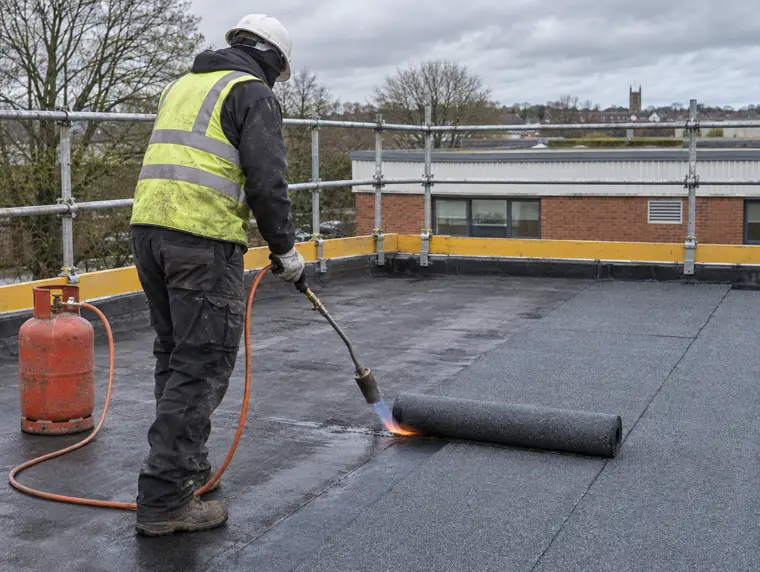
Torch-on felt is a modern built-up roof: two or three layers of polymer-modified bitumen membrane, each reinforced with polyester, bonded together with heat to form one thick waterproof covering. BS 8217 is the code of practice that governs how these systems are designed and laid.
A typical warm-roof build-up, from the deck upwards:
- Deck: sound boards retained, defective ones replaced.
- Vapour control layer: often a bitumen membrane itself, bonded to the deck.
- Insulation: PIR or other rigid boards suited to hot bitumen work, sometimes tapered to improve falls.
- Underlay: the first membrane layer, partially or fully bonded depending on the system.
- Intermediate layer (three-layer systems): adds thickness and a second line of defence.
- Cap sheet: the top layer, faced with mineral granules to protect the bitumen from UV light.
Laps between sheets are staggered so that no two joins sit on top of each other, and upstands are built up in the same layers and dressed under flashings.
How much does a torch-on felt roof cost?
Torch-on felt generally costs £60–£105 per m² as a guide, which usually makes it the most economical of the main flat roof systems. Typical whole jobs, including VAT:
| Typical job | Guide price |
|---|---|
| Single garage, about 18 m², sound deck | £1,500–£2,600 |
| Extension roof, about 20 m², new deck and warm-roof insulation | £2,700–£4,700 |
| Block of flats, about 150 m², insulation and scaffold | £15,550–£27,200 |
The main variables are the number of layers, the deck (£20–£35 per m² where boards need renewing), insulation (£35–£60 per m²), new outlets or gutter runs (£120–£280 each), trims (£12–£22 per metre), waste removal (£250–£400) and scaffold (£450–£950 on a two-storey roof).
Please treat these as guide prices. The fixed price comes after a free survey and is confirmed in writing. Run your own figures through the guide-price tool or see the full price guide.
How long does a torch-on felt roof last, and what is the guarantee?
A modern torch-on roof typically lasts 15 to 25 years, and high-performance systems with better membranes can last longer. That is a big step up from older felt roofs, which were often single-layer, unreinforced or poorly bonded.
What shortens the life of a felt roof is usually visible: mineral chippings worn away so the bitumen is exposed to sunlight, blisters where moisture was trapped, split laps, and upstands that have slumped or pulled away from the wall. Ponding speeds all of this up.
Manufacturer material guarantees are available on many specified torch-on systems; they often depend on a particular build-up and registration, which we handle where the system allows. Every re-roof also comes with our written workmanship guarantee, the length of which is stated in the quote, and insurance-backed options can be discussed. Our flat roof lifespan guide compares felt with the other systems.
Should I choose torch-on felt or a different flat roof system?
Choose torch-on felt when you want a proven, layered system at a sensible price, particularly on larger roofs, blocks of flats and commercial buildings where several layers give useful redundancy. It is a weaker choice where hot works are hard to manage safely.
For: generally lower cost per square metre; two or three layers, so a single defect in one layer need not cause a leak; tough mineral finish; long track record and a British Standard code of practice; repairs can be made with compatible materials.
Against: needs a naked flame unless a cold-applied or self-adhesive alternative is used; shorter typical life than EPDM or GRP; the finish is functional rather than decorative; more laps to detail than a single sheet.
On small domestic roofs near timber, EPDM avoids the torch entirely. GRP gives a harder, neater surface. For an overlay, a liquid-applied system is often simpler. Large commercial roofs may suit single-ply, and older buildings may suit mastic asphalt. See our comparison guide.
Does replacing a felt roof mean upgrading the insulation?
Usually, yes, when the roof is over a heated space and more than half of it is being re-covered. In England, Wales and Northern Ireland that is renovation of a thermal element, which should be brought towards the renovation U-value where feasible; a Scottish project goes through the council's building standards service, which confirms whether a warrant applies.
A felt replacement is a good point to switch to a warm roof, with insulation laid above the deck under the new membranes. On larger roofs, tapered insulation can also correct poor falls that have caused ponding, which a patch repair cannot fix. Raising the roof level affects upstands and door thresholds, so we check heights at survey. Any approval is arranged by us as part of the job, and the building regulations page sets out the rules by nation.
Is torch-on roofing safe, and what is the difference between two- and three-layer systems?
Yes, torch-on is safe when hot works are properly controlled, because most roof fires linked to torching start at hidden timber or debris near edges and upstands, not on the open roof. Our teams follow a hot-works routine on every job:
- check eaves, fascias, soffits and wall cavities for timber, nests and debris before lighting a torch;
- use a cold-applied or self-adhesive membrane, rather than a flame, at edges, against combustible materials and in tight details;
- keep fire extinguishers on the roof and the gas bottles secured and away from the work;
- stop torching well before the team leaves, then carry out a fire watch so smouldering is spotted while people are still on site.
As for layers, a two-layer system (underlay plus cap sheet) is common on domestic roofs such as garages and extensions. A three-layer system adds an intermediate sheet, giving more thickness and redundancy, and is often specified on larger, commercial and multi-occupied roofs. The right choice depends on the size and use of the roof and the system's requirements, so we set it out in the quote.
Near a boundary, the external fire performance of the tested build-up, such as a BROOF(t4) classification, can also matter, and we check it where it applies.
What's included when we do the work?
- Strip-off of the existing roof covering and removal of waste
- Deck inspection with replacement of damaged boards
- Vapour control layer and warm-roof insulation where needed
- Two- or three-layer reinforced bitumen membrane with staggered laps
- Mineral-finished cap sheet, upstands, outlets and edge trims
- Hot-works checks and fire watch on every torch-on job
What do guide prices look like?
Guide prices including VAT at West Midlands rates; regional pages adjust these for your area. The fixed price comes after a free survey for new and replacement roofs.
| Job | Guide price inc VAT |
|---|---|
| Single garage (18 m²), torch-on felt | £1,500–£2,600 |
| Extension (20 m²), felt, new deck + insulation | £2,700–£4,700 |
| Block of flats (150 m²), felt + insulation + scaffold | £15,550–£27,200 |
| Single garage (18 m²), EPDM rubber | £1,600–£2,800 |
| Extension (20 m²), EPDM, new deck + insulation | £2,800–£4,900 |
Does anything differ outside England?
- Wales: In Wales, most re-roofing needs building regulations approval, and it is worth checking if more than 25% of the roof is being replaced or repaired. The renovation target for a roof over a heated space is 0.16 W/m²K where feasible.
- Scotland: In Scotland, check with the council's building standards service whether a torch-on re-roof needs a building warrant; like-for-like repairs to the covering can be exempt. Section 6 of the technical handbooks sets a domestic roof benchmark of 0.12 W/m²K, pursued as far as reasonably practicable.
- Northern Ireland: In Northern Ireland, contact the district council's building control before a torch-on re-roof begins. Technical Booklets F1 and F2 apply a 0.18 W/m²K standard for roofs, and CDM (NI) 2016 covers the work.
How does the job run from start to finish?
Survey
We measure the roof, check the deck, falls and outlets, and note any timber or other combustible details near the edges.
Quote and specification
Your fixed written quote states the number of layers, the insulation, guarantee terms and any approval needed.
Strip and lay
The old covering comes off, the deck is repaired, insulation goes down, and each membrane layer is bonded with staggered laps.
Fire watch and sign-off
After the last torching, the team carries out a fire watch, then walks the roof with you to check upstands, outlets and trims before handing over the guarantee.
Questions about torch-on felt roofing
Is torch-on felt better than the old felt roofs?
Yes, considerably. Modern torch-on membranes are polymer-modified and polyester-reinforced, laid in bonded layers, and typically last much longer than the older felt systems they replace.
Can torch-on felt go over an existing felt roof?
Sometimes, if the old roof is dry, well bonded and the deck is sound. Often stripping is better, because overlaying can trap moisture and hide rot; our guide to overlay or strip explains how we decide.
How long does it take to lay a torch-on felt roof?
A garage roof typically takes one to two days and an insulated extension two to three. Larger roofs and blocks are phased over longer, with each area made weathertight before the team leaves.
Can torch-on felt be laid in wet weather?
Not in rain or on a wet deck, because moisture trapped under the membrane causes blisters. Light cold weather is usually workable, but we will postpone rather than lay on a damp surface.
Why does my felt roof have blisters?
Blisters usually form when moisture or air trapped beneath the felt expands in the sun. A few small, intact blisters may be monitored, but widespread or split blisters point to a repair or replacement.
Can I paint or coat an old felt roof?
Reflective or liquid coatings can extend the life of a sound felt roof, but they will not fix wet insulation, a rotten deck or poor falls. A survey shows whether coating or replacement makes more sense.
Is torch-on suitable for a block of flats?
Yes, layered bitumen systems are widely used on blocks of flats and commercial buildings. Larger roofs often use three layers and insulation, with hot works planned around residents.
Related services
Flat roof replacement
Full strip and re-roof of tired flat roofs, with new deck, insulation and falls where needed
Flats, HMOs and block roofs
Flat roofs for blocks, HMOs and converted flats, with itemised quotes and phased work.
Commercial flat roofing
Single-ply, felt and liquid roofs for shops, offices, units and clubs, planned around trading.
EPDM rubber roofing
Single-sheet synthetic rubber for garages, extensions and porches, laid cold with no flame
Where do you offer torch-on felt roofing?
- Bedfordshire
- Berkshire
- Bristol
- Buckinghamshire
- Cambridgeshire
- Cheshire
- Cornwall
- County Durham
- Cumbria
- Derbyshire
- Devon
- Dorset
- East Riding of Yorkshire
- East Sussex
- Essex
- Gloucestershire
- Greater Manchester
- Hampshire
- Herefordshire
- Hertfordshire
- Isle of Wight
- Kent
- Lancashire
- Leicestershire
- Lincolnshire
- London
- Merseyside
- Norfolk
- North Yorkshire
- Northamptonshire
- Northumberland
- Nottinghamshire
- Oxfordshire
- Shropshire
- Somerset
- South Yorkshire
- Staffordshire
- Suffolk
- Surrey
- Tyne and Wear
- Warwickshire
- West Midlands
- West Sussex
- West Yorkshire
- Wiltshire
- Worcestershire
- Blaenau Gwent
- Bridgend
- Caerphilly
- Cardiff
- Carmarthenshire
- Ceredigion
- Conwy
- Denbighshire
- Flintshire
- Gwynedd
- Isle of Anglesey
- Merthyr Tydfil
- Monmouthshire
- Neath Port Talbot
- Newport
- Pembrokeshire
- Powys
- Rhondda Cynon Taf
- Swansea
- Torfaen
- Vale of Glamorgan
- Wrexham
- Aberdeen City
- Aberdeenshire
- Angus
- Argyll and Bute
- City of Edinburgh
- Clackmannanshire
- Dumfries and Galloway
- Dundee City
- East Ayrshire
- East Dunbartonshire
- East Lothian
- East Renfrewshire
- Falkirk
- Fife
- Glasgow City
- Highland
- Inverclyde
- Midlothian
- Moray
- North Ayrshire
- North Lanarkshire
- Perth and Kinross
- Renfrewshire
- Scottish Borders
- South Ayrshire
- South Lanarkshire
- Stirling
- West Dunbartonshire
- West Lothian
- Belfast
- County Antrim
- County Armagh
- County Down
- County Fermanagh
- County Londonderry
- County Tyrone