- Guide price
- £3,000–£5,250
- Survey
- Free for new and replacement roofs
- Quote
- Fixed, in writing
- Coverage
- England, Wales, Scotland, NI
Why does a flat rooflight need an upstand?
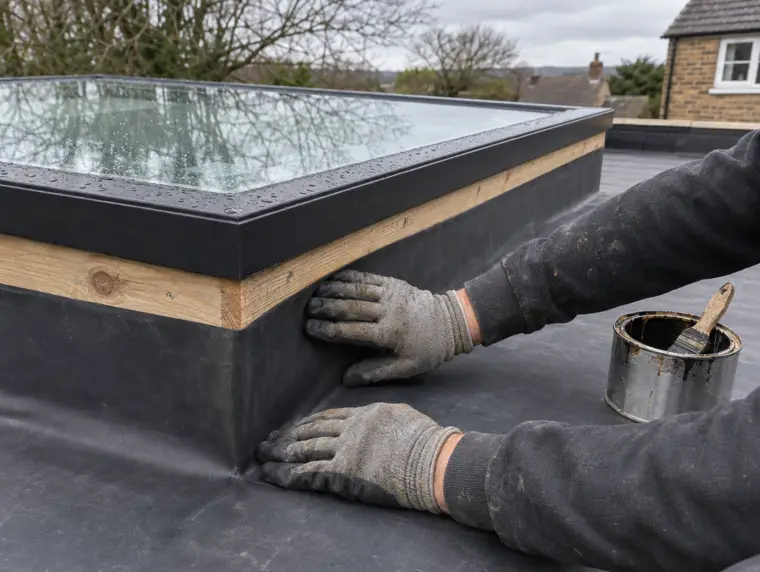
Because water lies on and moves across a flat roof, and the joint between the rooflight and the roof has to sit well above it. The waterproofing is usually taken up at least 150 mm above the finished roof surface before it meets the rooflight frame.
An upstand also gives the glazing a slight fall so rain runs off it, lifts the frame clear of snow and debris, and provides a solid, level base to fix the unit to. Most upstands are built on site from treated timber or come as pre-formed insulated kerbs, and they are insulated so the inner face doesn't become a cold spot. The membrane is dressed up the outside and finished under, or into, the rooflight frame following the rooflight maker's details.
Without a proper upstand, or with one that's too low, the junction sits in standing water and is one of the most common places for a flat roof to leak.
How much does it cost to add a rooflight to a flat roof?
Forming and waterproofing a rooflight upstand costs £180–£350 each as a guide, on top of the roof itself. A typical 20 m² extension roof in EPDM, with a new deck, warm-roof insulation and one rooflight upstand, is £3,000–£5,250.
| Item | Guide price |
|---|---|
| Rooflight upstand formed and dressed (each) | £180–£350 |
| 20 m² EPDM extension roof without a rooflight | £2,800–£4,900 |
| 20 m² EPDM extension roof with one rooflight upstand | £3,000–£5,250 |
| Repair to an existing upstand or flashing | £250–£650 |
These are guide prices including VAT at 20%, and they cover the upstand and its waterproofing. The rooflight or lantern itself is priced separately, as costs vary widely with size, glazing and whether it opens. Cutting a new opening also means trimming the joists, which is quoted after the free survey. The guide-price tool lets you add rooflights to an estimate.
Should I choose a fixed or an opening rooflight, or a lantern?
Choose a fixed rooflight if you only want daylight, an opening one if the room needs ventilation, and a lantern if you want a raised, pitched glazed feature over a larger space.
- Fixed flat rooflights are the simplest and usually the cheapest option. They have the fewest moving seals, and the upstand detail is straightforward.
- Opening rooflights can be manual or electric, and electric units often include a rain sensor that closes them automatically. They need a power supply planned in before the ceiling is finished. Some are designed as hatches to give access to the roof.
- Roof lanterns have a framed, pitched glazed top that brings in more light and adds height to the room. They are heavier and larger, so the upstand has to be strong, level and square, and the joists around the opening may need strengthening.
Whatever you choose, it helps to settle on the unit before the roof is built, so the upstand can be made to the maker's sizes. If you've already chosen one, we build the upstand to suit it.
Do rooflights in flat roofs need building regulations approval?
Usually, yes, for a new opening, because cutting through the roof and trimming joists is a structural alteration. Approval may also be needed because the roof itself is being re-covered.
New rooflights need to meet the energy efficiency standards for glazing, so that the unit doesn't become a weak point in an insulated roof. Many rooflights have a laminated inner pane, so that if the glass breaks it stays in place rather than falling into the room, which is worth asking for over kitchens, living spaces and stairs. Close to a boundary, the fire performance of the roof, including any rooflights, can matter under the fire safety rules.
Whether you need planning permission depends on the property and the unit. A raised lantern changes the roofline more than a flat rooflight, and listed buildings and conservation areas have stricter rules, which also differ between the four nations. We handle building control or building standards where it is needed. The building regulations page and the planning guide explain more.
Why is my flat rooflight leaking, and should it be repaired or replaced?
Most rooflight leaks come from the upstand detail rather than the glass: the membrane has split or pulled away at a corner, the upstand is too low, or the flashing at the top has failed. Repair the detail if the unit and the roof around it are sound.
Drips on the inside of the upstand in cold weather may be condensation rather than a leak, especially on older, uninsulated kerbs or single-glazed domes. Warm, moist air from a kitchen or bathroom meets the cold surface and condenses.
If the roof covering is near the end of its life, it is usually better to rebuild the upstand properly as part of a replacement, ideally with a new insulated kerb, rather than patching the old detail. Our repair or replace guide and flat roof repairs page cover the options.
How long does a rooflight upstand last?
A properly built, insulated upstand with waterproofing dressed to the maker's details should last as long as the roof covering around it. The rooflight's own seals and opening parts may need attention sooner.
Upstands fail early when they are too low, poorly insulated or built on a deck that moves. Keeping the area around the rooflight clear of leaves and debris, checking the corners after storms from a safe position and cleaning the glazing gently all help. Never lean on or stand on a rooflight: most are fragile, and the roof around them should be treated as fragile too. The maintenance guide covers routine checks.
What's included when we do the work?
- Opening cut and joists trimmed to suit the rooflight
- Insulated timber or pre-formed upstand to the maker's size
- Waterproofing dressed up the upstand, about 150 mm above the roof
- Fixed or opening rooflights and lanterns fitted on the roof job
- Joints finished to the rooflight maker's details
- Building control or building standards handled where needed
What do guide prices look like?
Guide prices including VAT at West Midlands rates; regional pages adjust these for your area. The fixed price comes after a free survey for new and replacement roofs.
| Job | Guide price inc VAT |
|---|---|
| Extension (20 m²), EPDM, insulation + 1 rooflight upstand | £3,000–£5,250 |
| Extension (20 m²), EPDM, new deck + insulation | £2,800–£4,900 |
| Extension (20 m²), EPDM with sedum green roof | £4,400–£8,100 |
Does anything differ outside England?
- Wales: In Wales, cutting a new rooflight opening and re-roofing will usually need building regulations approval. Planning rules for rooflights differ from England, particularly for listed buildings and conservation areas.
- Scotland: In Scotland, a new rooflight opening is an alteration that usually needs a building warrant, so check with the council's building standards team before work starts. Glazing and thermal standards follow the Scottish technical handbooks.
- Northern Ireland: In Northern Ireland, contact the district council's building control before cutting a new opening for a rooflight. The thermal standards for glazing are set by Technical Booklets F1 and F2.
How does the job run from start to finish?
Survey and choose the unit
We check the joists, deck and roof build-up, discuss what kind of rooflight or lantern you want and where it should go.
Fixed quote
You get a fixed written quote for the roof, the opening and the upstand, with the rooflight or lantern listed separately.
Form and waterproof
We cut and trim the opening, build and insulate the upstand, and dress the waterproofing up it as part of the roof.
Fit and finish
The rooflight or lantern is fitted and sealed to the upstand following the maker's instructions, and we check the finished detail before we leave.
Questions about rooflights in flat roofs
Can a rooflight be added to an existing flat roof?
Yes, if the structure allows it. The opening is cut, the joists are trimmed and an upstand is built and waterproofed into the existing covering. On an older roof, it is often better to do it as part of a replacement.
How high should a flat rooflight upstand be?
Usually at least 150 mm from the finished roof surface to the top of the waterproofing, so the joint stays above standing water. Some rooflight makers specify more.
Do you supply rooflights and lanterns?
We fit rooflights and lanterns as part of a flat roof job, but we don't sell them as a separate product. If you've chosen a unit, we'll build the upstand to suit it.
Why does my rooflight drip in winter?
If it only drips in cold weather and not when it rains, it is probably condensation on a cold, poorly insulated upstand or older glazing. Better ventilation helps, and an insulated kerb and modern unit usually fix it.
Can I walk on a flat rooflight?
No, unless it is a unit specifically designed and rated for foot traffic. Treat standard rooflights and the roof around them as fragile.
Can a lantern go on a warm roof?
Yes. The upstand is built and insulated to the full height of the warm roof build-up, so the lantern sits at the right level above the finished surface.
Will an opening rooflight let rain in if I leave it open?
Many electric opening rooflights include a rain sensor that closes them automatically when it starts raining. With manual units, it's up to you to close them.
Related services
Extension and kitchen roofs
Warm-roof replacement for kitchen and rear extensions, with sound abutments and rooflight kerbs
Warm roof insulation upgrades
Insulation laid above the deck during a re-roof, to cut heat loss and condensation risk.
Flat roof replacement
Full strip and re-roof of tired flat roofs, with new deck, insulation and falls where needed
Flat roof repairs
Patch, seam, upstand and outlet repairs on felt, EPDM, GRP, liquid and asphalt flat roofs.
Where do you offer rooflights in flat roofs?
- Bedfordshire
- Berkshire
- Bristol
- Buckinghamshire
- Cambridgeshire
- Cheshire
- Cornwall
- County Durham
- Cumbria
- Derbyshire
- Devon
- Dorset
- East Riding of Yorkshire
- East Sussex
- Essex
- Gloucestershire
- Greater Manchester
- Hampshire
- Herefordshire
- Hertfordshire
- Isle of Wight
- Kent
- Lancashire
- Leicestershire
- Lincolnshire
- London
- Merseyside
- Norfolk
- North Yorkshire
- Northamptonshire
- Northumberland
- Nottinghamshire
- Oxfordshire
- Shropshire
- Somerset
- South Yorkshire
- Staffordshire
- Suffolk
- Surrey
- Tyne and Wear
- Warwickshire
- West Midlands
- West Sussex
- West Yorkshire
- Wiltshire
- Worcestershire
- Blaenau Gwent
- Bridgend
- Caerphilly
- Cardiff
- Carmarthenshire
- Ceredigion
- Conwy
- Denbighshire
- Flintshire
- Gwynedd
- Isle of Anglesey
- Merthyr Tydfil
- Monmouthshire
- Neath Port Talbot
- Newport
- Pembrokeshire
- Powys
- Rhondda Cynon Taf
- Swansea
- Torfaen
- Vale of Glamorgan
- Wrexham
- Aberdeen City
- Aberdeenshire
- Angus
- Argyll and Bute
- City of Edinburgh
- Clackmannanshire
- Dumfries and Galloway
- Dundee City
- East Ayrshire
- East Dunbartonshire
- East Lothian
- East Renfrewshire
- Falkirk
- Fife
- Glasgow City
- Highland
- Inverclyde
- Midlothian
- Moray
- North Ayrshire
- North Lanarkshire
- Perth and Kinross
- Renfrewshire
- Scottish Borders
- South Ayrshire
- South Lanarkshire
- Stirling
- West Dunbartonshire
- West Lothian
- Belfast
- County Antrim
- County Armagh
- County Down
- County Fermanagh
- County Londonderry
- County Tyrone