- Guide price
- £2,800–£4,900
- Survey
- Free for new and replacement roofs
- Quote
- Fixed, in writing
- Coverage
- England, Wales, Scotland, NI
What does a flat roof replacement involve?
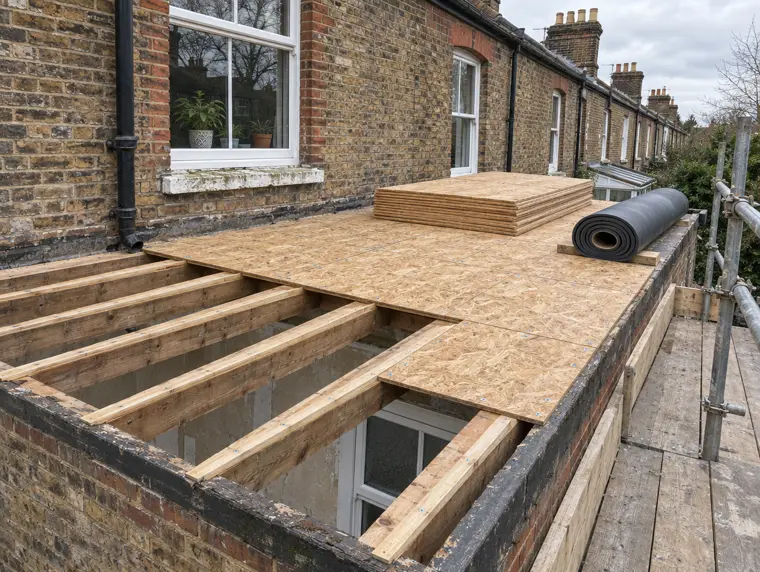
A flat roof replacement strips the old covering, repairs or renews the deck, sets the falls, adds insulation where the rules require it and lays a new waterproof system with fresh trims and outlets. It is a rebuild from the timber up, not another layer over old problems.
- Strip every layer of the old covering to a skip, treating the roof as fragile until it is confirmed otherwise.
- Check the deck board by board, replacing soft or delaminated boards with OSB3 or plywood.
- Set the falls with firrings or tapered insulation. BS 6229 looks for a finished fall of at least 1:80, with 1:60 a common design starting point.
- Build a warm roof over heated rooms: vapour control layer, insulation boards, then the membrane.
- Form upstands at walls and rooflights, usually 150 mm above the finished roof, with flashings over them.
- Fit new edge trims, drip trims and outlets so water leaves the roof instead of running down the walls.
Any hidden defect found once the old roof is off, such as a rotten joist end, is shown to you and priced before work carries on.
How much does a flat roof replacement cost?
Most domestic replacements fall within the guide ranges below, which include VAT at 20%; your fixed price comes in writing after a free survey. System rates are per square metre on a sound deck with one layer to strip.
| System | Guide rate | Indicative service life |
|---|---|---|
| Torch-on felt | £60–£105 per m² | 15–25 years |
| EPDM rubber | £65–£115 per m² | 25–50 years |
| GRP fibreglass | £75–£140 per m² | 20–40 years |
| Liquid-applied | £90–£140 per m² | 10–25+ years by product |
| Single-ply | £90–£145 per m² | 25–35+ years |
A new deck adds £20–£35 per m², warm-roof insulation £35–£60 per m² and new edge trims £12–£22 per metre. Waste and skip are typically £250–£400, and scaffold for a two-storey or dormer roof £450–£950. As whole jobs, a 20 m² extension roof in EPDM with a new deck and insulation is typically £2,800–£4,900, and a single garage in torch-on felt £1,500–£2,600. Full re-roofs carry a minimum charge of £750–£1,250. Try the guide-price tool or read the cost guide.
Which system should I replace my flat roof with?
The right system depends on the roof's size, shape, use and number of details, so no single material suits every roof. These are the usual starting points:
- EPDM rubber suits simple, rectangular roofs, where one sheet can often cover the area with few or no joins.
- GRP fibreglass suits roofs with many corners, rooflights or edges, and gives a rigid surface for occasional maintenance traffic.
- Torch-on felt is a layered, hard-wearing system that keeps the cost down on larger or plain roofs.
- Liquid-applied systems handle awkward details and can overlay a sound existing surface.
- Single-ply and mastic asphalt are more usual on commercial roofs, blocks and terraces.
We recommend a system at survey and explain why. Our EPDM vs GRP vs felt guide sets out the trade-offs if you want to compare first.
Do I need building regulations approval to replace a flat roof?
Often, yes. Replacing the covering of a flat roof over a heated room is usually treated as renovating a thermal element, which brings insulation requirements and, in most cases, approval.
In England, if more than half of that roof is renovated, the whole roof should be upgraded towards a U-value of 0.16 W/m²K for homes (0.18 for non-domestic buildings) where that is technically, functionally and economically feasible, judged against a simple payback of 15 years. Approval comes from building control or self-certification through a registered competent person scheme. Structural changes, or a covering that adds 15% or more to the roof's weight, also need approval.
The other nations differ: most re-roofing in Wales needs approval, Scotland works through building standards and the building warrant, and in Northern Ireland you contact the district council's building control first. An unheated detached garage is not normally a thermal element. Planning permission is not usually needed if the roof looks much the same afterwards, though listed buildings and conservation areas are different. We handle approvals where needed; see building regulations.
How long does it take to replace a flat roof?
A garage or single-storey extension roof is usually stripped and re-covered in one to three working days; larger, higher or more detailed roofs take longer. Weather sets the pace, because the deck must be dry before insulation and membrane go down.
We strip only as much as can be made weathertight that day, so the roof is never left open overnight. Expect noise and some vibration during the strip, a skip on the drive (or on the road with a permit) and ladders or a tower against the house. Rooms below stay usable, though it helps to clear shelves near the ceiling. Resin systems such as GRP smell strongly while they cure, so keep nearby windows closed that day. Two-storey roofs need scaffold, which goes up before we start and comes down after sign-off.
Should I overlay my old flat roof or strip it fully?
Strip it fully if the deck is soft, the insulation is wet or the falls are wrong; an overlay only suits a dry, sound roof that already drains well. Covering a wet roof traps the moisture, and rot carries on out of sight.
An overlay also raises the roof level, eating into upstand height at walls and door thresholds, and every layer adds weight. In England, a covering that adds 15% or more to the roof's weight needs building control approval. Signs it is time to replace rather than repair:
- ponding that lingers long after rain
- blisters, cracking or crazing across wide areas
- bare bitumen where the mineral chippings have gone
- split laps and lifted upstands or flashings
- damp ceilings, or a deck that has gone soft
- leaks that return after each repair
A single defect on an otherwise dry roof can usually be put right with a repair. If you're unsure, a survey settles it, and our guides to overlay or strip and repair or replace go further.
What's included when we do the work?
- Free survey of the deck, falls, edges and insulation
- Fixed written quote listing the full build-up
- Strip-out of the old covering, with waste and skip
- New deck, firrings and warm-roof insulation where needed
- New membrane, upstands, edge trims and outlets
- Building control handled where needed, plus a written workmanship guarantee
What do guide prices look like?
Guide prices including VAT at West Midlands rates; regional pages adjust these for your area. The fixed price comes after a free survey for new and replacement roofs.
| Job | Guide price inc VAT |
|---|---|
| Extension (20 m²), EPDM, new deck + insulation | £2,800–£4,900 |
| Single garage (18 m²), torch-on felt | £1,500–£2,600 |
| Extension (20 m²), GRP, new deck + insulation | £3,000–£5,400 |
| Single garage (18 m²), EPDM rubber | £1,600–£2,800 |
Does anything differ outside England?
- Wales: In Wales most re-roofing needs building regulations approval, so check before work starts if more than 25% of the roof is being replaced or repaired. The renovation target for a roof over a heated space is 0.16 W/m²K.
- Scotland: In Scotland, check with the council's building standards service whether a building warrant is needed; like-for-like covering repairs can be exempt, but alterations and structural work usually need one. Insulation is assessed under Section 6 of the technical handbooks, with a domestic roof benchmark of 0.12 W/m²K pursued as far as reasonably practicable.
- Northern Ireland: In Northern Ireland, contact the district council's building control before starting. Technical Booklet F1/F2 sets a roof U-value of 0.18 W/m²K.
How does the job run from start to finish?
Survey
We inspect and measure the roof, check the deck and edges, and look at the ceiling below where we can.
Written quote
You get a fixed price that lists the system, insulation, trims and any approvals needed, with no obligation to go ahead.
Strip and rebuild
The team strips the old roof in weathertight stages, repairs the deck, sets the falls and lays the new system with fresh trims and outlets.
Sign-off
We check every edge and outlet, clear the site, register any manufacturer guarantee where the system allows and hand over your paperwork.
Questions about flat roof replacement
What time of year is best for a flat roof replacement?
Late spring to early autumn gives the most reliable dry spells, but a roof can be replaced in any season when the forecast allows. Adhesives and resins have minimum application temperatures, so winter work is planned around mild, dry days.
Will a new flat roof be better insulated than the old one?
If it is over a heated room, yes. A full replacement usually has to be upgraded towards current insulation levels where feasible, and we build it as a warm roof with the insulation above the deck.
Do I need to be at home while the roof is replaced?
Not for most of the job, as long as the team can reach the roof and there is room for a skip. We ask you to be there at the start to agree the plan and at the end to look over the finished roof.
Will a replacement make my roof higher?
Usually a little, if insulation is added above the deck. We check door thresholds, window sills, upstands and wall flashings at survey so the new level works.
Is VAT charged on a flat roof replacement?
Yes, roof replacement is standard-rated at 20%, and an insulated replacement is treated as a single supply. Our guide prices already include VAT.
What guarantees come with a replacement roof?
Every re-roof comes with a written workmanship guarantee, with the length set out in your quote. Manufacturer material guarantees are available on many systems and we register them for you where the system allows; ask about insurance-backed options too.
Can you replace just part of a flat roof?
Sometimes, if the rest is sound and dry. Renovating more than half of a roof over a heated room usually brings the whole roof under the insulation rules, so a full replacement can make more sense.
Related services
Flat roof repairs
Patch, seam, upstand and outlet repairs on felt, EPDM, GRP, liquid and asphalt flat roofs.
Flat roof surveys and leak tracing
Condition surveys and leak tracing with moisture readings, core checks and a written report.
Warm roof insulation upgrades
Insulation laid above the deck during a re-roof, to cut heat loss and condensation risk.
EPDM rubber roofing
Single-sheet synthetic rubber for garages, extensions and porches, laid cold with no flame
Where do you offer flat roof replacement?
- Bedfordshire
- Berkshire
- Bristol
- Buckinghamshire
- Cambridgeshire
- Cheshire
- Cornwall
- County Durham
- Cumbria
- Derbyshire
- Devon
- Dorset
- East Riding of Yorkshire
- East Sussex
- Essex
- Gloucestershire
- Greater Manchester
- Hampshire
- Herefordshire
- Hertfordshire
- Isle of Wight
- Kent
- Lancashire
- Leicestershire
- Lincolnshire
- London
- Merseyside
- Norfolk
- North Yorkshire
- Northamptonshire
- Northumberland
- Nottinghamshire
- Oxfordshire
- Shropshire
- Somerset
- South Yorkshire
- Staffordshire
- Suffolk
- Surrey
- Tyne and Wear
- Warwickshire
- West Midlands
- West Sussex
- West Yorkshire
- Wiltshire
- Worcestershire
- Blaenau Gwent
- Bridgend
- Caerphilly
- Cardiff
- Carmarthenshire
- Ceredigion
- Conwy
- Denbighshire
- Flintshire
- Gwynedd
- Isle of Anglesey
- Merthyr Tydfil
- Monmouthshire
- Neath Port Talbot
- Newport
- Pembrokeshire
- Powys
- Rhondda Cynon Taf
- Swansea
- Torfaen
- Vale of Glamorgan
- Wrexham
- Aberdeen City
- Aberdeenshire
- Angus
- Argyll and Bute
- City of Edinburgh
- Clackmannanshire
- Dumfries and Galloway
- Dundee City
- East Ayrshire
- East Dunbartonshire
- East Lothian
- East Renfrewshire
- Falkirk
- Fife
- Glasgow City
- Highland
- Inverclyde
- Midlothian
- Moray
- North Ayrshire
- North Lanarkshire
- Perth and Kinross
- Renfrewshire
- Scottish Borders
- South Ayrshire
- South Lanarkshire
- Stirling
- West Dunbartonshire
- West Lothian
- Belfast
- County Antrim
- County Armagh
- County Down
- County Fermanagh
- County Londonderry
- County Tyrone