- Guide price
- £13,250–£21,800
- Survey
- Free for new and replacement roofs
- Quote
- Fixed, in writing
- Coverage
- England, Wales, Scotland, NI
What commercial flat roofing work do you take on?
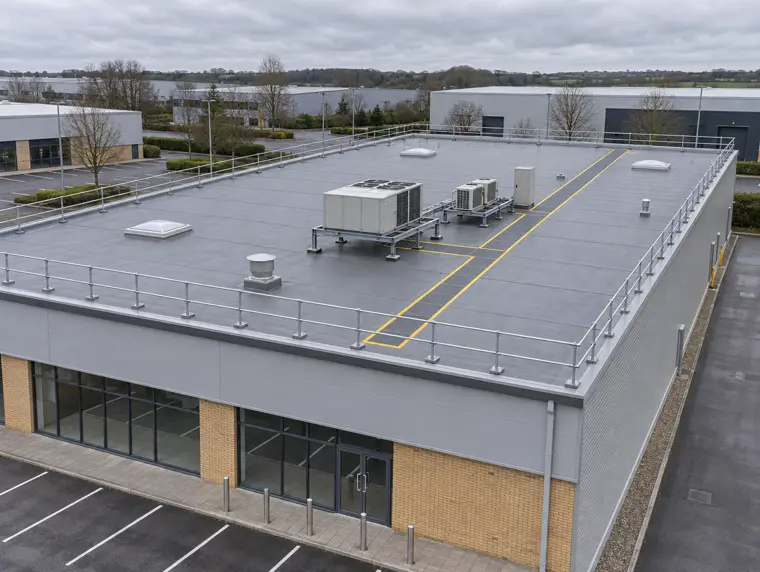
We replace, overlay and repair flat roofs on small and medium commercial buildings: shops and parades, offices, trade and light industrial units, clubs, surgeries and similar premises. That covers planned work, such as a full re-roof with new insulation, and reactive work, such as tracing and fixing a leak over a stockroom or consulting room.
Typical jobs include strip-and-replace with a warm-roof build-up, overlays on roofs that are still sound, new outlets and edge trims, rebuilt upstands around plant and rooflights, and repairs that keep a roof going until a planned replacement. For an active leak we offer an emergency temporary-weatherproofing visit as soon as a team is available.
Schools can appoint us directly where the school or its managing body chooses its own contractor; if your procurement rules require a framework contractor, check that before asking for a quote. We don't re-sheet large industrial metal roofs or remove asbestos.
Which roofing system suits a commercial flat roof?
Single-ply membrane usually suits large, simple roofs; built-up felt suits roofs with heavy foot traffic, plant or complex detailing; and a liquid-applied overlay suits a sound roof that needs new waterproofing without a full strip-out.
- Single-ply (PVC, TPO or FPO): light and quick to lay over large areas, with hot-air welded laps and fixing or bonding designed for the site's wind uplift. Indicative life 25–35+ years. See single-ply roofing.
- Built-up felt: two or three layers of reinforced bitumen membrane laid to BS 8217, hard-wearing around plant and maintenance routes. Modern systems last 15–25 years, high-performance systems longer. See torch-on felt roofing.
- Liquid-applied overlay: a reinforced coating that cures to one continuous layer, well suited to pipework, plant bases and awkward details. Indicative life 10–25+ years depending on the product. See liquid roofing.
Mastic asphalt suits concrete decks and walkways, and EPDM suits simpler roofs with few penetrations. An overlay only works where the existing roof is dry and firmly bonded, so we check for wet insulation before recommending one (see overlay or strip).
How much does a commercial flat roof cost?
As a guide, a 100 m² commercial roof re-covered in single-ply with new warm-roof insulation costs around £13,250–£21,800, including VAT. Rates per square metre usually ease as a roof gets bigger, because set-up, access and waste are spread over a larger area.
| Item | Guide price |
|---|---|
| Single-ply membrane | £90–£145 per m² |
| Built-up torch-on felt | £60–£105 per m² |
| Liquid-applied overlay | £90–£140 per m² |
| Warm-roof insulation added | £35–£60 per m² |
| 100 m² single-ply with insulation | £13,250–£21,800 |
| 150 m² torch-on felt with insulation and scaffold | £15,550–£27,200 |
The biggest cost drivers are area, the system, whether the deck and insulation need replacing, access equipment, plant that has to be lifted or moved, the number of outlets and upstands, and any out-of-hours working. These are guide prices: the fixed price comes after the free survey. See the cost guide, or get a quick figure from the guide-price tool.
Can you work around our trading hours and site rules?
Yes. Most commercial roofs can be replaced while the building stays open, and we agree the programme with you before any work starts.
That normally means set working hours, delivery and skip positions that keep entrances and fire exits clear, and phasing the roof so each section is watertight before the team leaves site. Noisy tasks such as strip-out can be timed for quieter periods, and early starts or weekend working can be arranged where your site allows. We tell you in advance which areas below the roof may be affected, so stock and equipment can be protected or moved.
Where torch-on felt is specified, the team works under your hot works permit system, with a fire watch after the torch is put away. If your site does not allow naked flames, we specify a cold-applied, self-adhesive or other flame-free system instead. Tenants, alarm companies and mechanical contractors are coordinated through one named contact.
How do you handle CDM, roof access and fragile surfaces?
Every job is planned under the Construction (Design and Management) Regulations 2015, or CDM (NI) 2016 in Northern Ireland, with a construction phase plan and a method statement for the roof.
As a commercial client you have duties under CDM too, including passing on information about the building, such as drawings, details of previous roof work and the asbestos register. Buildings put up before 2000 can contain asbestos, so we ask for the register or a refurbishment survey before pricing a strip-out. If asbestos is found, a licensed specialist surveys and removes it before we start.
Roofs and rooflights are treated as fragile until a competent person confirms otherwise. Edge protection goes up on every job, rooflights and fragile sheets are covered or fenced off, and we agree safe access before work starts: scaffold, a tower, a powered access platform or a fixed access point where one is suitable.
Do you offer condition surveys and phased budgets?
Yes. A condition survey with a written report is a paid service, guide £150–£300 for a typical single roof, with larger or multi-roof sites priced before we attend. A survey and quote for replacement work is free.
The report covers the covering, upstands, outlets, edges and rooflights, signs of ponding or wet insulation, and what needs doing now, soon and later. You can then plan a phased programme: urgent repairs first, then re-roofing in sections over one or more budget years, with each phase priced separately in your written quote.
Re-covering more than half of a roof over heated space usually triggers the thermal element rules, so the insulation is upgraded towards the renovation U-value where feasible; in England the non-domestic target is 0.18 W/m²K. We handle building control where it is needed. See building regulations and flat roof surveys.
What's included when we do the work?
- Free survey and fixed written quote for replacement and new roofs
- Single-ply, built-up felt, liquid-applied and mastic asphalt systems
- Warm-roof insulation upgrades and building control where needed
- Programme planned around trading hours, deliveries and site rules
- CDM planning, edge protection and fragile-surface controls on every job
- Written workmanship guarantee, with manufacturer guarantees registered where the system allows
What do guide prices look like?
Guide prices including VAT at West Midlands rates; regional pages adjust these for your area. The fixed price comes after a free survey for new and replacement roofs.
| Job | Guide price inc VAT |
|---|---|
| Commercial roof (100 m²), single-ply + insulation | £13,250–£21,800 |
| Condition survey and leak investigation | £150–£300 |
| Block of flats (150 m²), felt + insulation + scaffold | £15,550–£27,200 |
Does anything differ outside England?
- Wales: In Wales, most re-roofing needs building regulations approval, so check before work starts if more than 25% of the roof is being replaced or repaired. CDM 2015 applies as it does in England.
- Scotland: In Scotland, roof work is assessed under Section 6 of the building standards technical handbooks, so ask the council's building standards service whether a building warrant is needed before work starts. CDM 2015 applies in Scotland as it does in England and Wales.
- Northern Ireland: In Northern Ireland, contact the district council's building control before work starts; Technical Booklet F2 covers the insulation standard for non-domestic buildings. Site safety is planned under CDM (NI) 2016.
How does the job run from start to finish?
Survey and brief
We inspect the covering, upstands, outlets, rooflights and access, check the asbestos register, and agree your working hours and site rules.
Fixed written quote
You get an itemised quote showing the system, build-up, phasing, access and price, with building control included where the work needs it.
Planned works
The team works to an agreed programme and method statement, with edge protection in place and each section watertight before leaving site.
Handover
We inspect the finished roof with you, clear the outlets and hand over the workmanship guarantee and any manufacturer guarantee registration.
Questions about commercial flat roofing
Can you re-roof while our premises stay open?
Usually, yes. We phase the work so each section is watertight before the team leaves site, keep entrances and fire exits clear, and agree working hours and deliveries with you first.
Do you need a hot works permit?
Only if torch-on felt or other naked-flame work is used, in which case the team works under your permit system with a fire watch afterwards. Where hot works are not allowed, we specify a flame-free system such as a cold-applied membrane.
Can our existing roof be overlaid instead of stripped?
Often, if the survey shows the existing covering is sound, dry and firmly bonded. Wet insulation, a soft deck or several old layers mean a strip-out is the better long-term answer.
Do you work on school roofs?
Yes, where the school or its managing body appoints its own contractor. If your procurement rules require a framework contractor, check that before asking us to quote.
Who deals with building control on a commercial re-roof?
We do, where the work needs approval. Replacing more than half of a roof over heated space usually means upgrading the insulation towards the renovation U-value where feasible, which is 0.18 W/m²K for non-domestic buildings in England.
Can the cost be spread over more than one budget year?
Yes. We can price a phased programme with each section shown separately, starting with the most urgent areas, so you can plan the spend while the building stays protected.
What happens to air conditioning units and other roof plant?
Plant can often stay in place, with the new roof detailed around its supports. Where it has to be isolated and lifted, your mechanical contractor does that while we re-roof beneath it, and we agree the timing at survey stage.
Related services
Single-ply membrane roofing
PVC, TPO or FPO sheet with hot-air welded seams, for commercial roofs and larger buildings
Torch-on felt roofing
Layered bitumen membrane, heat-bonded on site, for houses, blocks of flats and commercial roofs
Liquid-applied roofing
Cold-applied liquid membrane for balconies, awkward details and overlays on sound roofs
Flats, HMOs and block roofs
Flat roofs for blocks, HMOs and converted flats, with itemised quotes and phased work.
Where do you offer commercial flat roofing?
- Bedfordshire
- Berkshire
- Bristol
- Buckinghamshire
- Cambridgeshire
- Cheshire
- Cornwall
- County Durham
- Cumbria
- Derbyshire
- Devon
- Dorset
- East Riding of Yorkshire
- East Sussex
- Essex
- Gloucestershire
- Greater Manchester
- Hampshire
- Herefordshire
- Hertfordshire
- Isle of Wight
- Kent
- Lancashire
- Leicestershire
- Lincolnshire
- London
- Merseyside
- Norfolk
- North Yorkshire
- Northamptonshire
- Northumberland
- Nottinghamshire
- Oxfordshire
- Shropshire
- Somerset
- South Yorkshire
- Staffordshire
- Suffolk
- Surrey
- Tyne and Wear
- Warwickshire
- West Midlands
- West Sussex
- West Yorkshire
- Wiltshire
- Worcestershire
- Blaenau Gwent
- Bridgend
- Caerphilly
- Cardiff
- Carmarthenshire
- Ceredigion
- Conwy
- Denbighshire
- Flintshire
- Gwynedd
- Isle of Anglesey
- Merthyr Tydfil
- Monmouthshire
- Neath Port Talbot
- Newport
- Pembrokeshire
- Powys
- Rhondda Cynon Taf
- Swansea
- Torfaen
- Vale of Glamorgan
- Wrexham
- Aberdeen City
- Aberdeenshire
- Angus
- Argyll and Bute
- City of Edinburgh
- Clackmannanshire
- Dumfries and Galloway
- Dundee City
- East Ayrshire
- East Dunbartonshire
- East Lothian
- East Renfrewshire
- Falkirk
- Fife
- Glasgow City
- Highland
- Inverclyde
- Midlothian
- Moray
- North Ayrshire
- North Lanarkshire
- Perth and Kinross
- Renfrewshire
- Scottish Borders
- South Ayrshire
- South Lanarkshire
- Stirling
- West Dunbartonshire
- West Lothian
- Belfast
- County Antrim
- County Armagh
- County Down
- County Fermanagh
- County Londonderry
- County Tyrone