- Guide price
- £15,550–£27,200
- Survey
- Free for new and replacement roofs
- Quote
- Fixed, in writing
- Coverage
- England, Wales, Scotland, NI
Who do you carry out block and HMO roof work for?
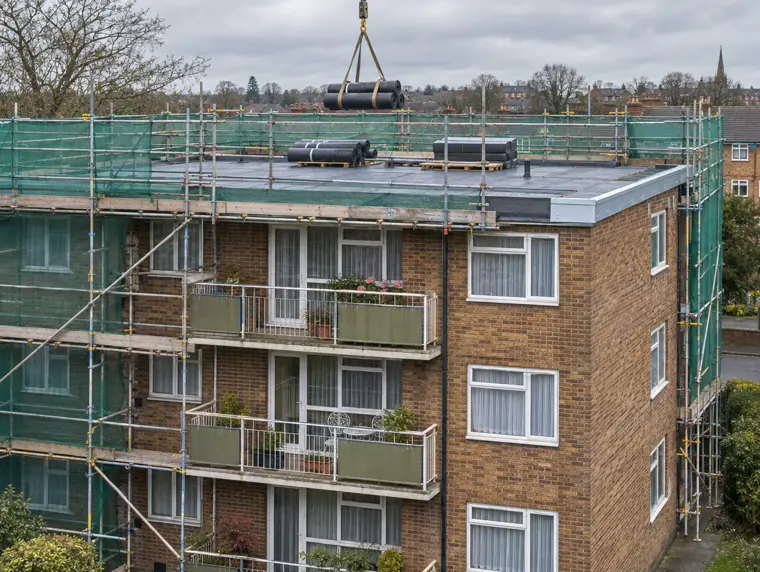
We work for whoever is responsible for the roof: freeholders, landlords of HMOs and converted flats, managing agents, and resident management or right-to-manage companies. One named contact takes instructions, and the written quote is addressed to the client who will contract with us.
Typical jobs include full replacement of the main roof on a purpose-built block, re-roofing over stair cores, lift rooms, bin stores and garages, flat roofs on rear extensions and dormers in converted houses, and leak repairs over top-floor flats. Where a leak is active, we offer an emergency temporary-weatherproofing visit as soon as a team is available, so the building is protected while a permanent repair or replacement is agreed.
We don't remove asbestos. Older blocks can contain it in roof coverings, soffits and bitumen products, so the asbestos register helps at survey stage; if asbestos is found, a licensed specialist surveys and removes it before we start.
How does Section 20 consultation affect roof works?
In England and Wales, if leaseholders pay for roof works through the service charge and any one leaseholder's share will be over the statutory threshold, the freeholder or managing agent must consult them under Section 20 of the Landlord and Tenant Act 1985 before the work is contracted.
The consultation is run by the freeholder or agent, not by us. It usually involves a notice of intention and then estimates shared with leaseholders, each stage with time for comments, and missing a step can limit what can be recovered through the service charge. Take advice from your agent or a specialist adviser if you are unsure; we don't give legal advice.
What we provide is an itemised written quote that is easy to share and compare: system and build-up, roof area, scaffold and access, insulation, outlets, upstands and trims, waste disposal, provisional sums for hidden defects such as deck repairs, and VAT shown clearly. We can price more than one system on the same scope, so leaseholders are comparing like with like.
Which roofing systems last longest on a block of flats?
Mastic asphalt, EPDM, single-ply and high-performance built-up felt all give long service lives on block roofs; the right choice depends on the deck, how the roof is used, the details and the whole-life cost.
- Mastic asphalt: 30–60 years with maintenance, common on concrete-decked blocks and walkways. See mastic asphalt roofing.
- EPDM: 25–50 years, laid in large sheets with few joins.
- Single-ply: 25–35+ years, quick to lay on larger roofs, with welded laps. See single-ply roofing.
- Built-up felt: 15–25 years for modern torch-on systems and longer for high-performance systems, robust where maintenance teams walk the roof.
- Liquid-applied: 10–25+ years by product, useful as an overlay on a sound roof with complex details.
The cheapest roof today is not always the cheapest over the life of the building. A longer-life system, with tapered insulation to cure ponding, can mean fewer reactive repairs and fewer rounds of consultation. These lives are indicative and assume good specification and regular maintenance.
How much does a block of flats roof cost?
As a guide, a 150 m² block roof re-covered in built-up torch-on felt with new insulation and scaffold costs around £15,550–£27,200, including VAT.
| Item | Guide price |
|---|---|
| Built-up torch-on felt | £60–£105 per m² |
| Single-ply membrane | £90–£145 per m² |
| Mastic asphalt | £85–£150 per m² |
| Warm-roof insulation added | £35–£60 per m² |
| 150 m² torch-on felt with insulation and scaffold | £15,550–£27,200 |
| 100 m² single-ply with insulation | £13,250–£21,800 |
Price depends mainly on roof area, the system, whether the deck is concrete or timber and its condition, the insulation needed to meet building regulations, scaffold height and access around the building, outlets, upstands and rooflights, and how the work is phased. These are guide prices: the fixed price comes after the free survey, set out line by line for consultation. See the cost guide or try the guide-price tool.
How do you manage access and residents during the work?
We agree an access and communication plan with the agent or freeholder before the scaffold goes up, so residents know what is happening and when.
That usually covers notices in the common parts and letters to each flat, scaffold and skip positions, keeping entrances, escape routes and bin stores clear, working hours, securing the scaffold out of hours, and a named contact for questions. If we need to look at a ceiling inside a top-floor flat, we arrange access through the agent or landlord.
Occupied blocks are re-roofed in phases, with each section watertight before the team leaves site, which also lets a larger roof be spread over more than one service charge year. Hot works near windows, vents and escape routes are tightly controlled, or avoided altogether with cold-applied systems.
Do fire and insulation rules affect block roofs?
Yes. Where a roof is close to a boundary, building regulations limit which coverings can be used, and the build-up should carry a suitable external fire classification such as BROOF(t4); in England this is covered by Approved Document B.
BROOF(t4) applies to a tested build-up, so we check that the manufacturer's classification covers the deck, insulation and membrane actually being installed, not just the membrane name. Where the roof crosses a separating or compartment wall, the fire-stopping detail is kept intact.
Re-covering more than half of a roof over heated flats usually triggers the thermal element rules, so the insulation is upgraded towards the renovation U-value where feasible: 0.16 W/m²K for dwellings in England and Wales. We handle building control where it is needed. See building regulations and warm vs cold roofs.
What's included when we do the work?
- Free survey and fixed, itemised written quote
- Quotes laid out to support leaseholder consultation
- Long-life systems: mastic asphalt, EPDM, single-ply and built-up felt
- Resident notices, access planning and phased work
- Building control and insulation upgrades handled where needed
- Written workmanship guarantee, with manufacturer guarantees registered where the system allows
What do guide prices look like?
Guide prices including VAT at West Midlands rates; regional pages adjust these for your area. The fixed price comes after a free survey for new and replacement roofs.
| Job | Guide price inc VAT |
|---|---|
| Block of flats (150 m²), felt + insulation + scaffold | £15,550–£27,200 |
| Commercial roof (100 m²), single-ply + insulation | £13,250–£21,800 |
Does anything differ outside England?
- Wales: Section 20 consultation applies in Wales as it does in England, and most re-roofing needs building regulations approval, so check if more than 25% of the roof is being replaced or repaired. The Welsh renovation target for a roof over dwellings is 0.16 W/m²K.
- Scotland: Section 20 does not apply in Scotland; shared roof repairs in tenements and blocks are governed by the title deeds or, where they are silent, the Tenement Management Scheme. Ask the council's building standards service whether a building warrant is needed before work starts.
- Northern Ireland: Section 20 of the Landlord and Tenant Act 1985 does not extend to Northern Ireland, so check the lease for how service charge works are agreed. Contact the district council's building control before work starts; Technical Booklet F1 sets the insulation standard for dwellings.
How does the job run from start to finish?
Survey
We inspect the covering, deck, falls, outlets, upstands and access, and note fire-related details near boundaries and separating walls.
Itemised quote
You get a fixed written quote set out line by line, with provisional sums for hidden defects and alternative systems priced on the same scope if you want them.
Programme and notices
Once you are ready to instruct, we agree dates, scaffold positions and resident notices with the agent or freeholder.
Phased works and handover
Each section is made watertight before the team leaves site, and at the end we inspect the roof with you and hand over the guarantee paperwork.
Questions about flats, HMOs and block roofs
Do you run the Section 20 consultation?
No. The freeholder or managing agent runs the consultation; we provide itemised written quotes that can be shared with leaseholders and answer technical questions passed on through the agent.
Can you quote for more than one roofing system?
Yes. We can price two or more systems on the same scope, for example built-up felt and single-ply, so leaseholders and the freeholder can compare cost against expected service life.
Do residents need to move out during a re-roof?
No. Block roofs are normally replaced with residents in place, and if we need to check a ceiling inside a top-floor flat, access is arranged through the agent or landlord.
Can a block roof be replaced in phases?
Yes. Larger roofs can be split into sections over one or more budget years, with each phase priced separately and each section left watertight before the team leaves site.
Do you work for HMO landlords?
Yes. We replace and repair flat roofs on HMOs and converted flats, arrange access with tenants through the landlord or agent, and keep escape routes and entrances clear while we work.
What if a top-floor flat is leaking before the roof is replaced?
We can attend for emergency temporary weatherproofing as soon as a team is available, guide £180–£450. That protects the flat while the permanent work is agreed.
Does a block roof replacement need building control?
Usually, yes. Re-covering more than half of a roof over heated flats normally triggers the thermal element rules, which bring insulation and approval requirements, and we handle building control or building standards where it is needed.
Related services
Flat roof replacement
Full strip and re-roof of tired flat roofs, with new deck, insulation and falls where needed
Mastic asphalt roofing
Hot-poured asphalt laid by specialists, for older buildings, concrete roofs and heavy wear
Single-ply membrane roofing
PVC, TPO or FPO sheet with hot-air welded seams, for commercial roofs and larger buildings
Commercial flat roofing
Single-ply, felt and liquid roofs for shops, offices, units and clubs, planned around trading.
Where do you offer flats, HMOs and block roofs?
- Bedfordshire
- Berkshire
- Bristol
- Buckinghamshire
- Cambridgeshire
- Cheshire
- Cornwall
- County Durham
- Cumbria
- Derbyshire
- Devon
- Dorset
- East Riding of Yorkshire
- East Sussex
- Essex
- Gloucestershire
- Greater Manchester
- Hampshire
- Herefordshire
- Hertfordshire
- Isle of Wight
- Kent
- Lancashire
- Leicestershire
- Lincolnshire
- London
- Merseyside
- Norfolk
- North Yorkshire
- Northamptonshire
- Northumberland
- Nottinghamshire
- Oxfordshire
- Shropshire
- Somerset
- South Yorkshire
- Staffordshire
- Suffolk
- Surrey
- Tyne and Wear
- Warwickshire
- West Midlands
- West Sussex
- West Yorkshire
- Wiltshire
- Worcestershire
- Blaenau Gwent
- Bridgend
- Caerphilly
- Cardiff
- Carmarthenshire
- Ceredigion
- Conwy
- Denbighshire
- Flintshire
- Gwynedd
- Isle of Anglesey
- Merthyr Tydfil
- Monmouthshire
- Neath Port Talbot
- Newport
- Pembrokeshire
- Powys
- Rhondda Cynon Taf
- Swansea
- Torfaen
- Vale of Glamorgan
- Wrexham
- Aberdeen City
- Aberdeenshire
- Angus
- Argyll and Bute
- City of Edinburgh
- Clackmannanshire
- Dumfries and Galloway
- Dundee City
- East Ayrshire
- East Dunbartonshire
- East Lothian
- East Renfrewshire
- Falkirk
- Fife
- Glasgow City
- Highland
- Inverclyde
- Midlothian
- Moray
- North Ayrshire
- North Lanarkshire
- Perth and Kinross
- Renfrewshire
- Scottish Borders
- South Ayrshire
- South Lanarkshire
- Stirling
- West Dunbartonshire
- West Lothian
- Belfast
- County Antrim
- County Armagh
- County Down
- County Fermanagh
- County Londonderry
- County Tyrone