- Price per m²
- £75–£140
- Typical life
- 20–40 years
- Manufacturer guarantees
- 20–25 year material warranties on specified systems
- Typical garage roof
- £1,800–£3,250
What is a GRP fibreglass roof and how is it laid?
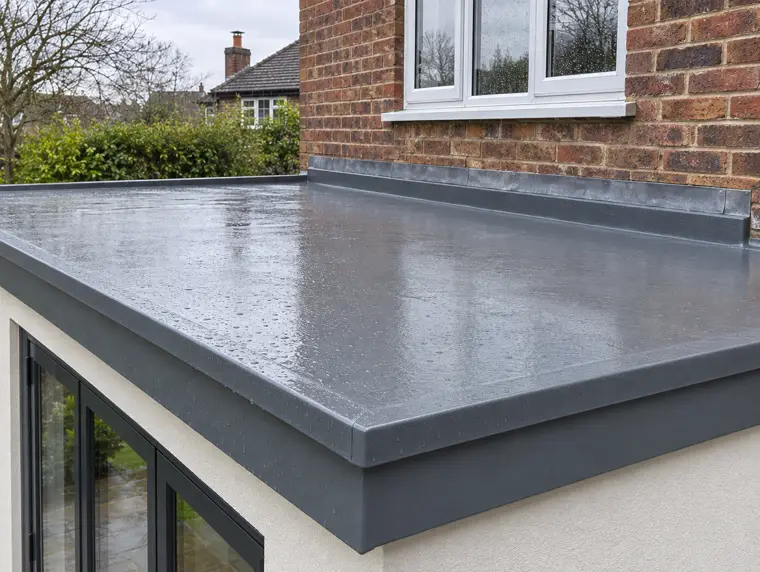
A GRP roof is glass reinforced plastic: layers of resin and glass matting laid on a timber deck that harden into a single rigid skin. Unlike a sheet membrane, it is made on the roof itself, so the quality depends heavily on the team and the conditions on the day.
A typical build-up, working upwards:
- New deck: GRP usually goes on fresh OSB3 or plywood boards, fixed at close centres. Existing decks are rarely suitable.
- Insulation and vapour control: on a warm roof, PIR boards with a vapour control layer sit beneath the deck boards.
- Trims: pre-formed GRP edge trims, kerbs and wall trims are fixed before laminating.
- Joint tape: board joints and trim junctions are taped and reinforced to cope with movement.
- Laminate: catalysed resin is rolled in, glass mat laid on top, and more resin worked through until the mat is fully wetted with no air pockets.
- Topcoat: a pigmented, UV-stable topcoat goes on once the laminate has cured, with an anti-slip finish available.
How much does a GRP fibreglass roof cost?
GRP typically costs £75–£140 per m² as a guide, so it usually sits at the upper end of domestic flat roof prices. These whole-job figures include VAT:
| Typical job | Guide price |
|---|---|
| Dormer roof, about 8 m², including scaffold | £1,400–£2,650 |
| Single garage, about 18 m², sound deck | £1,800–£3,250 |
| Extension roof, about 20 m², new deck and warm-roof insulation | £3,000–£5,400 |
What changes the figure: new deck boards (£20–£35 per m²), insulation (£35–£60 per m²), trims (£12–£22 per metre), strip-out and skip (£250–£400), and scaffold for a dormer or two-storey roof (£450–£950). Each rooflight upstand adds £180–£350.
All of these are guide prices. Your fixed price follows a free survey, set out in writing. Try the guide-price tool for your own measurements, or see how GRP compares in the cost guide and our flat roof cost guide.
How long does a GRP roof last, and is it guaranteed?
A properly laid GRP roof typically lasts 20 to 40 years. The range is wide because so much depends on the laminate being fully wetted out, the deck staying dry and stable, and the topcoat being renewed if it wears.
When GRP fails early, the cause is usually one of these:
- resin laid in damp or cold conditions that never fully cured;
- cracks at board joints or trims where movement was not allowed for;
- a deck that was wet, soft or poorly fixed before laminating;
- a thin or patchy topcoat that has weathered through.
On guarantees, manufacturer material guarantees are available on many specified GRP systems, and some need a registered build-up or an approved installer. Where registration is possible, we do it for you. Every re-roof also comes with our written workmanship guarantee, with the length set out in your quote, and you can ask about insurance-backed options. Read more in our guarantees guide.
Is GRP better than EPDM, felt or a liquid roof?
GRP is the better choice when you want a rigid, walkable finish, a neat look on a visible roof, or crisp moulded details on a complicated shape. It is not automatically better on a plain garage that nobody steps on.
Strengths: hard surface that takes occasional foot traffic; jointless finish with no laps; trims, kerbs and upstands moulded as part of the roof; choice of topcoat colours; small repairs can be laminated in.
Weaknesses: sensitive to weather while laying; rigid, so it can crack where the structure moves; usually needs a new deck; styrene smell during application; skill-dependent, so workmanship matters more than with sheet systems.
For a simple roof, EPDM rubber is often quicker to lay and more forgiving of movement. Torch-on felt is usually cheaper per square metre. A liquid-applied roof can go over a sound existing surface, larger commercial roofs tend to suit single-ply, and older buildings may already have mastic asphalt worth keeping. The EPDM vs GRP vs felt guide compares the three most common choices.
Will a new GRP roof need extra insulation to meet building regulations?
If the roof is over a heated room and you are replacing more than half of it, usually yes. In England, Wales and Northern Ireland that counts as renovating a thermal element, and in Scotland the council's building standards service will say whether a building warrant applies.
GRP pairs well with a warm roof because the new deck boards it needs can sit on top of the insulation. The result is thicker, so we check at survey that there is room under door cills and wall flashings, and that the upstands can finish around 150 mm above the new surface. Where approval is needed we arrange it with building control or building standards.
Unheated, detached garages normally sit outside the thermal rules. See the building regulations page for each nation, or the warm vs cold roof guide for why we avoid cold roofs where we can.
Why do GRP roofs crack, and can weather affect the installation?
GRP usually cracks where the structure moves and the laminate cannot, typically along board joints, at the junction with trims, or where a roof meets a wall. Weather during laying is the other big factor, because resin cures by chemical reaction and that reaction is sensitive to temperature and moisture.
How we reduce the risk of cracking:
- boards fixed at close centres so the deck does not flex;
- joints taped and reinforced with an extra strip of mat;
- wall junctions finished with a separate trim or flashing, not laminated hard into the masonry;
- roofs over a certain size divided with movement details where the system calls for them.
And how weather is managed:
- no laminating in rain, on a damp deck, or when dew or frost is likely before the resin sets;
- catalyst levels adjusted for the temperature, so resin neither stays tacky on a cold day nor kicks too fast in summer heat;
- the roof sheeted over if a shower threatens a fresh laminate.
That is why a GRP date can move at short notice. A day's delay costs far less than a laminate that never cures properly.
What's included when we do the work?
- Removal of the old covering and disposal of waste
- New OSB3 or plywood deck, fixed at close centres
- Warm-roof insulation and vapour control layer where the room below is heated
- Moulded GRP trims, kerbs and upstands
- Resin and glass-mat laminate with taped and reinforced joints
- Coloured UV-stable topcoat, with anti-slip finish on request
What do guide prices look like?
Guide prices including VAT at West Midlands rates; regional pages adjust these for your area. The fixed price comes after a free survey for new and replacement roofs.
| Job | Guide price inc VAT |
|---|---|
| Extension (20 m²), GRP, new deck + insulation | £3,000–£5,400 |
| Dormer (8 m²), GRP, scaffold | £1,400–£2,650 |
| Single garage (18 m²), GRP fibreglass | £1,800–£3,250 |
| Single garage (18 m²), EPDM rubber | £1,600–£2,800 |
| Extension (20 m²), EPDM, new deck + insulation | £2,800–£4,900 |
Does anything differ outside England?
- Wales: Welsh building regulations mean most re-roofing needs approval, so check before work if more than 25% of the roof is being replaced or repaired. A new GRP roof over a heated room should aim for the 0.16 W/m²K renovation U-value where feasible.
- Scotland: In Scotland, ask the council's building standards service whether a GRP re-roof needs a building warrant; like-for-like covering repairs can be exempt, while alterations and structural work usually need one. The domestic roof benchmark of 0.12 W/m²K, pursued as far as reasonably practicable, can mean a thicker warm-roof build-up under the new deck.
- Northern Ireland: For a GRP roof in Northern Ireland, speak to the district council's building control before starting. Technical Booklets F1 and F2 set 0.18 W/m²K for roofs, which shapes the insulation under the new deck.
How does the job run from start to finish?
Survey and measure
We inspect the joists and existing deck, measure the roof, and check falls, upstands and access for scaffold if needed.
Written fixed quote
You receive a fixed price showing the build-up, the topcoat colour, guarantee terms and any approval that is needed.
Deck, trims and laminate
The team fits the new deck and trims, then laminates on a dry day, adjusting the resin mix to the temperature.
Topcoat and handover
Once the topcoat has cured we inspect every joint and detail with you, then issue the workmanship guarantee and any manufacturer registration.
Questions about GRP fibreglass roofing
Can GRP be laid over an existing felt roof?
Generally no. GRP needs a clean, dry, rigid timber deck, so the old felt is usually stripped and the boards replaced before laminating.
What colours does a GRP roof come in?
Topcoats are typically available in greys, greens, black and some other shades. Lighter colours absorb less heat, and an anti-slip finish can be added where people will walk on the roof.
Does GRP smell when it is being laid?
Yes, the resin gives off a strong styrene smell while it cures. It usually fades within a day or so, and we advise keeping nearby windows closed while the team works.
Can you walk on a GRP roof?
Yes, a correctly laid GRP roof takes occasional foot traffic, such as cleaning windows or maintaining plant. For a regular walkway or terrace, an anti-slip topcoat and a suitable specification are needed.
Can a cracked GRP roof be repaired?
Often, yes. The area is ground back, cleaned and re-laminated with fresh mat and topcoat. If cracks keep returning along joints, the deck or detailing usually needs attention rather than another patch.
Is GRP suitable for a dormer roof?
Yes, GRP is commonly used on dormers because the trims can be moulded neatly and the finish looks tidy from the ground. Scaffold is normally needed, which we include in the quote.
How long before a new GRP roof is fully cured?
The topcoat is usually touch-dry within hours in reasonable weather, but full cure takes longer in cold conditions. We advise keeping off the roof until the team confirms it is ready.
Related services
EPDM rubber roofing
Single-sheet synthetic rubber for garages, extensions and porches, laid cold with no flame
Dormer roofs
Dormer flat roof replacement with scaffold, insulation and neat tile abutments, usually in GRP
Extension and kitchen roofs
Warm-roof replacement for kitchen and rear extensions, with sound abutments and rooflight kerbs
Garage roofs
Garage roof replacement in EPDM, GRP or felt, for single, double, attached and lock-up garages
Where do you offer GRP fibreglass roofing?
- Bedfordshire
- Berkshire
- Bristol
- Buckinghamshire
- Cambridgeshire
- Cheshire
- Cornwall
- County Durham
- Cumbria
- Derbyshire
- Devon
- Dorset
- East Riding of Yorkshire
- East Sussex
- Essex
- Gloucestershire
- Greater Manchester
- Hampshire
- Herefordshire
- Hertfordshire
- Isle of Wight
- Kent
- Lancashire
- Leicestershire
- Lincolnshire
- London
- Merseyside
- Norfolk
- North Yorkshire
- Northamptonshire
- Northumberland
- Nottinghamshire
- Oxfordshire
- Shropshire
- Somerset
- South Yorkshire
- Staffordshire
- Suffolk
- Surrey
- Tyne and Wear
- Warwickshire
- West Midlands
- West Sussex
- West Yorkshire
- Wiltshire
- Worcestershire
- Blaenau Gwent
- Bridgend
- Caerphilly
- Cardiff
- Carmarthenshire
- Ceredigion
- Conwy
- Denbighshire
- Flintshire
- Gwynedd
- Isle of Anglesey
- Merthyr Tydfil
- Monmouthshire
- Neath Port Talbot
- Newport
- Pembrokeshire
- Powys
- Rhondda Cynon Taf
- Swansea
- Torfaen
- Vale of Glamorgan
- Wrexham
- Aberdeen City
- Aberdeenshire
- Angus
- Argyll and Bute
- City of Edinburgh
- Clackmannanshire
- Dumfries and Galloway
- Dundee City
- East Ayrshire
- East Dunbartonshire
- East Lothian
- East Renfrewshire
- Falkirk
- Fife
- Glasgow City
- Highland
- Inverclyde
- Midlothian
- Moray
- North Ayrshire
- North Lanarkshire
- Perth and Kinross
- Renfrewshire
- Scottish Borders
- South Ayrshire
- South Lanarkshire
- Stirling
- West Dunbartonshire
- West Lothian
- Belfast
- County Antrim
- County Armagh
- County Down
- County Fermanagh
- County Londonderry
- County Tyrone