- Guide price
- £2,800–£4,900
- Survey
- Free for new and replacement roofs
- Quote
- Fixed, in writing
- Coverage
- England, Wales, Scotland, NI
What is the difference between a warm roof and a cold roof?
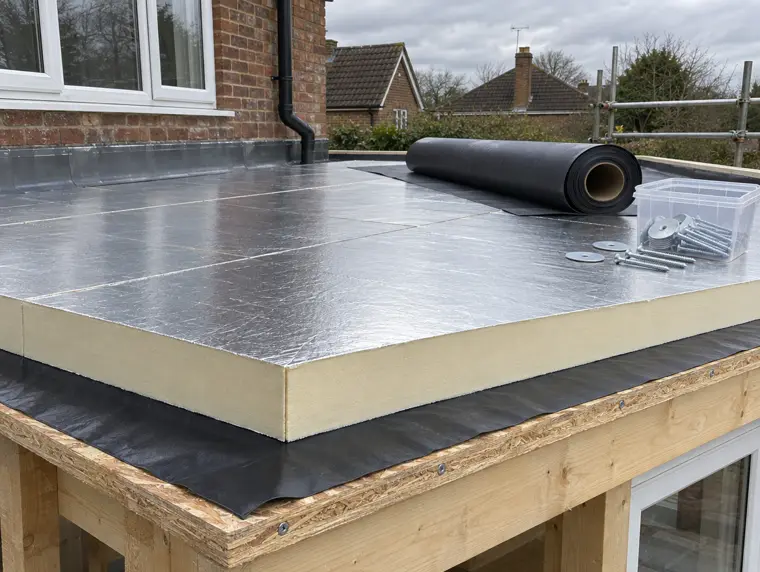
In a warm roof, the insulation sits above the deck, so the deck and joists stay at roughly room temperature. In a cold roof, the insulation sits between or below the joists, leaving the deck cold.
That difference matters for condensation. Warm, moist air from the room below can reach a cold deck and condense on it, which over time can rot timber and wet insulation. A cold roof needs a clear, ventilated gap above the insulation to carry that moisture away, and in practice that gap is often missing, blocked or too small. Industry guidance advises avoiding cold roofs where possible.
A warm roof avoids the problem by keeping the deck warm and placing a vapour control layer on the warm side of the insulation. A third option, an inverted roof, puts the insulation above the waterproofing and is mainly used on terraces and green roofs. Our warm vs cold roof guide compares the three.
Do I have to insulate my flat roof when I replace it?
Usually, yes, if the roof is over a heated room and you are replacing more than half of its covering. In England, Wales and Northern Ireland, that counts as renovating a thermal element, so the roof should be upgraded to the renovation standard where that is technically, functionally and economically feasible.
The rules don't usually apply to patch repairs, or to an unheated, detached garage. The target U-value depends on where you live:
| Nation | Roof renovation target |
|---|---|
| England | 0.16 W/m²K (homes), 0.18 (non-domestic) |
| Wales | 0.16 W/m²K |
| Scotland | Section 6 framework, with a domestic benchmark of 0.12 W/m²K pursued as far as reasonably practicable |
| Northern Ireland | 0.18 W/m²K |
A new extension roof has a tighter target than a renovation: 0.15 in England and 0.13 in Wales. The economic test in England's guidance is a simple payback within 15 years. We handle building control or building standards where it is needed. The building regulations page sets out the approval routes in each nation.
How much does warm roof insulation cost?
Warm roof insulation adds £35–£60 per m² as a guide to the cost of re-covering the roof, covering the insulation boards and the vapour control layer. It is almost always fitted as part of a replacement, not on its own.
| Item | Guide price |
|---|---|
| Warm roof insulation and vapour control layer | £35–£60 per m² |
| New OSB3 or plywood deck | £20–£35 per m² |
| 20 m² extension, EPDM, new deck and insulation | £2,800–£4,900 |
| 20 m² extension, GRP, new deck and insulation | £3,000–£5,400 |
These are guide prices including VAT at 20%. Insulation that forms part of a roof replacement is normally charged at the standard rate, so don't count on a VAT reduction. Thicker insulation, raised upstands and new trims all affect the cost. Your fixed price comes after the free survey, and our guide-price tool gives a quick estimate.
Will insulating the roof raise its height, and what about doors and upstands?
Yes. A warm roof makes the roof thicker, often by more than 100 mm depending on the insulation and the U-value target. That extra height is the main thing we plan around.
Waterproofing at a wall usually needs to rise about 150 mm above the finished roof surface, so if the roof gets higher, the upstand has to go higher too. That can be a problem where the roof meets a door threshold, a low window sill, a cavity tray or a rooflight kerb. At the edges, trims and fascias are reset to the new level, and gutters may need to move.
Where there isn't enough height, the options include using thinner, higher-performance insulation, lowering the deck where the structure allows, raising the sill or threshold, or, where it is genuinely not feasible to reach the full target, insulating as far as is reasonable and recording why with building control. We work this out at the survey so there are no surprises on the day.
Can a cold flat roof be converted to a warm roof?
Yes, and it is the usual approach when an older cold roof is re-covered. The old covering is stripped, the deck is checked and replaced where needed, and the vapour control layer, insulation and new waterproofing go on top.
The existing insulation between the joists is assessed at the same time. Leaving it in place can create a cold, unventilated gap that traps moisture, so it is often removed or the build-up is designed so that most of the insulation sits above the deck. We decide this case by case once we can see inside the roof. If the covering is still sound and you are only patching it, the upgrade isn't usually required, and our repair or replace guide explains how to decide between the two.
How long does a warm roof last?
The insulation in a warm roof should last for the life of the waterproofing above it, as long as it stays dry. Rigid PIR boards don't settle or slump in the way some loose insulation can.
The waterproofing is what sets the timescale. EPDM is typically quoted at 25 to 50 years, GRP at 20 to 40 years and modern torch-on felt at 15 to 25 years with good specification and care. A warm build-up also helps the deck, because keeping it warm and dry lowers the risk of condensation rot. If the waterproofing fails and water gets into the insulation, the wet boards should be replaced, so leaks need prompt attention. The lifespan guide compares the systems.
What's included when we do the work?
- Survey of the deck, joists and existing insulation
- Vapour control layer on the warm side of the insulation
- Rigid insulation boards sized to the U-value target
- Upstands, trims and kerbs reset to the new roof level
- Building control or building standards handled where needed
- New waterproofing, with a written workmanship guarantee
What do guide prices look like?
Guide prices including VAT at West Midlands rates; regional pages adjust these for your area. The fixed price comes after a free survey for new and replacement roofs.
| Job | Guide price inc VAT |
|---|---|
| Extension (20 m²), EPDM, new deck + insulation | £2,800–£4,900 |
| Extension (20 m²), EPDM with sedum green roof | £4,400–£8,100 |
Does anything differ outside England?
- Wales: In Wales, the roof renovation target is 0.16 W/m²K and a new extension roof is 0.13. Most re-roofing in Wales needs building regulations approval, so check whether it applies if more than 25% of the roof is being replaced.
- Scotland: Scotland uses Section 6 of the building standards technical handbooks, with a domestic roof benchmark of 0.12 W/m²K to be pursued as far as reasonably practicable. Check with the council's building standards team whether the work needs a building warrant.
- Northern Ireland: Northern Ireland follows Technical Booklets F1 and F2, with a roof target of 0.18 W/m²K. Contact the district council's building control before starting the work.
How does the job run from start to finish?
Free survey
We check the deck, the existing build-up and the heights at doors, sills and walls, and confirm which thermal rules apply.
Design and fixed quote
We specify the insulation thickness and how the upstands and edges will work, then send a fixed written quote.
Strip and rebuild
The old covering comes off, the deck is repaired or replaced, then the vapour control layer, insulation and waterproofing go on.
Sign-off
Where approval is needed, we arrange the building control or building standards sign-off and register any material guarantee the system allows.
Questions about warm roof insulation upgrades
How thick does flat roof insulation need to be?
It depends on the insulation product and the U-value target. With common PIR boards, meeting a renovation target usually means well over 100 mm. Thinner, higher-performance boards are available where height is tight.
Is a warm roof worth it on a garage?
On a detached, unheated garage, usually not, as there is no heated space to protect and the thermal rules don't normally apply. On an integral or heated garage, or one being converted into a room, it is.
Does a warm roof stop condensation?
It greatly reduces the risk by keeping the deck warm and placing a vapour control layer on the warm side. Good ventilation in kitchens and bathrooms below still helps.
Can you insulate a flat roof from inside instead?
It is possible, but insulating between or under the joists creates a cold roof, which needs ventilation and carries a higher condensation risk. When the roof is being re-covered anyway, a warm roof from above is usually the better option.
Will a warm roof make my room warmer?
Usually, yes. A room under a poorly insulated flat roof loses less heat once the roof is upgraded and tends to feel more even in temperature. How much difference you notice depends on how the roof was built before.
Is there VAT relief on flat roof insulation?
Don't count on it. Insulation fitted as part of a roof replacement is usually treated as part of a single standard-rated job. Check your own case with HMRC guidance or an adviser.
Can you add insulation over my existing roof without stripping it?
Sometimes, if the existing covering and deck are dry and sound. We will check at the survey and explain the risks, and our overlay or strip guide covers this choice.
Related services
Flat roof replacement
Full strip and re-roof of tired flat roofs, with new deck, insulation and falls where needed
Extension and kitchen roofs
Warm-roof replacement for kitchen and rear extensions, with sound abutments and rooflight kerbs
Green and sedum roofs
Sedum and extensive green roofs built over new waterproofing, after a structural check.
Flat roof surveys and leak tracing
Condition surveys and leak tracing with moisture readings, core checks and a written report.
Where do you offer warm roof insulation upgrades?
- Bedfordshire
- Berkshire
- Bristol
- Buckinghamshire
- Cambridgeshire
- Cheshire
- Cornwall
- County Durham
- Cumbria
- Derbyshire
- Devon
- Dorset
- East Riding of Yorkshire
- East Sussex
- Essex
- Gloucestershire
- Greater Manchester
- Hampshire
- Herefordshire
- Hertfordshire
- Isle of Wight
- Kent
- Lancashire
- Leicestershire
- Lincolnshire
- London
- Merseyside
- Norfolk
- North Yorkshire
- Northamptonshire
- Northumberland
- Nottinghamshire
- Oxfordshire
- Shropshire
- Somerset
- South Yorkshire
- Staffordshire
- Suffolk
- Surrey
- Tyne and Wear
- Warwickshire
- West Midlands
- West Sussex
- West Yorkshire
- Wiltshire
- Worcestershire
- Blaenau Gwent
- Bridgend
- Caerphilly
- Cardiff
- Carmarthenshire
- Ceredigion
- Conwy
- Denbighshire
- Flintshire
- Gwynedd
- Isle of Anglesey
- Merthyr Tydfil
- Monmouthshire
- Neath Port Talbot
- Newport
- Pembrokeshire
- Powys
- Rhondda Cynon Taf
- Swansea
- Torfaen
- Vale of Glamorgan
- Wrexham
- Aberdeen City
- Aberdeenshire
- Angus
- Argyll and Bute
- City of Edinburgh
- Clackmannanshire
- Dumfries and Galloway
- Dundee City
- East Ayrshire
- East Dunbartonshire
- East Lothian
- East Renfrewshire
- Falkirk
- Fife
- Glasgow City
- Highland
- Inverclyde
- Midlothian
- Moray
- North Ayrshire
- North Lanarkshire
- Perth and Kinross
- Renfrewshire
- Scottish Borders
- South Ayrshire
- South Lanarkshire
- Stirling
- West Dunbartonshire
- West Lothian
- Belfast
- County Antrim
- County Armagh
- County Down
- County Fermanagh
- County Londonderry
- County Tyrone