- Guide price
- £150–£300
- Repair price
- Confirmed once the leak or damage is found
- Condition survey report
- £150–£300
- Coverage
- England, Wales, Scotland, NI
Is a flat roof survey free or paid?
Both, depending on what you need. If you already know you want a new roof, the survey and written quote for a replacement are free, with no obligation. A condition survey or leak investigation with a written report is a paid service.
The difference is the output. A free replacement survey measures the roof, checks the deck, access, drainage and details, and produces a fixed-price quote for the work. A paid survey answers a wider question, such as why a roof keeps leaking, how much life an older roof has left, or what a property you are buying will need. It produces a report you can keep, share with a buyer, seller, landlord or managing agent, or use to plan a budget.
If a paid survey shows that replacement is the right answer, the quote for that work is included.
How much does a flat roof survey cost?
A condition survey and leak investigation report costs £150–£300 as a guide. Larger or higher roofs, roofs needing access equipment and commercial roofs with several areas are priced individually.
| Survey type | Guide price |
|---|---|
| Survey and quote for a replacement or new roof | Free, no obligation |
| Condition survey and leak investigation report | £150–£300 |
| Follow-on patch repair, if needed | £150–£500 |
These are guide prices including VAT at 20%. We confirm the fee in writing before the visit. Where a survey needs scaffold or a tower to reach the roof safely, that is agreed with you first. See the cost guide for repair and replacement prices.
How do you find where a flat roof is leaking?
By working from the evidence inside back to the likely entry points outside, then confirming the path with moisture readings and, where needed, small test openings.
We start indoors, looking at where the staining is, when it appears and whether it follows rain, wind from one direction or cold weather. Then, on the roof, we check the details where most leaks start: upstands and flashings, laps and seams, outlets, gutters, edge trims, rooflight kerbs and anything that passes through the covering. Walls, copings and cavity trays above the roof are checked too, because water getting in behind an upstand can look like a roof leak.
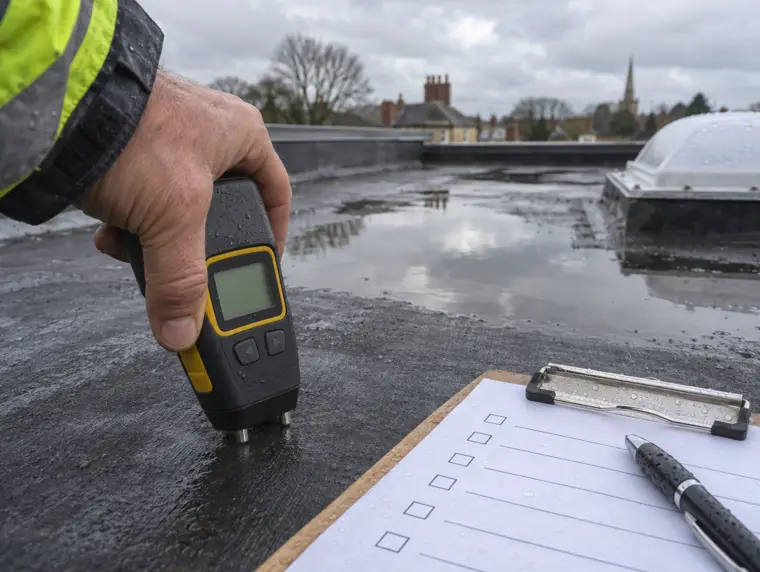
A moisture meter shows where the covering, or the material beneath it, is holding water, and readings across the roof help map how far the wet has spread. Meter readings are a guide, not proof, so where they suggest a problem we may take a core sample: a small cut through the covering and insulation to see what is underneath and whether the deck is sound. The opening is sealed again with compatible material before we leave.
Condensation can also look like a leak, especially in older cold roofs without adequate ventilation, and the survey considers that possibility too. The flat roof leaks guide explains the common causes.
What does a flat roof survey report cover?
The report sets out what the roof is, what condition it is in and what we recommend, in plain language.
- The roof system, approximate area and how the roof is built, as far as can be seen.
- The condition of the covering: splits, blisters, crazing, lost chippings, open laps and wear.
- Upstands, flashings, edge trims and rooflights.
- Falls, ponding and the state of outlets and gutters.
- Moisture readings and the findings of any core samples.
- The likely cause of any leak, and how confident we are in it.
- Recommended action, ranked by urgency, with guide costs.
We are clear about what we could and couldn't see. A survey can't inspect hidden timbers without opening them up, and we will say where a finding is an inference rather than a direct observation.
Will the survey tell me whether to repair or replace?
Yes. That is one of the main things a survey is for. Isolated damage on a dry, sound roof points to repair. Wet insulation, a soft deck, widespread cracking or repeated leaks point to replacement.
The report puts that recommendation in context, including the roof's age, its system, how long a repair would be likely to hold and whether the thermal upgrade rules would apply to a replacement. If you decide to replace, it also helps you choose between stripping the roof back and overlaying it. Our repair or replace guide and overlay or strip guide go into more detail.
How long does a flat roof survey take and how long is it valid?
A survey of a typical garage or extension roof usually takes an hour or two on site. Larger, higher or multi-area roofs take longer, and the written report follows afterwards.
A survey describes the roof on the day it was inspected. It stays a useful baseline for planning, but roofs change, particularly older ones and after a hard winter or a storm. If you are using a report to plan a replacement some time later, or after a fresh leak, a short follow-up check is sensible. For roofs you manage over the long term, a regular inspection backed by the maintenance checklist picks up problems early.
What's included when we do the work?
- Inspection of the covering, upstands, edges and outlets
- Moisture meter readings across the roof
- Core samples where readings need confirming
- Checks on walls, copings and trays above the roof
- Plain written report with ranked recommendations
- Free quote if replacement is the right answer
What do guide prices look like?
Guide prices including VAT at West Midlands rates; regional pages adjust these for your area. We confirm the price once we've traced the leak or seen the damage.
| Job | Guide price inc VAT |
|---|---|
| Condition survey and leak investigation | £150–£300 |
| Localised patch repair | £150–£500 |
| Upstand or flashing repair | £250–£650 |
| Emergency temporary weatherproofing visit | £180–£450 |
Does anything differ outside England?
- Wales: If a survey in Wales leads to replacing more than about a quarter of the roof, building regulations approval will usually be needed, and the report helps scope that work. Wales's renovation U-value target for roofs is 0.16 W/m²K.
- Scotland: In Scotland, if the survey leads to a re-roof, the council's building standards team can tell you whether a building warrant is needed. Thermal standards follow Section 6 of the Scottish technical handbooks rather than the rules used in England.
- Northern Ireland: A survey in Northern Ireland follows the same approach. If it leads to a re-roof, contact the district council's building control first. Technical Booklets F1 and F2 set the thermal standard.
How does the job run from start to finish?
Book the survey
Tell us about the roof, any leak history and what you need the survey for. We confirm whether it is a free replacement survey or a paid report, and agree the fee in writing.
Inspect inside and out
We look at the evidence indoors, then inspect the roof details, falls and drainage, taking moisture readings as we go.
Confirm with cores if needed
Where readings suggest wet insulation or a damaged deck, a small core sample confirms it. The opening is sealed again before we leave.
Written report
You receive a written report explaining the condition, the cause of any leak and what we recommend, with guide costs.
Questions about flat roof surveys and leak tracing
Can you trace a flat roof leak without opening the roof up?
Often, yes. Careful inspection and moisture readings can usually locate the problem area. Where they can't, a small core sample is the most reliable way to confirm what is happening under the covering.
Does a moisture meter work on every flat roof?
Not equally well. Readings vary with the material, and some coverings, foils and metal layers can affect them, which is why we treat readings as a guide and confirm doubtful areas with a core.
Is a core sample damaging to the roof?
It's a small, deliberate opening that is sealed again with compatible material before we leave. It shouldn't affect how the roof performs.
Do I need a roof survey when buying a house with a flat roof?
It's worth considering if the general survey flags damp, ponding or an ageing covering, or if the roof is large. A specific flat roof report gives you a clearer idea of what work may be needed and what it might cost.
Can a survey tell how old my flat roof is?
Only approximately. The type of covering and its condition give a reasonable estimate, but paperwork such as an invoice or guarantee is the only reliable record.
Can a survey tell me if my flat roof has condensation rather than a leak?
It can often point to it. Damp that appears in cold weather without rain, a cold roof build-up with little ventilation and a dry covering above the damp all suggest condensation rather than a leak.
Do you survey commercial and block roofs?
Yes. We survey flat roofs on shops, offices, units, blocks of flats and HMOs, with the report structured so a landlord, managing agent or owner can plan and budget the work.
Related services
Flat roof repairs
Patch, seam, upstand and outlet repairs on felt, EPDM, GRP, liquid and asphalt flat roofs.
Emergency leak repairs
Temporary weatherproofing for a leaking flat roof, followed by a proper permanent repair.
Flat roof replacement
Full strip and re-roof of tired flat roofs, with new deck, insulation and falls where needed
Warm roof insulation upgrades
Insulation laid above the deck during a re-roof, to cut heat loss and condensation risk.
Where do you offer flat roof surveys and leak tracing?
- Bedfordshire
- Berkshire
- Bristol
- Buckinghamshire
- Cambridgeshire
- Cheshire
- Cornwall
- County Durham
- Cumbria
- Derbyshire
- Devon
- Dorset
- East Riding of Yorkshire
- East Sussex
- Essex
- Gloucestershire
- Greater Manchester
- Hampshire
- Herefordshire
- Hertfordshire
- Isle of Wight
- Kent
- Lancashire
- Leicestershire
- Lincolnshire
- London
- Merseyside
- Norfolk
- North Yorkshire
- Northamptonshire
- Northumberland
- Nottinghamshire
- Oxfordshire
- Shropshire
- Somerset
- South Yorkshire
- Staffordshire
- Suffolk
- Surrey
- Tyne and Wear
- Warwickshire
- West Midlands
- West Sussex
- West Yorkshire
- Wiltshire
- Worcestershire
- Blaenau Gwent
- Bridgend
- Caerphilly
- Cardiff
- Carmarthenshire
- Ceredigion
- Conwy
- Denbighshire
- Flintshire
- Gwynedd
- Isle of Anglesey
- Merthyr Tydfil
- Monmouthshire
- Neath Port Talbot
- Newport
- Pembrokeshire
- Powys
- Rhondda Cynon Taf
- Swansea
- Torfaen
- Vale of Glamorgan
- Wrexham
- Aberdeen City
- Aberdeenshire
- Angus
- Argyll and Bute
- City of Edinburgh
- Clackmannanshire
- Dumfries and Galloway
- Dundee City
- East Ayrshire
- East Dunbartonshire
- East Lothian
- East Renfrewshire
- Falkirk
- Fife
- Glasgow City
- Highland
- Inverclyde
- Midlothian
- Moray
- North Ayrshire
- North Lanarkshire
- Perth and Kinross
- Renfrewshire
- Scottish Borders
- South Ayrshire
- South Lanarkshire
- Stirling
- West Dunbartonshire
- West Lothian
- Belfast
- County Antrim
- County Armagh
- County Down
- County Fermanagh
- County Londonderry
- County Tyrone