- Guide price
- £2,100–£3,600
- Survey
- Free for new and replacement roofs
- Quote
- Fixed, in writing
- Coverage
- England, Wales, Scotland, NI
Oxfordshire at a glance
- Largest towns
- Oxford, Banbury, Abingdon, Bicester
- Postcode areas
- OX
- Building control
- Oxford City Council, Cherwell District Council, Vale of White Horse District Council and 2 other councils
- Neighbouring areas
- Buckinghamshire · Berkshire · Bedfordshire · Warwickshire
- Guide price region
- South East (+10% on West Midlands rates)
How much does balcony or terrace waterproofing cost in Oxfordshire?
Guide prices including VAT at South East rates. The fixed price comes after a free survey for new and replacement roofs.
| Job | Guide price inc VAT |
|---|---|
| Balcony (12 m²), liquid-applied, scaffold | £2,100–£3,600 |
| Single garage (18 m²), EPDM rubber | £1,750–£3,100 |
| Extension (20 m²), GRP, new deck + insulation | £3,300–£5,900 |
Which flat roofs are common in Oxfordshire?
Flat roofs in Oxfordshire sit on bungalows with flat-roofed side extensions and dormers, low-rise post-war blocks of flats and 1960s and 1970s link-detached houses with flat-roofed garages and porches. Much of the South East sits in the drier Thames catchment at roughly 730 mm of rain a year, so the usual failures are at joints, upstands and outlets rather than from sheer volume of rain. Approximate 1991–2020 regional averages based on Met Office data.
Building regulations in England
Replacing more than half of a roof over a heated room usually counts as renovating a thermal element, so it is insulated to current standards and notified to building control. Renovated roofs over heated rooms are insulated to around 0.16 W/m²K where that's feasible, and new extension roofs are built to 0.15 W/m²K. In Oxfordshire the application goes to Oxford City Council, Cherwell District Council, Vale of White Horse District Council and 2 other councils. More on the rules.
How are thresholds, drainage and paving handled on a terrace?
They are designed together, because most balcony leaks start at the door threshold, a blocked outlet or a fixing driven through the membrane. Getting those three right matters more than the brand of membrane.
Thresholds: upstands are usually 150 mm above the finished surface, but a level or low step-out door cannot always achieve that. Where the upstand has to be reduced, extra protection is needed, such as a drainage channel at the door and a fall away from it, and the membrane must still run up and under the door sill.
Drainage: every terrace needs a reliable way off for water, with outlets sized for the area and an overflow if one outlet could block. Outlets under paving need access for cleaning.
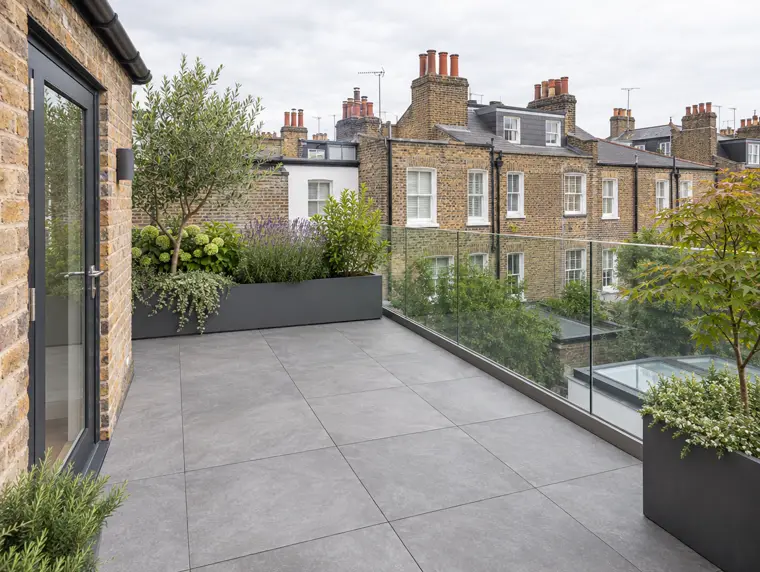
Inverted roofs and pedestals: on an inverted roof the insulation sits above the waterproofing and is held down by paving or ballast, protecting the membrane from sun and foot traffic. Adjustable pedestals lift paving slabs level above the falls, so water drains underneath and the surface stays flat. Balustrade posts are fixed through upstands or side-fixed where possible, with every penetration sealed into the membrane.
Do I need planning permission for a balcony or roof terrace?
For a new balcony or roof terrace, generally yes. In England, balconies and raised platforms are not permitted development for houses, so a planning application is normally needed, and the other nations have their own rules.
Re-waterproofing an existing, approved balcony that looks the same afterwards does not normally need planning. Building regulations are a separate question. A terrace over a heated room is a thermal element, so replacing most of it can bring insulation requirements and approval. Turning a flat roof into a terrace also raises structural questions, because people, furniture and paving add load, and it needs guarding, such as a balustrade, that meets the regulations. A structural engineer should confirm that the roof can carry the new use.
Listed buildings and conservation areas add another layer of control. Our building regulations page covers approvals, and our planning permission guide covers the planning side.
Which towns in Oxfordshire do we cover?
Balconies and roof terraces in Oxfordshire: questions
Which towns in Oxfordshire do you cover?
All of Oxfordshire. The main towns have their own pages below, and if yours isn't listed we still cover it: send your postcode and we'll confirm.
How much does balcony or terrace waterproofing cost in Oxfordshire?
£2,100–£3,600 for a 12 m² balcony in a liquid-applied system including scaffold, at South East guide rates including VAT. The fixed price comes after a free survey for new and replacement roofs.
Which postcode areas do you cover in Oxfordshire?
All of Oxfordshire, including the OX postcode areas. Send your full postcode and we'll confirm.
Can you waterproof a balcony without lifting the tiles?
Sometimes a liquid system can go over a sound, well-bonded surface, but if water is already getting under the tiles they usually have to come up.
What is an inverted roof terrace?
It is a terrace where the insulation sits above the waterproofing, held down by paving or ballast. The membrane stays protected and at a steadier temperature.
How long does balcony waterproofing last?
It depends on the system and how well it is protected. As indicative ranges, liquid-applied systems last 10–25+ years by product and mastic asphalt 30–60, with good maintenance.
Everything about balconies and roof terraces → · All flat roofing in Oxfordshire →