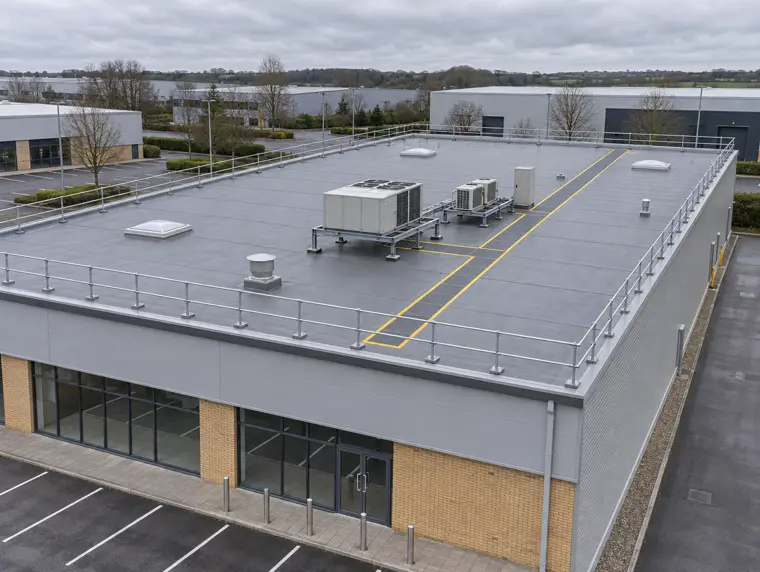
Carnoustie at a glance
- Postcode districts
- DD7
- Population
- about 11,310 (GeoNames)
- Council area
- Angus Council
- Building approval
- Angus Council building standards
- Nearest main town
- Arbroath, about 6 miles
- Guide price region
- Scotland (−5% on West Midlands rates)
What do commercial flat roofs in Carnoustie need?
Owners and agents in Carnoustie can plan spending with a phased programme: urgent repairs now, then re-roofing section by section over one or more budget years. Each phase is priced separately in writing, and the survey and quote for replacement work are free, with no obligation to go ahead.
Around Carnoustie, flat roofs are common on low-rise post-war blocks of flats and on lock-up garage blocks on estates. Scotland averages roughly 1,570 mm of rain a year, with the west far wetter than the east, so drainage, falls and wind uplift are part of every specification we write.
How much does a commercial flat roof cost in Carnoustie?
For Carnoustie we use Scotland rates: £12,550–£20,700 is the guide for a 100 m² commercial roof in single-ply with insulation, VAT included. The fixed price comes after a free survey for new and replacement roofs.
| Job | Guide price inc VAT |
|---|---|
| Commercial roof (100 m²), single-ply + insulation | £12,550–£20,700 |
| Condition survey and leak investigation | £140–£290 |
| Block of flats (150 m²), felt + insulation + scaffold | £14,750–£25,850 |
Can you work around our trading hours and site rules?
Yes. Most commercial roofs can be replaced while the building stays open, and we agree the programme with you before any work starts.
That normally means set working hours, delivery and skip positions that keep entrances and fire exits clear, and phasing the roof so each section is watertight before the team leaves site. Noisy tasks such as strip-out can be timed for quieter periods, and early starts or weekend working can be arranged where your site allows. We tell you in advance which areas below the roof may be affected, so stock and equipment can be protected or moved.
Where torch-on felt is specified, the team works under your hot works permit system, with a fire watch after the torch is put away. If your site does not allow naked flames, we specify a cold-applied, self-adhesive or other flame-free system instead. Tenants, alarm companies and mechanical contractors are coordinated through one named contact.
What's included?
- Written workmanship guarantee, with manufacturer guarantees registered where the system allows
- CDM planning, edge protection and fragile-surface controls on every job
- Single-ply, built-up felt, liquid-applied and mastic asphalt systems
- Warm-roof insulation upgrades and building standards where needed
Building standards in Scotland
In Scotland the building standards technical handbooks (Section 6 for energy) apply, and the council's building standards service decides whether a building warrant is needed. Like-for-like repairs to a roof covering can be exempt; alterations, structural work and new roofs usually need a warrant before work starts. The domestic roof benchmark is 0.12 W/m²K, applied as far as reasonably practicable on an existing roof. More on the rules.
Which nearby areas do we also cover?
Commercial flat roofing in Carnoustie: questions
Do you cover Carnoustie?
Yes. Carnoustie is part of our Angus coverage, including postcode districts DD7. Surveys and roofs are carried out by vetted roofing teams working under S&K Property Investments and Improvement Ltd.
Who checks building standards for a flat roof in Carnoustie?
Where the work needs approval it goes to Angus Council building standards. We tell you at the survey whether your job needs it and deal with the paperwork as part of the quote.
How much does a commercial flat roof cost in Carnoustie?
£12,550–£20,700 for a 100 m² commercial roof in single-ply with insulation, at Scotland guide rates including VAT. The fixed price comes after a free survey for new and replacement roofs.
Can our existing roof be overlaid instead of stripped?
Often, if the survey shows the existing covering is sound, dry and firmly bonded. Wet insulation, a soft deck or several old layers mean a strip-out is the better long-term answer.
Do you need a hot works permit?
Only if torch-on felt or other naked-flame work is used, in which case the team works under your permit system with a fire watch afterwards. Where hot works are not allowed, we specify a flame-free system such as a cold-applied membrane.