- Guide price
- £12,300–£20,250
- Survey
- Free for new and replacement roofs
- Quote
- Fixed, in writing
- Coverage
- England, Wales, Scotland, NI
Tyne and Wear at a glance
- Largest towns
- Newcastle upon Tyne, Sunderland, South Shields, Washington
- Postcode areas
- DH, NE, SR
- Building control
- Newcastle City Council, Sunderland City Council, South Tyneside Council and 2 other councils
- Neighbouring areas
- Northumberland · County Durham · North Yorkshire · Cumbria
- Guide price region
- North East (−7% on West Midlands rates)
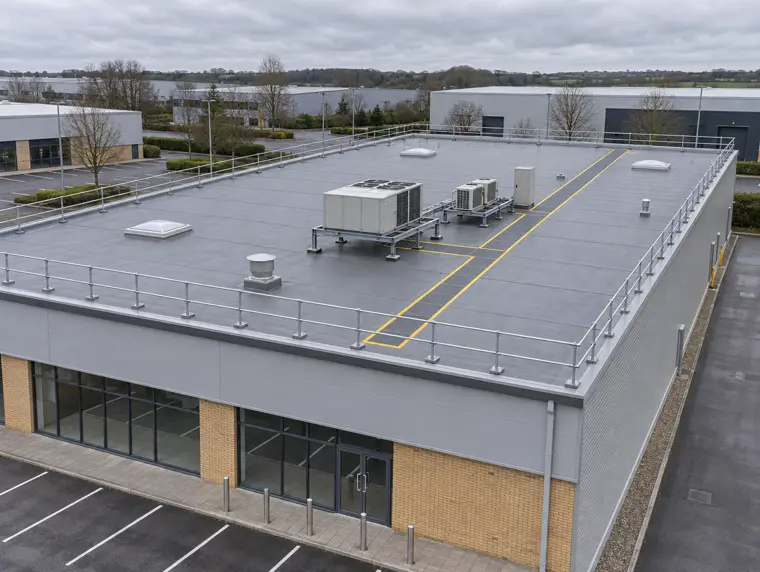
How much does a commercial flat roof cost in Tyne and Wear?
Guide prices including VAT at North East rates. The fixed price comes after a free survey for new and replacement roofs.
| Job | Guide price inc VAT |
|---|---|
| Commercial roof (100 m²), single-ply + insulation | £12,300–£20,250 |
| Condition survey and leak investigation | £140–£280 |
| Block of flats (150 m²), felt + insulation + scaffold | £14,450–£25,300 |
Which flat roofs are common in Tyne and Wear?
Flat roofs in Tyne and Wear sit on bungalows with flat-roofed side extensions and dormers, 1930s semis with flat-roofed garages and kitchen extensions and shops with flat-roofed rear stores below flats. England averages roughly 870 mm of rain a year; the North East is drier than the west but cold and windy near the coast, so wind uplift and freeze-thaw are in the specification. Approximate 1991–2020 regional averages based on Met Office data.
Building regulations in England
Replacing more than half of a roof over a heated room usually counts as renovating a thermal element, so it is insulated to current standards and notified to building control. Renovated roofs over heated rooms are insulated to around 0.16 W/m²K where that's feasible, and new extension roofs are built to 0.15 W/m²K. In Tyne and Wear the application goes to Newcastle City Council, Sunderland City Council, South Tyneside Council and 2 other councils. More on the rules.
How do you handle CDM, roof access and fragile surfaces?
Every job is planned under the Construction (Design and Management) Regulations 2015, or CDM (NI) 2016 in Northern Ireland, with a construction phase plan and a method statement for the roof.
As a commercial client you have duties under CDM too, including passing on information about the building, such as drawings, details of previous roof work and the asbestos register. Buildings put up before 2000 can contain asbestos, so we ask for the register or a refurbishment survey before pricing a strip-out. If asbestos is found, a licensed specialist surveys and removes it before we start.
Roofs and rooflights are treated as fragile until a competent person confirms otherwise. Edge protection goes up on every job, rooflights and fragile sheets are covered or fenced off, and we agree safe access before work starts: scaffold, a tower, a powered access platform or a fixed access point where one is suitable.
Which roofing system suits a commercial flat roof?
Single-ply membrane usually suits large, simple roofs; built-up felt suits roofs with heavy foot traffic, plant or complex detailing; and a liquid-applied overlay suits a sound roof that needs new waterproofing without a full strip-out.
- Single-ply (PVC, TPO or FPO): light and quick to lay over large areas, with hot-air welded laps and fixing or bonding designed for the site's wind uplift. Indicative life 25–35+ years. See single-ply roofing.
- Built-up felt: two or three layers of reinforced bitumen membrane laid to BS 8217, hard-wearing around plant and maintenance routes. Modern systems last 15–25 years, high-performance systems longer. See torch-on felt roofing.
- Liquid-applied overlay: a reinforced coating that cures to one continuous layer, well suited to pipework, plant bases and awkward details. Indicative life 10–25+ years depending on the product. See liquid roofing.
Mastic asphalt suits concrete decks and walkways, and EPDM suits simpler roofs with few penetrations. An overlay only works where the existing roof is dry and firmly bonded, so we check for wet insulation before recommending one (see overlay or strip).
Which towns in Tyne and Wear do we cover?
- Newcastle upon Tyne
- Sunderland
- South Shields
- Washington
- Wallsend
- Newburn
- Whitley Bay
- Houghton-Le-Spring
- Felling
- Jarrow
- Gosforth
- Whickham
- Blaydon-on-Tyne
Commercial flat roofing in Tyne and Wear: questions
Which towns in Tyne and Wear do you cover?
All of Tyne and Wear. The main towns have their own pages below, and if yours isn't listed we still cover it: send your postcode and we'll confirm.
How much does a commercial flat roof cost in Tyne and Wear?
£12,300–£20,250 for a 100 m² commercial roof in single-ply with insulation, at North East guide rates including VAT. The fixed price comes after a free survey for new and replacement roofs.
Which postcode areas do you cover in Tyne and Wear?
All of Tyne and Wear, including the DH, NE, SR postcode areas. Send your full postcode and we'll confirm.
Can you re-roof while our premises stay open?
Usually, yes. We phase the work so each section is watertight before the team leaves site, keep entrances and fire exits clear, and agree working hours and deliveries with you first.
Can the cost be spread over more than one budget year?
Yes. We can price a phased programme with each section shown separately, starting with the most urgent areas, so you can plan the spend while the building stays protected.
What happens to air conditioning units and other roof plant?
Plant can often stay in place, with the new roof detailed around its supports. Where it has to be isolated and lifted, your mechanical contractor does that while we re-roof beneath it, and we agree the timing at survey stage.
Everything about commercial flat roofing → · All flat roofing in Tyne and Wear →