Clydebank at a glance
- Postcode districts
- G60, G81
- Population
- about 25,620 (GeoNames)
- Council area
- West Dunbartonshire Council
- Building approval
- West Dunbartonshire Council building standards
- Nearest main town
- Bearsden, about 3 miles
- Guide price region
- Scotland (−5% on West Midlands rates)
What do commercial flat roofs in Clydebank need?
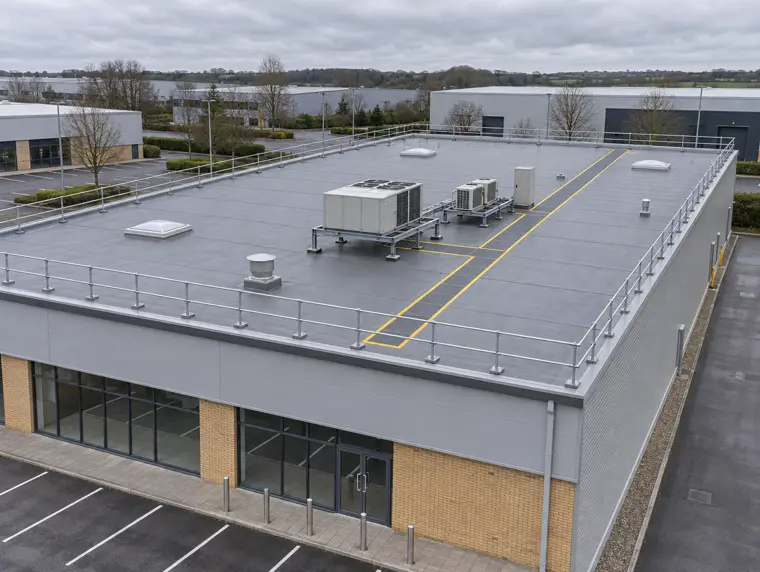
We are flat roof specialists, so a commercial roof in Clydebank gets a system chosen for the job: single-ply for large, simple areas, built-up felt where there is foot traffic and plant, or a liquid overlay where the existing roof is sound. The survey explains the trade-offs in plain terms.
In a town like Clydebank, flat roofs are commonly found on shops with flat-roofed rear stores below flats or low-rise post-war blocks of flats. Scotland averages roughly 1,570 mm of rain a year, with the west far wetter than the east, so drainage, falls and wind uplift are part of every specification we write.
How much does a commercial flat roof cost in Clydebank?
At Scotland guide rates, a 100 m² commercial roof in single-ply with insulation comes to £12,550–£20,700 including VAT. The fixed price comes after a free survey for new and replacement roofs.
| Job | Guide price inc VAT |
|---|---|
| Commercial roof (100 m²), single-ply + insulation | £12,550–£20,700 |
| Condition survey and leak investigation | £140–£290 |
| Block of flats (150 m²), felt + insulation + scaffold | £14,750–£25,850 |
How do you handle CDM, roof access and fragile surfaces?
Every job is planned under the Construction (Design and Management) Regulations 2015, or CDM (NI) 2016 in Northern Ireland, with a construction phase plan and a method statement for the roof.
As a commercial client you have duties under CDM too, including passing on information about the building, such as drawings, details of previous roof work and the asbestos register. Buildings put up before 2000 can contain asbestos, so we ask for the register or a refurbishment survey before pricing a strip-out. If asbestos is found, a licensed specialist surveys and removes it before we start.
Roofs and rooflights are treated as fragile until a competent person confirms otherwise. Edge protection goes up on every job, rooflights and fragile sheets are covered or fenced off, and we agree safe access before work starts: scaffold, a tower, a powered access platform or a fixed access point where one is suitable.
What's included?
- Single-ply, built-up felt, liquid-applied and mastic asphalt systems
- Programme planned around trading hours, deliveries and site rules
- Free survey and fixed written quote for replacement and new roofs
- Warm-roof insulation upgrades and building standards where needed
Building standards in Scotland
In Scotland the building standards technical handbooks (Section 6 for energy) apply, and the council's building standards service decides whether a building warrant is needed. Like-for-like repairs to a roof covering can be exempt; alterations, structural work and new roofs usually need a warrant before work starts. The domestic roof benchmark is 0.12 W/m²K, applied as far as reasonably practicable on an existing roof. More on the rules.
Which nearby areas do we also cover?
Commercial flat roofing in Clydebank: questions
Do you cover Clydebank?
Yes. Clydebank is part of our West Dunbartonshire coverage, including postcode districts G60, G81. Surveys and roofs are carried out by vetted roofing teams working under S&K Property Investments and Improvement Ltd.
Who checks building standards for a flat roof in Clydebank?
Where the work needs approval it goes to West Dunbartonshire Council building standards. We tell you at the survey whether your job needs it and deal with the paperwork as part of the quote.
How much does a commercial flat roof cost in Clydebank?
£12,550–£20,700 for a 100 m² commercial roof in single-ply with insulation, at Scotland guide rates including VAT. The fixed price comes after a free survey for new and replacement roofs.
What happens to air conditioning units and other roof plant?
Plant can often stay in place, with the new roof detailed around its supports. Where it has to be isolated and lifted, your mechanical contractor does that while we re-roof beneath it, and we agree the timing at survey stage.
Can our existing roof be overlaid instead of stripped?
Often, if the survey shows the existing covering is sound, dry and firmly bonded. Wet insulation, a soft deck or several old layers mean a strip-out is the better long-term answer.