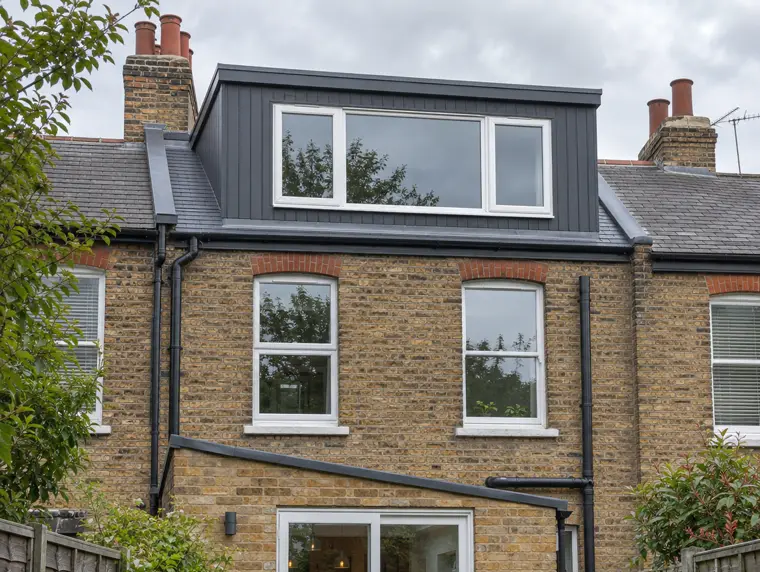
- Guide price
- £1,350–£2,500
- Survey
- Free for new and replacement roofs
- Quote
- Fixed, in writing
- Coverage
- England, Wales, Scotland, NI
Merseyside at a glance
- Largest towns
- Liverpool, Birkenhead, St Helens, Southport
- Postcode areas
- CH, L, PR, WA
- Building control
- Liverpool City Council, Wirral Council, St Helens Borough Council and 2 other councils
- Neighbouring areas
- Cheshire · Greater Manchester · Lancashire · Shropshire
- Guide price region
- North West (−5% on West Midlands rates)
How much does a new dormer roof cost in Merseyside?
Guide prices including VAT at North West rates. The fixed price comes after a free survey for new and replacement roofs.
| Job | Guide price inc VAT |
|---|---|
| Dormer (8 m²), GRP, scaffold | £1,350–£2,500 |
| Single garage (18 m²), EPDM rubber | £1,500–£2,650 |
| Extension (20 m²), GRP, new deck + insulation | £2,850–£5,100 |
Which flat roofs are common in Merseyside?
Flat roofs in Merseyside sit on low-rise post-war blocks of flats, 1930s semis with flat-roofed garages and kitchen extensions and newer estates where the first extension roofs are now being replaced. The North West is one of England's wetter regions, averaging roughly 1,290 mm of rain a year, so falls, outlets and well-detailed upstands matter more than the membrane colour. Approximate 1991–2020 regional averages based on Met Office data.
Building regulations in England
Replacing more than half of a roof over a heated room usually counts as renovating a thermal element, so it is insulated to current standards and notified to building control. Renovated roofs over heated rooms are insulated to around 0.16 W/m²K where that's feasible, and new extension roofs are built to 0.15 W/m²K. In Merseyside the application goes to Liverpool City Council, Wirral Council, St Helens Borough Council and 2 other councils. More on the rules.
Why is scaffold and tile detailing so important on a dormer?
Because a dormer roof is high, small and surrounded by a pitched tiled roof, most failures happen at the edges rather than in the middle. Safe access is what allows those edges to be done properly.
Ladders alone do not give a safe working platform at that height, and every roof is treated as fragile until a competent person confirms otherwise. Scaffold with edge protection lets the team work along the front and sides of the dormer, and reach the junction with the main roof.
The back of the dormer is where most leaks start. The new membrane has to turn up under the tiles or slates, with a flashing that sheds water over it. Where the old detail used lead, we reinstate or replace it. Small roofs also leave little room for error at the drip edge: the front trim must throw water clear of the window frame and fascia, and any gutter has to be big enough for the area it drains. Dormer cheeks with tile hanging or cladding are checked for gaps that let water behind.
If you are also planning insulation upgrades or work on the main roof, tell us at survey so the scaffold can be shared.
Is GRP or EPDM better on a dormer roof?
GRP fibreglass is often the first choice on a dormer, because it is laid as a liquid resin over a mat and forms neat, rigid edges, corners and drip details on a small roof. It cures to a hard surface that copes with occasional foot traffic during window cleaning or maintenance.
EPDM rubber works well on a plain rectangular dormer and can usually be laid as one sheet, with no field joins. Unlike GRP, it does not depend on resin curing conditions on the day. Torch-on felt can be used, but working a torch close to timber cladding, fascias and tiles needs extra care, so a cold-applied system is often chosen instead.
We recommend the system after surveying the dormer, its edges and how it meets the main roof.
Which towns in Merseyside do we cover?
- Liverpool
- Birkenhead
- St Helens
- Southport
- Wallasey
- Bootle
- Bebington
- Huyton
- Kirkby
- Prescot
- Heswall
- Maghull
- Newton-le-Willows
- Formby
- Garston
- Speke
- Norris Green
- Kirkdale
- Moreton
- Haydock
- Belle Vale
- Old Swan
- Allerton
Dormer roofs in Merseyside: questions
Which towns in Merseyside do you cover?
All of Merseyside. The main towns have their own pages below, and if yours isn't listed we still cover it: send your postcode and we'll confirm.
How much does a new dormer roof cost in Merseyside?
£1,350–£2,500 for an 8 m² GRP dormer roof including scaffold, at North West guide rates including VAT. The fixed price comes after a free survey for new and replacement roofs.
Which council handles building control for a flat roof in Merseyside?
It depends on where the roof is: in Merseyside that's Liverpool City Council, Wirral Council, St Helens Borough Council and 2 other councils. Replacing more than half of a roof over a heated room usually counts as renovating a thermal element, so it is insulated to current standards and notified to building control. We confirm which applies at the survey.
Can you replace the lead on my dormer at the same time?
Yes, where lead forms part of the dormer abutment or cheek flashings, we include renewing it in the roof job.
Why does my dormer leak at the back where it meets the roof?
That junction is the most common leak point, usually because the upstand or flashing under the tiles has failed. A proper re-roof rebuilds it.
Will insulating my dormer roof make it higher?
Yes, by the insulation thickness. We plan the build-up so the new roof still sits correctly under the main roof tiles at the back edge.
Everything about dormer roofs → · All flat roofing in Merseyside →