Porthcawl at a glance
- Postcode districts
- CF36
- Population
- about 15,672 (GeoNames)
- Council area
- Bridgend County Borough Council
- Building approval
- Bridgend County Borough Council building control, or a registered building control approver
- Nearest main town
- Bridgend, about 6 miles
- Guide price region
- Wales (−8% on West Midlands rates)
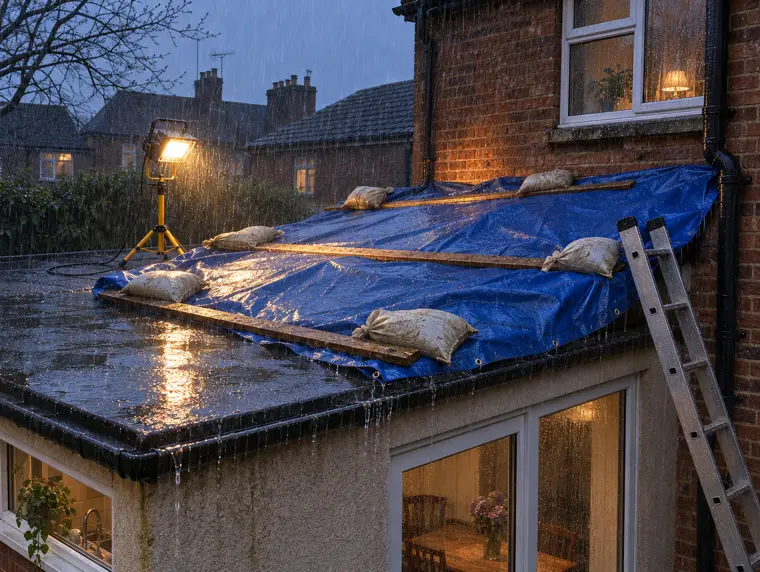
What should you do about a roof leak in Porthcawl?
In Porthcawl, as elsewhere, many flat roofs sit over rooms that matter: kitchens, bedrooms, shops and offices. A sudden leak can damage ceilings, flooring and stock within hours, which is why getting the roof temporarily weathertight comes first and the permanent fix follows.
Porthcawl's flat roofs are mostly on terraced streets with flat-roofed rear kitchens and bathrooms, with plenty on newer estates where the first extension roofs are now being replaced too. Wales averages roughly 1,460 mm of rain a year, among the wettest in Britain, so we design for steady run-off: proper falls, clear outlets and upstands well above the finished roof.
How much does an emergency leak repair cost in Porthcawl?
At Wales guide rates, an emergency temporary weatherproofing visit comes to £170–£410 including VAT. We confirm the price once we've traced the leak or seen the damage.
| Job | Guide price inc VAT |
|---|---|
| Emergency temporary weatherproofing visit | £170–£410 |
| Localised patch repair | £140–£460 |
| Upstand or flashing repair | £230–£600 |
| Condition survey and leak investigation | £140–£280 |
How long does a temporary repair last?
A temporary repair is designed to hold for days or weeks, not years. It buys time for the roof to dry and for the permanent work to be planned.
Temporary sheeting can be lifted by high winds, and a cold-weather seal on a wet surface won't bond as well as a proper repair. We recommend booking the permanent repair or replacement promptly rather than relying on the temporary fix through a season. If the temporary work moves or the leak returns, call us again.
Once the permanent work is done, how long it lasts depends on the repair and on the rest of the roof. Our lifespan guide gives typical service lives for each roof system.
What's included?
- Blocked outlets and gutters cleared where they're the cause
- Temporary weatherproofing as soon as a team is available
- Written quote for the permanent repair or replacement
- Safe working, with edge protection on every job
Building regulations in Wales
The Welsh Approved Document L applies. Renovating more than half of a roof over a heated room means upgrading it to around 0.16 W/m²K where feasible, and new extension roofs are built to 0.13 W/m²K. Welsh Government guidance is that most re-roofing needs building control approval, so check whenever more than a quarter of a roof is replaced or repaired. We deal with the application as part of the job. More on the rules.
Which nearby areas do we also cover?
Emergency leak repairs in Porthcawl: questions
Do you cover Porthcawl?
Yes. Porthcawl is part of our Bridgend coverage, including postcode districts CF36. Surveys and roofs are carried out by vetted roofing teams working under S&K Property Investments and Improvement Ltd.
Who checks building regulations for a flat roof in Porthcawl?
Where the work needs approval it goes to Bridgend County Borough Council building control, or a registered building control approver. We tell you at the survey whether your job needs it and deal with the paperwork as part of the quote.
How much does an emergency leak repair cost in Porthcawl?
£170–£410 for an emergency temporary weatherproofing visit, at Wales guide rates including VAT. We confirm the price once we've traced the leak or seen the damage.
Will my home insurance cover an emergency roof repair?
It depends on your policy and the cause. Storm damage is often covered, while wear and tear usually isn't, so check with your insurer. Notes made at the time, plus our written report, can help with a claim.
What causes a sudden flat roof leak?
Common causes are storm damage that lifts seams, edges or trims, outlets blocked by leaves so water backs up over upstands, and old felt cracking after a cold snap. Sometimes the cause is a wall or coping above the roof rather than the roof itself.