Denny at a glance
- Postcode districts
- FK6
- Population
- about 7,860 (GeoNames)
- Council area
- Falkirk Council
- Building approval
- Falkirk Council building standards
- Nearest main town
- Falkirk, about 5 miles
- Guide price region
- Scotland (−5% on West Midlands rates)
Why choose EPDM rubber roofing in Denny?
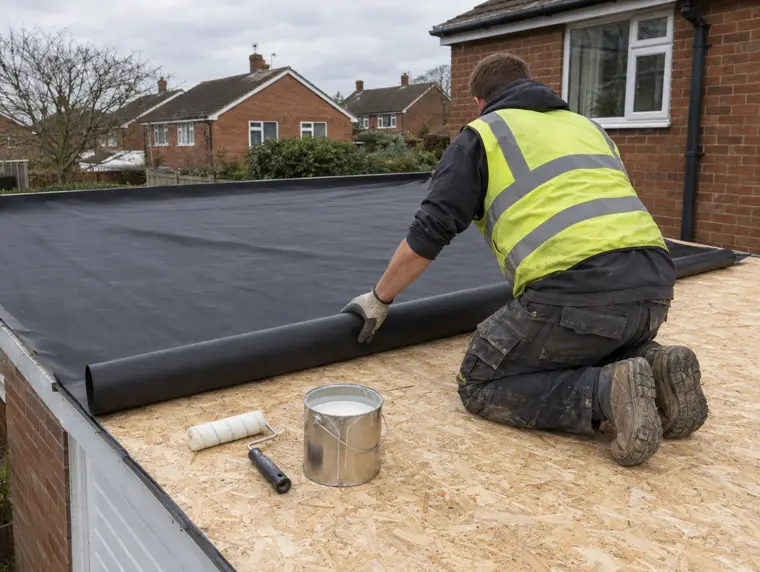
Rubber is a sensible pick in Denny where a roof sits close to bedrooms or a kitchen and you would rather avoid hot works. It suits porches, bays and dormers too, where the small area means a single sheet can cover the whole roof with no joins at all.
Around Denny, flat roofs are common on lock-up garage blocks on estates and on 1960s and 1970s link-detached houses with flat-roofed garages and porches. Scotland averages roughly 1,570 mm of rain a year, with the west far wetter than the east, so drainage, falls and wind uplift are part of every specification we write.
How much does an EPDM rubber roof cost in Denny?
For Denny we use Scotland rates: £1,500–£2,650 is the guide for a typical 18 m² garage roof in EPDM, VAT included. The fixed price comes after a free survey for new and replacement roofs.
| Job | Guide price inc VAT |
|---|---|
| Single garage (18 m²), EPDM rubber | £1,500–£2,650 |
| Extension (20 m²), EPDM, new deck + insulation | £2,650–£4,650 |
| Porch or bay (4 m²), EPDM | £700–£1,200 |
How long does an EPDM roof last, and what guarantees come with it?
A well-specified EPDM roof typically lasts 25 to 50 years, and one BBA assessment of an EPDM membrane puts its expected life at 35 years or more. Problems usually come from poorly bonded upstands, damaged trims or ponding, rather than the rubber itself.
Three separate documents can sit behind an EPDM roof:
- Manufacturer material guarantee: covers the membrane and, on some systems, the wider build-up. Many need registration and a specified build-up, so we register it for you where the system allows.
- Our written workmanship guarantee: given on every re-roof, with the length set out in your quote.
- Insurance-backed guarantee: an option worth asking about if you want cover that does not depend on the contractor still trading.
A BBA certificate is an assessment of the product, not a guarantee. Our guide to flat roof guarantees explains the differences, and the lifespan guide compares EPDM with the other systems.
What's included?
- EPDM membrane fully bonded, in one sheet where the roof size allows
- New drip and kerb trims, outlets and upstand details
- Strip-out of the old covering, with waste taken away
- Deck check and replacement of soft or rotten boards
Building standards in Scotland
In Scotland the building standards technical handbooks (Section 6 for energy) apply, and the council's building standards service decides whether a building warrant is needed. Like-for-like repairs to a roof covering can be exempt; alterations, structural work and new roofs usually need a warrant before work starts. The domestic roof benchmark is 0.12 W/m²K, applied as far as reasonably practicable on an existing roof. More on the rules.
Which nearby areas do we also cover?
EPDM rubber roofing in Denny: questions
Do you cover Denny?
Yes. Denny is part of our Falkirk coverage, including postcode districts FK6. Surveys and roofs are carried out by vetted roofing teams working under S&K Property Investments and Improvement Ltd.
Who checks building standards for a flat roof in Denny?
Where the work needs approval it goes to Falkirk Council building standards. We tell you at the survey whether your job needs it and deal with the paperwork as part of the quote.
How much does an EPDM rubber roof cost in Denny?
£1,500–£2,650 for a typical 18 m² garage roof in EPDM, at Scotland guide rates including VAT. The fixed price comes after a free survey for new and replacement roofs.
Can you put a green roof on top of EPDM?
Yes. EPDM is often used under sedum, with a protection layer, drainage and growing medium laid on top. The structure must be able to carry the extra weight, which we check before quoting.
Can an EPDM roof be fitted in winter?
Yes, as long as the deck is dry. The adhesives are affected by cold and damp, so very cold or wet days can delay bonding, and the roof is kept temporarily weathertight between dry spells.