- Guide price
- £2,900–£5,050
- Survey
- Free for new and replacement roofs
- Quote
- Fixed, in writing
- Coverage
- England, Wales, Scotland, NI
Devon at a glance
How much does a new extension roof cost in Devon?
Guide prices including VAT at South West rates. The fixed price comes after a free survey for new and replacement roofs.
| Job | Guide price inc VAT |
|---|---|
| Extension (20 m²), EPDM, new deck + insulation | £2,900–£5,050 |
| Extension (20 m²), GRP, new deck + insulation | £3,100–£5,550 |
| Extension (20 m²), EPDM, insulation + 1 rooflight upstand | £3,100–£5,400 |
| Single garage (18 m²), EPDM rubber | £1,650–£2,900 |
Which flat roofs are common in Devon?
Flat roofs in Devon sit on bungalows with flat-roofed side extensions and dormers, shops with flat-roofed rear stores below flats and low-rise post-war blocks of flats. The South West averages roughly 1,260 mm of rain a year and many roofs face wind off the Atlantic, so we specify fixings and edge details for wind uplift as well as drainage. Approximate 1991–2020 regional averages based on Met Office data.
Building regulations in England
Replacing more than half of a roof over a heated room usually counts as renovating a thermal element, so it is insulated to current standards and notified to building control. Renovated roofs over heated rooms are insulated to around 0.16 W/m²K where that's feasible, and new extension roofs are built to 0.15 W/m²K. In Devon the application goes to Plymouth City Council, Exeter City Council, Torbay Council and 5 other councils. More on the rules.
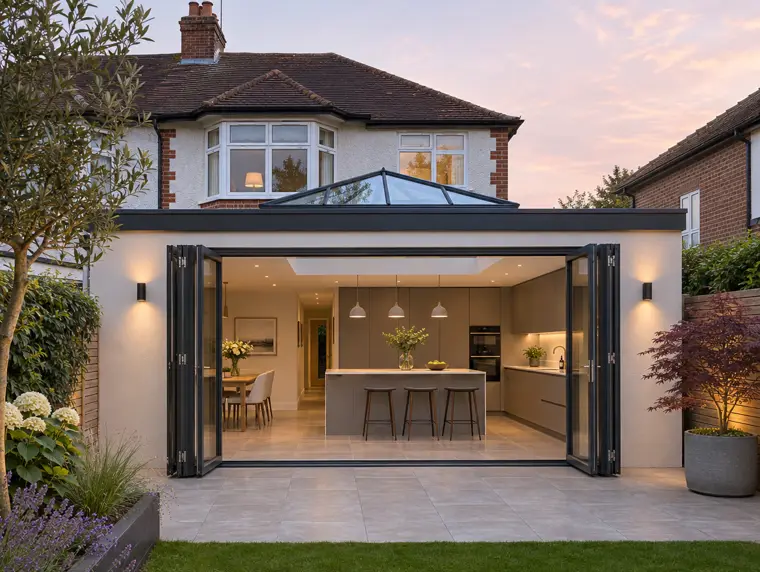
Which flat roof system suits a kitchen extension?
On a plain rectangular extension, EPDM rubber is a strong, quiet choice that can often be laid in one sheet. It handles the slight movement between an extension and the house well.
Where the roof has a lantern, several rooflights or an internal corner, GRP fibreglass forms neat, rigid details around each one. Torch-on felt is a proven layered system and keeps costs down, though near timber cladding or at fragile junctions we may prefer a cold-applied method. If the extension is overlooked from upstairs windows, a sedum green roof is worth considering, provided the structure can take the extra load.
Whatever the membrane, the insulation sits above the deck as a warm roof. Our warm vs cold roof guide explains why.
Why does water pond or leak where the extension meets the house?
Usually because the fall runs the wrong way, the abutment detail has failed, or the roof has sagged close to the wall. The junction with the house is the most common leak point on an extension roof.
If the roof falls towards the house, or the deck dips near the wall, water sits against the upstand and finds any weakness in the flashing above. Older roofs often have the felt simply turned up the brickwork with no cover flashing, or a flashing that has pulled out of its joint. A patch will not change a fall. We re-firr or use tapered insulation so water runs away from the wall, then form a new upstand, usually 150 mm above the finished roof, with a flashing chased into the mortar joint.
Rooflights and lanterns are the other weak point. A lantern needs a properly built kerb with the membrane dressed up and under its frame. We rebuild rooflight upstands within the roof job; we do not supply the lantern itself. Our guide to ponding water explains the causes in more depth.
Which towns in Devon do we cover?
Extension and kitchen roofs in Devon: questions
Which towns in Devon do you cover?
All of Devon. The main towns have their own pages below, and if yours isn't listed we still cover it: send your postcode and we'll confirm.
How much does a new extension roof cost in Devon?
£2,900–£5,050 for a 20 m² extension roof in EPDM with a new deck and insulation, at South West guide rates including VAT. The fixed price comes after a free survey for new and replacement roofs.
Which council handles building control for a flat roof in Devon?
It depends on where the roof is: in Devon that's Plymouth City Council, Exeter City Council, Torbay Council and 5 other councils. Replacing more than half of a roof over a heated room usually counts as renovating a thermal element, so it is insulated to current standards and notified to building control. We confirm which applies at the survey.
How do I know my extension roof needs replacing rather than repairing?
Repeated leaks, a soft deck, wet insulation or widespread cracking point to replacement. A single defect on a dry, sound roof can usually be repaired.
Will a new extension roof sit higher than the old one?
Usually, by the thickness of the added insulation. We check the height against the upstairs window sills, door thresholds and wall flashings at survey so everything still works.
Is EPDM or GRP better for a kitchen extension?
Neither is better in every case. EPDM suits simple rectangular roofs with few details, while GRP is often chosen where there are rooflights, corners or occasional foot traffic.
Everything about extension and kitchen roofs → · All flat roofing in Devon →