Ware at a glance
- Postcode districts
- SG12
- Population
- about 17,576 (GeoNames)
- Council area
- East Hertfordshire District Council
- Building approval
- East Hertfordshire District Council building control, or a registered building control approver
- Nearest main town
- Harlow, about 6 miles
- Guide price region
- East of England (+5% on West Midlands rates)
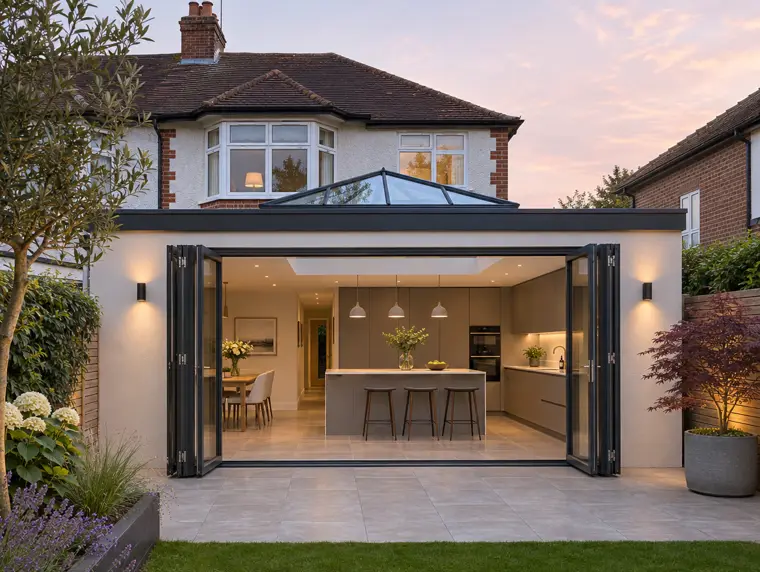
What makes a good extension roof in Ware?
Extension roofs in Ware are often replaced because the original was built cheaply: thin chipboard decks, little or no insulation and felt turned up the wall without a proper flashing. Twenty or thirty years on, those weaknesses show up as leaks at the back wall and a cold, damp ceiling.
In and around Ware, flat roofs are typically found on bungalows with flat-roofed side extensions and dormers, and on 1960s and 1970s link-detached houses with flat-roofed garages and porches. The East of England is the driest part of Britain, with parts of the Anglian region around 630 mm a year, so summer heat and UV, not rainfall, do most of the ageing on a felt roof.
How much does a new extension roof cost in Ware?
For Ware we use East of England rates: £2,950–£5,150 is the guide for a 20 m² extension roof in EPDM with a new deck and insulation, VAT included. The fixed price comes after a free survey for new and replacement roofs.
| Job | Guide price inc VAT |
|---|---|
| Extension (20 m²), EPDM, new deck + insulation | £2,950–£5,150 |
| Extension (20 m²), GRP, new deck + insulation | £3,150–£5,650 |
| Extension (20 m²), EPDM, insulation + 1 rooflight upstand | £3,150–£5,500 |
| Single garage (18 m²), EPDM rubber | £1,700–£2,950 |
Why does water pond or leak where the extension meets the house?
Usually because the fall runs the wrong way, the abutment detail has failed, or the roof has sagged close to the wall. The junction with the house is the most common leak point on an extension roof.
If the roof falls towards the house, or the deck dips near the wall, water sits against the upstand and finds any weakness in the flashing above. Older roofs often have the felt simply turned up the brickwork with no cover flashing, or a flashing that has pulled out of its joint. A patch will not change a fall. We re-firr or use tapered insulation so water runs away from the wall, then form a new upstand, usually 150 mm above the finished roof, with a flashing chased into the mortar joint.
Rooflights and lanterns are the other weak point. A lantern needs a properly built kerb with the membrane dressed up and under its frame. We rebuild rooflight upstands within the roof job; we do not supply the lantern itself. Our guide to ponding water explains the causes in more depth.
What's included?
- Free survey of the roof, abutment and room below
- New abutment upstand and flashing, plus rebuilt rooflight kerbs
- Falls set away from the house wall
- New deck, vapour control layer and warm-roof insulation
Building regulations in England
Replacing more than half of a flat roof over a heated room usually counts as renovating a thermal element, so the roof is insulated to around 0.16 W/m²K where that's technically and economically feasible, and the work is notified to building control: the council or a registered building control approver, unless a registered competent person self-certifies it. A roof on a new extension is built to 0.15 W/m²K. Patch repairs, and most unheated detached garages, don't trigger the upgrade. Structural changes, or a new covering that adds 15% or more to the roof's weight, also need approval. More on the rules.
Which nearby areas do we also cover?
- Hertford · 2 mi
- Hoddesdon · 3 mi
- Harlow · 6 mi
- Cheshunt · 8 mi
- Welwyn Garden City · 8 mi
- Waltham Abbey · 9 mi
Extension and kitchen roofs in Ware: questions
Do you cover Ware?
Yes. Ware is part of our Hertfordshire coverage, including postcode districts SG12. Surveys and roofs are carried out by vetted roofing teams working under S&K Property Investments and Improvement Ltd.
Who checks building regulations for a flat roof in Ware?
Where the work needs approval it goes to East Hertfordshire District Council building control, or a registered building control approver. We tell you at the survey whether your job needs it and deal with the paperwork as part of the quote.
How much does a new extension roof cost in Ware?
£2,950–£5,150 for a 20 m² extension roof in EPDM with a new deck and insulation, at East of England guide rates including VAT. The fixed price comes after a free survey for new and replacement roofs.
Will a new extension roof sit higher than the old one?
Usually, by the thickness of the added insulation. We check the height against the upstairs window sills, door thresholds and wall flashings at survey so everything still works.
Why does my extension ceiling get damp in winter if the roof isn't leaking?
That is often condensation in a cold roof, where warm, moist air reaches the cold underside of the deck. A warm-roof replacement with a vapour control layer usually solves it.