- Guide price
- £2,750–£4,800
- Survey
- Free for new and replacement roofs
- Quote
- Fixed, in writing
- Coverage
- England, Wales, Scotland, NI
Lincolnshire at a glance
- Largest towns
- Lincoln, Grimsby, Scunthorpe, Boston
- Postcode areas
- DN, LN, NG, PE
- Building control
- City of Lincoln Council, North East Lincolnshire Council, North Lincolnshire Council and 6 other councils
- Neighbouring areas
- Nottinghamshire · East Riding of Yorkshire · South Yorkshire · Derbyshire
- Guide price region
- East Midlands (−2% on West Midlands rates)
How much does a new extension roof cost in Lincolnshire?
Guide prices including VAT at East Midlands rates. The fixed price comes after a free survey for new and replacement roofs.
| Job | Guide price inc VAT |
|---|---|
| Extension (20 m²), EPDM, new deck + insulation | £2,750–£4,800 |
| Extension (20 m²), GRP, new deck + insulation | £2,950–£5,300 |
| Extension (20 m²), EPDM, insulation + 1 rooflight upstand | £2,950–£5,150 |
| Single garage (18 m²), EPDM rubber | £1,550–£2,750 |
Which flat roofs are common in Lincolnshire?
Flat roofs in Lincolnshire sit on low-rise post-war blocks of flats, shops with flat-roofed rear stores below flats and terraced streets with flat-roofed rear kitchens and bathrooms. The East Midlands is drier than the west of Britain, so most flat roofs here fail through age, UV and poor detailing at upstands rather than sheer rainfall. Approximate 1991–2020 regional averages based on Met Office data.
Building regulations in England
Replacing more than half of a roof over a heated room usually counts as renovating a thermal element, so it is insulated to current standards and notified to building control. Renovated roofs over heated rooms are insulated to around 0.16 W/m²K where that's feasible, and new extension roofs are built to 0.15 W/m²K. In Lincolnshire the application goes to City of Lincoln Council, North East Lincolnshire Council, North Lincolnshire Council and 6 other councils. More on the rules.
How long will my kitchen be disrupted by a new roof?
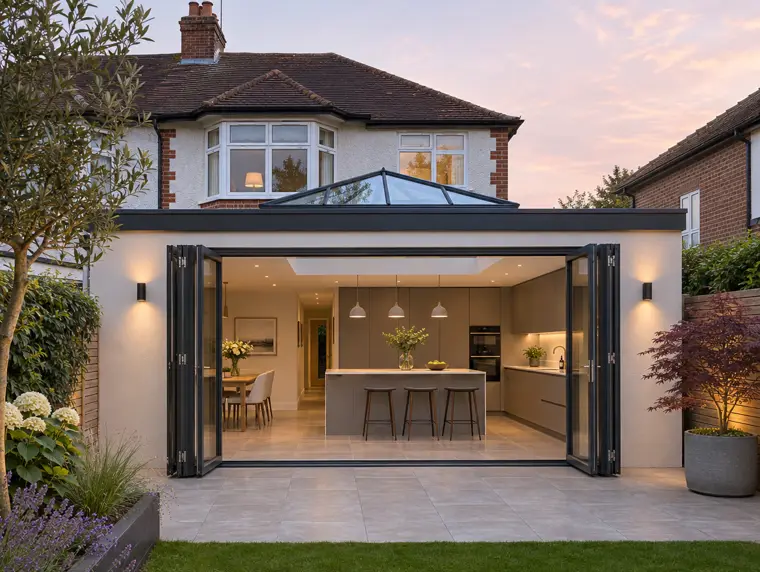
Most single-storey extension roofs are replaced in two to four working days, depending on size, rooflights and weather. The kitchen usually stays in use throughout.
Expect noise during the strip-out, and occasional dust through gaps around old rooflights, so it helps to cover worktops and move anything fragile off high shelves. We strip only what we can make weathertight by the end of each day. If a rooflight or lantern is being lifted and refitted, there may be a temporary cover over the opening for a short time. Resin systems smell while they cure, so keep the windows below the roof closed on that day.
Does an extension roof replacement need building regulations?
Usually, yes. An extension roof over a heated room is a thermal element, so replacing most of it typically brings insulation requirements and an approval route.
In England, renovating more than half of the roof means upgrading it towards 0.16 W/m²K where that is technically, functionally and economically feasible. The approval comes from building control or a competent person scheme. A brand-new extension roof is designed to 0.15. Wales usually requires approval for most re-roofing, with a renovation target of 0.16 and a new-extension target of 0.13. Scotland handles this through building standards and the warrant process, and Northern Ireland through district council building control.
Planning is not normally needed to re-cover an extension roof that looks broadly the same afterwards. Turning the roof into a terrace is another matter. We handle building control where the job needs it; see our building regulations page.
Which towns in Lincolnshire do we cover?
Extension and kitchen roofs in Lincolnshire: questions
Which towns in Lincolnshire do you cover?
All of Lincolnshire. The main towns have their own pages below, and if yours isn't listed we still cover it: send your postcode and we'll confirm.
How much does a new extension roof cost in Lincolnshire?
£2,750–£4,800 for a 20 m² extension roof in EPDM with a new deck and insulation, at East Midlands guide rates including VAT. The fixed price comes after a free survey for new and replacement roofs.
Which council handles building control for a flat roof in Lincolnshire?
It depends on where the roof is: in Lincolnshire that's City of Lincoln Council, North East Lincolnshire Council, North Lincolnshire Council and 6 other councils. Replacing more than half of a roof over a heated room usually counts as renovating a thermal element, so it is insulated to current standards and notified to building control. We confirm which applies at the survey.
Is EPDM or GRP better for a kitchen extension?
Neither is better in every case. EPDM suits simple rectangular roofs with few details, while GRP is often chosen where there are rooflights, corners or occasional foot traffic.
Why does my extension ceiling get damp in winter if the roof isn't leaking?
That is often condensation in a cold roof, where warm, moist air reaches the cold underside of the deck. A warm-roof replacement with a vapour control layer usually solves it.
Can you keep my existing roof lantern?
Often, if the lantern itself is sound. We lift it, rebuild the kerb, dress the new membrane up the upstand and refit the lantern.
Everything about extension and kitchen roofs → · All flat roofing in Lincolnshire →