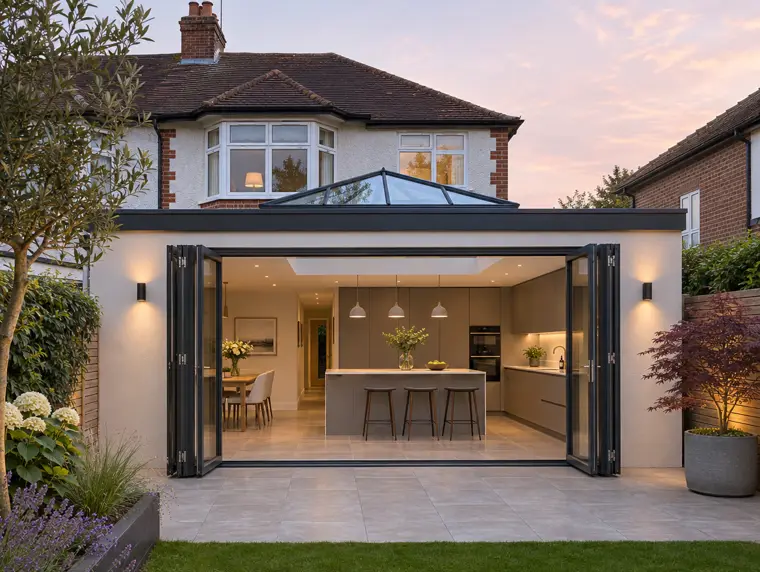
- Guide price
- £2,750–£4,800
- Survey
- Free for new and replacement roofs
- Quote
- Fixed, in writing
- Coverage
- England, Wales, Scotland, NI
Northamptonshire at a glance
- Largest towns
- Northampton, Corby, Kettering, Wellingborough
- Postcode areas
- NN
- Building control
- West Northamptonshire Council and North Northamptonshire Council
- Neighbouring areas
- Leicestershire · Bedfordshire · Warwickshire · Cambridgeshire
- Guide price region
- East Midlands (−2% on West Midlands rates)
How much does a new extension roof cost in Northamptonshire?
Guide prices including VAT at East Midlands rates. The fixed price comes after a free survey for new and replacement roofs.
| Job | Guide price inc VAT |
|---|---|
| Extension (20 m²), EPDM, new deck + insulation | £2,750–£4,800 |
| Extension (20 m²), GRP, new deck + insulation | £2,950–£5,300 |
| Extension (20 m²), EPDM, insulation + 1 rooflight upstand | £2,950–£5,150 |
| Single garage (18 m²), EPDM rubber | £1,550–£2,750 |
Which flat roofs are common in Northamptonshire?
Flat roofs in Northamptonshire sit on newer estates where the first extension roofs are now being replaced, terraced streets with flat-roofed rear kitchens and bathrooms and bungalows with flat-roofed side extensions and dormers. The East Midlands is drier than the west of Britain, so most flat roofs here fail through age, UV and poor detailing at upstands rather than sheer rainfall. Approximate 1991–2020 regional averages based on Met Office data.
Building regulations in England
Replacing more than half of a roof over a heated room usually counts as renovating a thermal element, so it is insulated to current standards and notified to building control. Renovated roofs over heated rooms are insulated to around 0.16 W/m²K where that's feasible, and new extension roofs are built to 0.15 W/m²K. In Northamptonshire the application goes to West Northamptonshire Council and North Northamptonshire Council. More on the rules.
Does an extension roof replacement need building regulations?
Usually, yes. An extension roof over a heated room is a thermal element, so replacing most of it typically brings insulation requirements and an approval route.
In England, renovating more than half of the roof means upgrading it towards 0.16 W/m²K where that is technically, functionally and economically feasible. The approval comes from building control or a competent person scheme. A brand-new extension roof is designed to 0.15. Wales usually requires approval for most re-roofing, with a renovation target of 0.16 and a new-extension target of 0.13. Scotland handles this through building standards and the warrant process, and Northern Ireland through district council building control.
Planning is not normally needed to re-cover an extension roof that looks broadly the same afterwards. Turning the roof into a terrace is another matter. We handle building control where the job needs it; see our building regulations page.
Why does water pond or leak where the extension meets the house?
Usually because the fall runs the wrong way, the abutment detail has failed, or the roof has sagged close to the wall. The junction with the house is the most common leak point on an extension roof.
If the roof falls towards the house, or the deck dips near the wall, water sits against the upstand and finds any weakness in the flashing above. Older roofs often have the felt simply turned up the brickwork with no cover flashing, or a flashing that has pulled out of its joint. A patch will not change a fall. We re-firr or use tapered insulation so water runs away from the wall, then form a new upstand, usually 150 mm above the finished roof, with a flashing chased into the mortar joint.
Rooflights and lanterns are the other weak point. A lantern needs a properly built kerb with the membrane dressed up and under its frame. We rebuild rooflight upstands within the roof job; we do not supply the lantern itself. Our guide to ponding water explains the causes in more depth.
Which towns in Northamptonshire do we cover?
Extension and kitchen roofs in Northamptonshire: questions
Which towns in Northamptonshire do you cover?
All of Northamptonshire. The main towns have their own pages below, and if yours isn't listed we still cover it: send your postcode and we'll confirm.
How much does a new extension roof cost in Northamptonshire?
£2,750–£4,800 for a 20 m² extension roof in EPDM with a new deck and insulation, at East Midlands guide rates including VAT. The fixed price comes after a free survey for new and replacement roofs.
Which postcode areas do you cover in Northamptonshire?
All of Northamptonshire, including the NN postcode areas. Send your full postcode and we'll confirm.
Will a new extension roof sit higher than the old one?
Usually, by the thickness of the added insulation. We check the height against the upstairs window sills, door thresholds and wall flashings at survey so everything still works.
Do I need my neighbour's permission to replace an extension roof?
Not for a like-for-like re-cover in most cases. The Party Wall Act in England and Wales can apply if the work raises or cuts into a shared wall, so we flag that at survey.
Why does my extension ceiling get damp in winter if the roof isn't leaking?
That is often condensation in a cold roof, where warm, moist air reaches the cold underside of the deck. A warm-roof replacement with a vapour control layer usually solves it.
Everything about extension and kitchen roofs → · All flat roofing in Northamptonshire →