- Guide price
- £140–£480
- Repair price
- Confirmed once the leak or damage is found
- Condition survey report
- £140–£290
- Coverage
- England, Wales, Scotland, NI
Argyll and Bute at a glance
- Largest towns
- Helensburgh, Dunoon, Oban
- Postcode areas
- G, PA
- Building standards
- Argyll and Bute Council
- Neighbouring areas
- West Dunbartonshire · East Dunbartonshire · Glasgow City · East Renfrewshire
- Guide price region
- Scotland (−5% on West Midlands rates)
How much does a flat roof repair cost in Argyll and Bute?
Guide prices including VAT at Scotland rates. We confirm the price once we've traced the leak or seen the damage.
| Job | Guide price inc VAT |
|---|---|
| Localised patch repair | £140–£480 |
| Upstand or flashing repair | £240–£620 |
| Outlet or drainage repair | £110–£330 |
| Emergency temporary weatherproofing visit | £170–£430 |
| Condition survey and leak investigation | £140–£290 |
Which flat roofs are common in Argyll and Bute?
Flat roofs in Argyll and Bute sit on terraced streets with flat-roofed rear kitchens and bathrooms, lock-up garage blocks on estates and shops with flat-roofed rear stores below flats. Scotland averages roughly 1,570 mm of rain a year, with the west far wetter than the east, so drainage, falls and wind uplift are part of every specification we write. Approximate 1991–2020 regional averages based on Met Office data.
Building standards in Scotland
In Scotland a building warrant is usually needed for alterations, structural work and new roofs; like-for-like repairs to a covering can be exempt. Section 6 of the technical handbooks sets a domestic roof benchmark of 0.12 W/m²K, applied as far as reasonably practicable on an existing roof. In Argyll and Bute the application goes to Argyll and Bute Council (building standards). More on the rules.
What do you check and do on a repair visit?
We inspect the whole roof, not only the spot that is leaking, and tell you what we have found before any work starts.
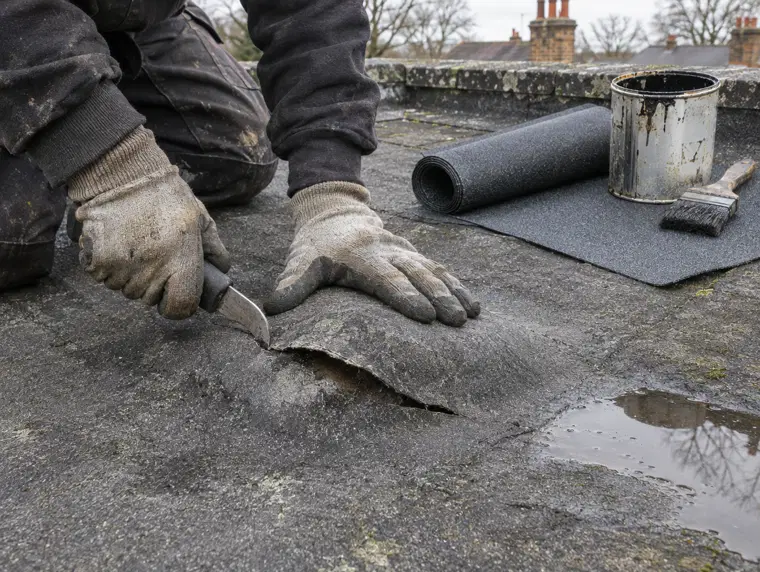
A typical visit covers the covering itself (splits, blisters, crazing, lost chippings and open laps), the upstands and flashings at walls, edge trims and drips, outlets and gutters, any rooflights, and how water sits on the roof after rain. Where it is safe to do so, we check the deck for soft spots. Every roof is treated as fragile until a competent person has confirmed otherwise, and edge protection goes in before anyone works near an open edge.
The repair itself means cutting back to sound material, drying the area and repairing with the same system. We clear the outlets while we are up there, because a blocked outlet is a common reason a repaired roof leaks again. What the repair covers, and what it doesn't, is set out in the written quote.
Which repair materials work with my type of flat roof?
The repair has to use the same system as the roof, because many flat roof materials don't bond to each other and some damage each other.
- Torch-on felt: repaired with compatible bitumen membrane, cut back to sound felt and lapped well beyond the defect. Torching near timber, insulation or fascias needs care, and some details are better done with cold-applied methods.
- EPDM rubber: repaired with EPDM patches and the manufacturer's primer and seam tape. Bitumen products and many general-purpose sealants won't bond to EPDM and shouldn't be used on it.
- GRP fibreglass: the area is ground back, then new resin and glass matting are laid and finished with topcoat to match.
- Liquid-applied and single-ply: repaired with the same manufacturer's products wherever possible, as mixing systems can affect a material guarantee.
- Mastic asphalt: cracks and blisters are cut out and made good with new asphalt by an operative who works with it.
A tin of roof sealant or bitumen paint may stop a drip for a while, but on the wrong membrane it makes a proper repair harder later.
Which towns in Argyll and Bute do we cover?
Flat roof repairs in Argyll and Bute: questions
Which towns in Argyll and Bute do you cover?
All of Argyll and Bute. The main towns have their own pages below, and if yours isn't listed we still cover it: send your postcode and we'll confirm.
How much does a flat roof repair cost in Argyll and Bute?
£140–£480 for a localised patch repair, at Scotland guide rates including VAT. We confirm the price once we've traced the leak or seen the damage.
Which council handles building standards for a flat roof in Argyll and Bute?
It depends on where the roof is: in Argyll and Bute that's Argyll and Bute Council. In Scotland a building warrant is usually needed for alterations, structural work and new roofs; like-for-like repairs to a covering can be exempt. We confirm which applies at the survey.
Who carries out the repair?
Vetted roofing teams working under S&K Property Investments and Improvement Ltd, part of the S&K Group, which is the company you contract with. The price and scope are agreed in writing before work starts.
How long does a flat roof repair take?
Most small repairs take a few hours on site once the roof is dry. Larger upstand or outlet repairs can take a day or more, and setting up scaffold or access equipment adds time.
Can you repair the roof if the ceiling is already damaged?
Yes. The roof is fixed first so the ceiling can dry out, and then a plasterer or decorator can make it good. Any wet insulation within the roof should be checked, as it may need replacing.
Everything about flat roof repairs → · All flat roofing in Argyll and Bute →