Donaghadee at a glance
- Postcode districts
- BT21
- Population
- about 7,369 (GeoNames)
- Council area
- Ards and North Down Borough Council
- Building approval
- Ards and North Down Borough Council building control
- Nearest main town
- Bangor, about 5 miles
- Guide price region
- Northern Ireland (−12% on West Midlands rates)
When is a repair the right answer in Donaghadee?
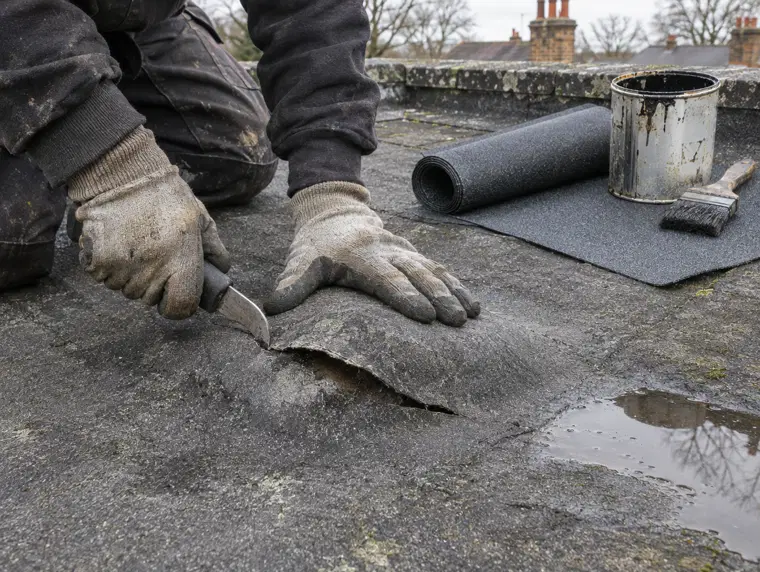
In a place like Donaghadee, flat roofs usually sit over garages, rear extensions, dormers and bays, and they take the full force of the weather with little margin for error. A single failed lap or a cracked upstand is enough to let water into a kitchen, bedroom or hallway below.
In a town like Donaghadee, flat roofs are commonly found on 1930s semis with flat-roofed garages and kitchen extensions or newer estates where the first extension roofs are now being replaced. Northern Ireland averages roughly 1,150 mm of rain a year, spread over many wet days, so a roof that sheds water quickly to clear outlets lasts far longer than one that holds puddles.
How much does a flat roof repair cost in Donaghadee?
Guide price in Donaghadee: £130–£440 for a localised patch repair, including VAT at Northern Ireland rates. We confirm the price once we've traced the leak or seen the damage.
| Job | Guide price inc VAT |
|---|---|
| Localised patch repair | £130–£440 |
| Upstand or flashing repair | £220–£570 |
| Outlet or drainage repair | £110–£310 |
| Emergency temporary weatherproofing visit | £160–£400 |
| Condition survey and leak investigation | £130–£260 |
How long will a flat roof repair last?
A well-made repair on a roof that is otherwise sound should last as long as the covering around it. It can't add years to the rest of the roof, though.
If your felt roof is twenty years old, a perfect patch still leaves twenty-year-old felt around it, and the next weak point will appear in its own time. That is why we give you an honest view of how much life the roof has left, so you can decide whether a repair now and a planned replacement later is better value than replacing straight away.
Simple care helps any repair last. Clearing leaves from outlets and gutters, keeping people off roofs that aren't designed for foot traffic, and looking over upstands and edges after storms all catch small problems before they reach the ceiling. Our maintenance guide lists the checks worth doing each year.
What's included?
- Upstands, flashings, laps and seams made good
- Leak path traced from the stain back to the entry point
- Repairs with materials compatible with your roof system
- Inspection of the whole roof, not just the wet patch
Building control in Northern Ireland
In Northern Ireland, Technical Booklet F1 sets roof insulation at 0.18 W/m²K when a roof over a heated room is renovated or newly built, where that's feasible. The district council's building control should be contacted before work starts, and we prepare the details it asks for. More on the rules.
Which nearby areas do we also cover?
Flat roof repairs in Donaghadee: questions
Do you cover Donaghadee?
Yes. Donaghadee is part of our County Down coverage, including postcode districts BT21. Surveys and roofs are carried out by vetted roofing teams working under S&K Property Investments and Improvement Ltd.
Who checks building regulations for a flat roof in Donaghadee?
Where the work needs approval it goes to Ards and North Down Borough Council building control. We tell you at the survey whether your job needs it and deal with the paperwork as part of the quote.
How much does a flat roof repair cost in Donaghadee?
£130–£440 for a localised patch repair, at Northern Ireland guide rates including VAT. We confirm the price once we've traced the leak or seen the damage.
How long does a flat roof repair take?
Most small repairs take a few hours on site once the roof is dry. Larger upstand or outlet repairs can take a day or more, and setting up scaffold or access equipment adds time.
Why does my flat roof only leak in heavy rain?
Usually because water only reaches a weak point when it builds up: a partly blocked outlet, a low spot where water ponds, or an upstand that is too low for the depth of water. Wind-driven rain against a wall above the roof is another common cause.