- Guide price
- £2,950–£5,150
- Survey
- Free for new and replacement roofs
- Quote
- Fixed, in writing
- Coverage
- England, Wales, Scotland, NI
Suffolk at a glance
- Largest towns
- Ipswich, Lowestoft, Bury St Edmunds, Haverhill
- Postcode areas
- CB, CO, IP, NR
- Building control
- Ipswich Borough Council, East Suffolk Council, West Suffolk Council and 2 other councils
- Neighbouring areas
- Norfolk · Essex · Cambridgeshire · Hertfordshire
- Guide price region
- East of England (+5% on West Midlands rates)
How much does a flat roof replacement cost in Suffolk?
Guide prices including VAT at East of England rates. The fixed price comes after a free survey for new and replacement roofs.
| Job | Guide price inc VAT |
|---|---|
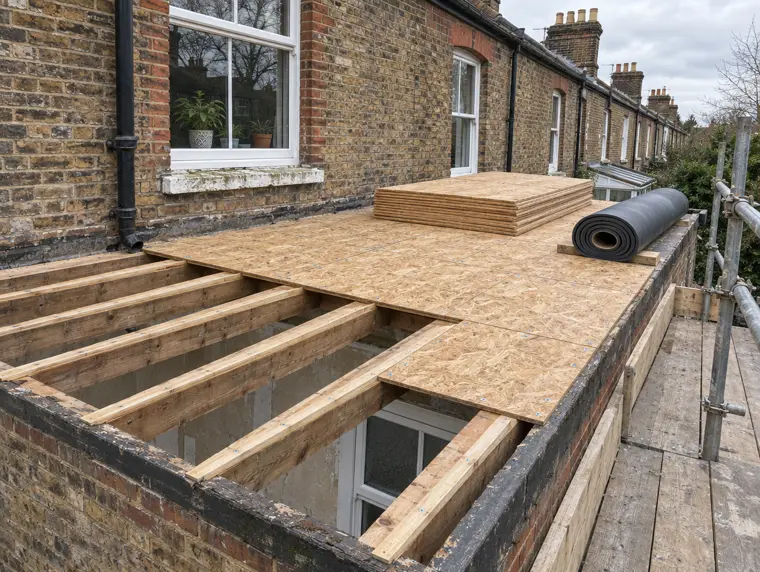
| Extension (20 m²), EPDM, new deck + insulation | £2,950–£5,150 |
| Single garage (18 m²), torch-on felt | £1,600–£2,750 |
| Extension (20 m²), GRP, new deck + insulation | £3,150–£5,650 |
| Single garage (18 m²), EPDM rubber | £1,700–£2,950 |
Which flat roofs are common in Suffolk?
Flat roofs in Suffolk sit on 1960s and 1970s link-detached houses with flat-roofed garages and porches, bungalows with flat-roofed side extensions and dormers and terraced streets with flat-roofed rear kitchens and bathrooms. The East of England is the driest part of Britain, with parts of the Anglian region around 630 mm a year, so summer heat and UV, not rainfall, do most of the ageing on a felt roof. Approximate 1991–2020 regional averages based on Met Office data.
Building regulations in England
Replacing more than half of a roof over a heated room usually counts as renovating a thermal element, so it is insulated to current standards and notified to building control. Renovated roofs over heated rooms are insulated to around 0.16 W/m²K where that's feasible, and new extension roofs are built to 0.15 W/m²K. In Suffolk the application goes to Ipswich Borough Council, East Suffolk Council, West Suffolk Council and 2 other councils. More on the rules.
Do I need building regulations approval to replace a flat roof?
Often, yes. Replacing the covering of a flat roof over a heated room is usually treated as renovating a thermal element, which brings insulation requirements and, in most cases, approval.
In England, if more than half of that roof is renovated, the whole roof should be upgraded towards a U-value of 0.16 W/m²K for homes (0.18 for non-domestic buildings) where that is technically, functionally and economically feasible, judged against a simple payback of 15 years. Approval comes from building control or self-certification through a registered competent person scheme. Structural changes, or a covering that adds 15% or more to the roof's weight, also need approval.
The other nations differ: most re-roofing in Wales needs approval, Scotland works through building standards and the building warrant, and in Northern Ireland you contact the district council's building control first. An unheated detached garage is not normally a thermal element. Planning permission is not usually needed if the roof looks much the same afterwards, though listed buildings and conservation areas are different. We handle approvals where needed; see building regulations.
Which system should I replace my flat roof with?
The right system depends on the roof's size, shape, use and number of details, so no single material suits every roof. These are the usual starting points:
- EPDM rubber suits simple, rectangular roofs, where one sheet can often cover the area with few or no joins.
- GRP fibreglass suits roofs with many corners, rooflights or edges, and gives a rigid surface for occasional maintenance traffic.
- Torch-on felt is a layered, hard-wearing system that keeps the cost down on larger or plain roofs.
- Liquid-applied systems handle awkward details and can overlay a sound existing surface.
- Single-ply and mastic asphalt are more usual on commercial roofs, blocks and terraces.
We recommend a system at survey and explain why. Our EPDM vs GRP vs felt guide sets out the trade-offs if you want to compare first.
Which towns in Suffolk do we cover?
Flat roof replacement in Suffolk: questions
Which towns in Suffolk do you cover?
All of Suffolk. The main towns have their own pages below, and if yours isn't listed we still cover it: send your postcode and we'll confirm.
How much does a flat roof replacement cost in Suffolk?
£2,950–£5,150 for a 20 m² extension roof in EPDM with a new deck and insulation, at East of England guide rates including VAT. The fixed price comes after a free survey for new and replacement roofs.
Which postcode areas do you cover in Suffolk?
All of Suffolk, including the CB, CO, IP, NR postcode areas. Send your full postcode and we'll confirm.
What time of year is best for a flat roof replacement?
Late spring to early autumn gives the most reliable dry spells, but a roof can be replaced in any season when the forecast allows. Adhesives and resins have minimum application temperatures, so winter work is planned around mild, dry days.
What guarantees come with a replacement roof?
Every re-roof comes with a written workmanship guarantee, with the length set out in your quote. Manufacturer material guarantees are available on many systems and we register them for you where the system allows; ask about insurance-backed options too.
Can you replace just part of a flat roof?
Sometimes, if the rest is sound and dry. Renovating more than half of a roof over a heated room usually brings the whole roof under the insulation rules, so a full replacement can make more sense.
Everything about flat roof replacement → · All flat roofing in Suffolk →