- Guide price
- £150–£290
- Repair price
- Confirmed once the leak or damage is found
- Condition survey report
- £150–£290
- Coverage
- England, Wales, Scotland, NI
Derbyshire at a glance
- Largest towns
- Derby, Chesterfield, Long Eaton, Ilkeston
- Postcode areas
- DE, NG, S, SK
- Building control
- Derby City Council, Chesterfield Borough Council, Erewash Borough Council and 4 other councils
- Neighbouring areas
- Nottinghamshire · Staffordshire · South Yorkshire · Leicestershire
- Guide price region
- East Midlands (−2% on West Midlands rates)
How much does a flat roof survey cost in Derbyshire?
Guide prices including VAT at East Midlands rates. We confirm the price once we've traced the leak or seen the damage.
| Job | Guide price inc VAT |
|---|---|
| Condition survey and leak investigation | £150–£290 |
| Localised patch repair | £150–£490 |
| Upstand or flashing repair | £250–£640 |
| Emergency temporary weatherproofing visit | £180–£440 |
Which flat roofs are common in Derbyshire?
Flat roofs in Derbyshire sit on terraced streets with flat-roofed rear kitchens and bathrooms, newer estates where the first extension roofs are now being replaced and lock-up garage blocks on estates. The East Midlands is drier than the west of Britain, so most flat roofs here fail through age, UV and poor detailing at upstands rather than sheer rainfall. Approximate 1991–2020 regional averages based on Met Office data.
Building regulations in England
Replacing more than half of a roof over a heated room usually counts as renovating a thermal element, so it is insulated to current standards and notified to building control. Renovated roofs over heated rooms are insulated to around 0.16 W/m²K where that's feasible, and new extension roofs are built to 0.15 W/m²K. In Derbyshire the application goes to Derby City Council, Chesterfield Borough Council, Erewash Borough Council and 4 other councils. More on the rules.
What does a flat roof survey report cover?
The report sets out what the roof is, what condition it is in and what we recommend, in plain language.
- The roof system, approximate area and how the roof is built, as far as can be seen.
- The condition of the covering: splits, blisters, crazing, lost chippings, open laps and wear.
- Upstands, flashings, edge trims and rooflights.
- Falls, ponding and the state of outlets and gutters.
- Moisture readings and the findings of any core samples.
- The likely cause of any leak, and how confident we are in it.
- Recommended action, ranked by urgency, with guide costs.
We are clear about what we could and couldn't see. A survey can't inspect hidden timbers without opening them up, and we will say where a finding is an inference rather than a direct observation.
How do you find where a flat roof is leaking?
By working from the evidence inside back to the likely entry points outside, then confirming the path with moisture readings and, where needed, small test openings.
We start indoors, looking at where the staining is, when it appears and whether it follows rain, wind from one direction or cold weather. Then, on the roof, we check the details where most leaks start: upstands and flashings, laps and seams, outlets, gutters, edge trims, rooflight kerbs and anything that passes through the covering. Walls, copings and cavity trays above the roof are checked too, because water getting in behind an upstand can look like a roof leak.
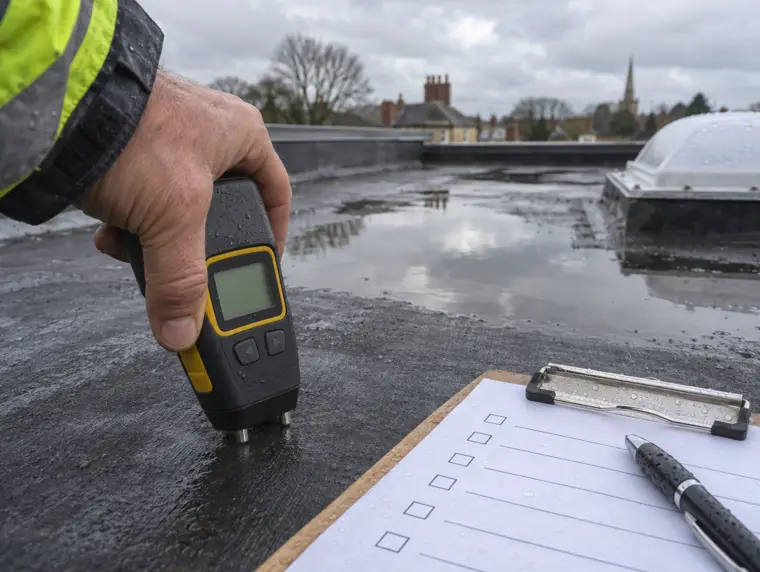
A moisture meter shows where the covering, or the material beneath it, is holding water, and readings across the roof help map how far the wet has spread. Meter readings are a guide, not proof, so where they suggest a problem we may take a core sample: a small cut through the covering and insulation to see what is underneath and whether the deck is sound. The opening is sealed again with compatible material before we leave.
Condensation can also look like a leak, especially in older cold roofs without adequate ventilation, and the survey considers that possibility too. The flat roof leaks guide explains the common causes.
Which towns in Derbyshire do we cover?
- Derby
- Chesterfield
- Long Eaton
- Ilkeston
- Swadlincote
- Staveley
- Belper
- Heanor
- Alfreton
- Dronfield
- Ripley
- Buxton
- New Mills
- Glossop
- Sinfin
Flat roof surveys and leak tracing in Derbyshire: questions
Which towns in Derbyshire do you cover?
All of Derbyshire. The main towns have their own pages below, and if yours isn't listed we still cover it: send your postcode and we'll confirm.
How much does a flat roof survey cost in Derbyshire?
£150–£290 for a condition survey and leak investigation, at East Midlands guide rates including VAT. We confirm the price once we've traced the leak or seen the damage.
Which postcode areas do you cover in Derbyshire?
All of Derbyshire, including the DE, NG, S, SK postcode areas. Send your full postcode and we'll confirm.
Is a core sample damaging to the roof?
It's a small, deliberate opening that is sealed again with compatible material before we leave. It shouldn't affect how the roof performs.
Do I need a roof survey when buying a house with a flat roof?
It's worth considering if the general survey flags damp, ponding or an ageing covering, or if the roof is large. A specific flat roof report gives you a clearer idea of what work may be needed and what it might cost.
Does a moisture meter work on every flat roof?
Not equally well. Readings vary with the material, and some coverings, foils and metal layers can affect them, which is why we treat readings as a guide and confirm doubtful areas with a core.
Everything about flat roof surveys and leak tracing → · All flat roofing in Derbyshire →