Kilmarnock at a glance
- Postcode districts
- KA1, KA3
- Population
- about 46,970 (GeoNames)
- Council area
- East Ayrshire Council
- Building approval
- East Ayrshire Council building standards
- Nearest main town
- Paisley, about 15 miles
- Guide price region
- Scotland (−5% on West Midlands rates)
When is a flat roof survey worth it in Kilmarnock?
Older extensions and garages in Kilmarnock frequently have felt roofs that have been patched several times. Before paying for another repair, many owners want to know whether the roof has much life left. That is exactly the question a condition survey answers.
Kilmarnock's flat roofs are mostly on lock-up garage blocks on estates, with plenty on 1930s semis with flat-roofed garages and kitchen extensions too. Scotland averages roughly 1,570 mm of rain a year, with the west far wetter than the east, so drainage, falls and wind uplift are part of every specification we write.
How much does a flat roof survey cost in Kilmarnock?
For Kilmarnock we use Scotland rates: £140–£290 is the guide for a condition survey and leak investigation, VAT included. We confirm the price once we've traced the leak or seen the damage.
| Job | Guide price inc VAT |
|---|---|
| Condition survey and leak investigation | £140–£290 |
| Localised patch repair | £140–£480 |
| Upstand or flashing repair | £240–£620 |
| Emergency temporary weatherproofing visit | £170–£430 |
What does a flat roof survey report cover?
The report sets out what the roof is, what condition it is in and what we recommend, in plain language.
- The roof system, approximate area and how the roof is built, as far as can be seen.
- The condition of the covering: splits, blisters, crazing, lost chippings, open laps and wear.
- Upstands, flashings, edge trims and rooflights.
- Falls, ponding and the state of outlets and gutters.
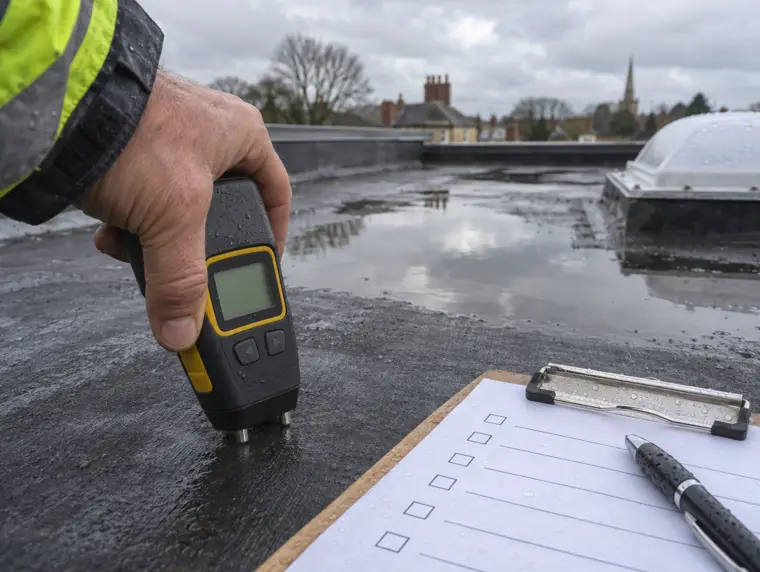
- Moisture readings and the findings of any core samples.
- The likely cause of any leak, and how confident we are in it.
- Recommended action, ranked by urgency, with guide costs.
We are clear about what we could and couldn't see. A survey can't inspect hidden timbers without opening them up, and we will say where a finding is an inference rather than a direct observation.
What's included?
- Inspection of the covering, upstands, edges and outlets
- Plain written report with ranked recommendations
- Free quote if replacement is the right answer
- Moisture meter readings across the roof
Building standards in Scotland
In Scotland the building standards technical handbooks (Section 6 for energy) apply, and the council's building standards service decides whether a building warrant is needed. Like-for-like repairs to a roof covering can be exempt; alterations, structural work and new roofs usually need a warrant before work starts. The domestic roof benchmark is 0.12 W/m²K, applied as far as reasonably practicable on an existing roof. More on the rules.
Which nearby areas do we also cover?
Flat roof surveys and leak tracing in Kilmarnock: questions
Do you cover Kilmarnock?
Yes. Kilmarnock is part of our East Ayrshire coverage, including postcode districts KA1, KA3. Surveys and roofs are carried out by vetted roofing teams working under S&K Property Investments and Improvement Ltd.
Who checks building standards for a flat roof in Kilmarnock?
Where the work needs approval it goes to East Ayrshire Council building standards. We tell you at the survey whether your job needs it and deal with the paperwork as part of the quote.
How much does a flat roof survey cost in Kilmarnock?
£140–£290 for a condition survey and leak investigation, at Scotland guide rates including VAT. We confirm the price once we've traced the leak or seen the damage.
Can you trace a flat roof leak without opening the roof up?
Often, yes. Careful inspection and moisture readings can usually locate the problem area. Where they can't, a small core sample is the most reliable way to confirm what is happening under the covering.
Can a survey tell me if my flat roof has condensation rather than a leak?
It can often point to it. Damp that appears in cold weather without rain, a cold roof build-up with little ventilation and a dry covering above the damp all suggest condensation rather than a leak.