Leatherhead at a glance
- Postcode districts
- KT21, KT22
- Population
- about 43,544 (GeoNames)
- Council area
- Mole Valley District Council
- Building approval
- Mole Valley District Council building control, or a registered building control approver
- Nearest main town
- Woking, about 10 miles
- Guide price region
- South East (+10% on West Midlands rates)
When is a flat roof survey worth it in Leatherhead?
Businesses in Leatherhead with a flat-roofed building can't plan maintenance around guesswork. A survey sets out what needs doing now, what can wait and roughly what each item will cost, so the work can be scheduled with as little disruption as possible.
Around Leatherhead, flat roofs are common on newer estates where the first extension roofs are now being replaced and on 1930s semis with flat-roofed garages and kitchen extensions. Much of the South East sits in the drier Thames catchment at roughly 730 mm of rain a year, so the usual failures are at joints, upstands and outlets rather than from sheer volume of rain.
How much does a flat roof survey cost in Leatherhead?
For Leatherhead we use South East rates: £170–£330 is the guide for a condition survey and leak investigation, VAT included. We confirm the price once we've traced the leak or seen the damage.
| Job | Guide price inc VAT |
|---|---|
| Condition survey and leak investigation | £170–£330 |
| Localised patch repair | £170–£550 |
| Upstand or flashing repair | £280–£720 |
| Emergency temporary weatherproofing visit | £200–£500 |
How do you find where a flat roof is leaking?
By working from the evidence inside back to the likely entry points outside, then confirming the path with moisture readings and, where needed, small test openings.
We start indoors, looking at where the staining is, when it appears and whether it follows rain, wind from one direction or cold weather. Then, on the roof, we check the details where most leaks start: upstands and flashings, laps and seams, outlets, gutters, edge trims, rooflight kerbs and anything that passes through the covering. Walls, copings and cavity trays above the roof are checked too, because water getting in behind an upstand can look like a roof leak.
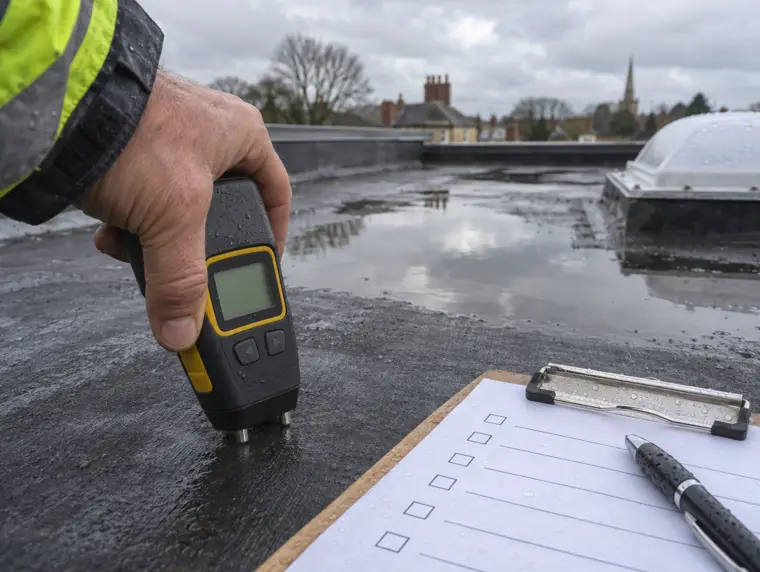
A moisture meter shows where the covering, or the material beneath it, is holding water, and readings across the roof help map how far the wet has spread. Meter readings are a guide, not proof, so where they suggest a problem we may take a core sample: a small cut through the covering and insulation to see what is underneath and whether the deck is sound. The opening is sealed again with compatible material before we leave.
Condensation can also look like a leak, especially in older cold roofs without adequate ventilation, and the survey considers that possibility too. The flat roof leaks guide explains the common causes.
What's included?
- Core samples where readings need confirming
- Checks on walls, copings and trays above the roof
- Inspection of the covering, upstands, edges and outlets
- Moisture meter readings across the roof
Building regulations in England
Replacing more than half of a flat roof over a heated room usually counts as renovating a thermal element, so the roof is insulated to around 0.16 W/m²K where that's technically and economically feasible, and the work is notified to building control: the council or a registered building control approver, unless a registered competent person self-certifies it. A roof on a new extension is built to 0.15 W/m²K. Patch repairs, and most unheated detached garages, don't trigger the upgrade. Structural changes, or a new covering that adds 15% or more to the roof's weight, also need approval. More on the rules.
Which nearby areas do we also cover?
Flat roof surveys and leak tracing in Leatherhead: questions
Do you cover Leatherhead?
Yes. Leatherhead is part of our Surrey coverage, including postcode districts KT21, KT22. Surveys and roofs are carried out by vetted roofing teams working under S&K Property Investments and Improvement Ltd.
Who checks building regulations for a flat roof in Leatherhead?
Where the work needs approval it goes to Mole Valley District Council building control, or a registered building control approver. We tell you at the survey whether your job needs it and deal with the paperwork as part of the quote.
How much does a flat roof survey cost in Leatherhead?
£170–£330 for a condition survey and leak investigation, at South East guide rates including VAT. We confirm the price once we've traced the leak or seen the damage.
Do you survey commercial and block roofs?
Yes. We survey flat roofs on shops, offices, units, blocks of flats and HMOs, with the report structured so a landlord, managing agent or owner can plan and budget the work.
Is a core sample damaging to the roof?
It's a small, deliberate opening that is sealed again with compatible material before we leave. It shouldn't affect how the roof performs.