- Guide price
- £16,000–£28,000
- Survey
- Free for new and replacement roofs
- Quote
- Fixed, in writing
- Coverage
- England, Wales, Scotland, NI
Cornwall at a glance
How much does a block or HMO roof cost in Cornwall?
Guide prices including VAT at South West rates. The fixed price comes after a free survey for new and replacement roofs.
| Job | Guide price inc VAT |
|---|---|
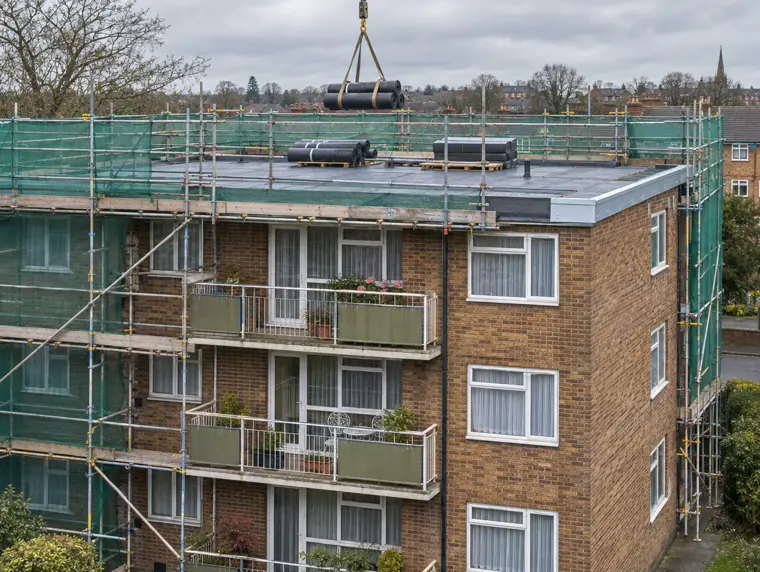
| Block of flats (150 m²), felt + insulation + scaffold | £16,000–£28,000 |
| Commercial roof (100 m²), single-ply + insulation | £13,650–£22,450 |
Which flat roofs are common in Cornwall?
Flat roofs in Cornwall sit on bungalows with flat-roofed side extensions and dormers, newer estates where the first extension roofs are now being replaced and shops with flat-roofed rear stores below flats. The South West averages roughly 1,260 mm of rain a year and many roofs face wind off the Atlantic, so we specify fixings and edge details for wind uplift as well as drainage. Approximate 1991–2020 regional averages based on Met Office data.
Building regulations in England
Replacing more than half of a roof over a heated room usually counts as renovating a thermal element, so it is insulated to current standards and notified to building control. Renovated roofs over heated rooms are insulated to around 0.16 W/m²K where that's feasible, and new extension roofs are built to 0.15 W/m²K. In Cornwall the application goes to Cornwall Council. More on the rules.
Which roofing systems last longest on a block of flats?
Mastic asphalt, EPDM, single-ply and high-performance built-up felt all give long service lives on block roofs; the right choice depends on the deck, how the roof is used, the details and the whole-life cost.
- Mastic asphalt: 30–60 years with maintenance, common on concrete-decked blocks and walkways. See mastic asphalt roofing.
- EPDM: 25–50 years, laid in large sheets with few joins.
- Single-ply: 25–35+ years, quick to lay on larger roofs, with welded laps. See single-ply roofing.
- Built-up felt: 15–25 years for modern torch-on systems and longer for high-performance systems, robust where maintenance teams walk the roof.
- Liquid-applied: 10–25+ years by product, useful as an overlay on a sound roof with complex details.
The cheapest roof today is not always the cheapest over the life of the building. A longer-life system, with tapered insulation to cure ponding, can mean fewer reactive repairs and fewer rounds of consultation. These lives are indicative and assume good specification and regular maintenance.
How do you manage access and residents during the work?
We agree an access and communication plan with the agent or freeholder before the scaffold goes up, so residents know what is happening and when.
That usually covers notices in the common parts and letters to each flat, scaffold and skip positions, keeping entrances, escape routes and bin stores clear, working hours, securing the scaffold out of hours, and a named contact for questions. If we need to look at a ceiling inside a top-floor flat, we arrange access through the agent or landlord.
Occupied blocks are re-roofed in phases, with each section watertight before the team leaves site, which also lets a larger roof be spread over more than one service charge year. Hot works near windows, vents and escape routes are tightly controlled, or avoided altogether with cold-applied systems.
Which towns in Cornwall do we cover?
Flats, HMOs and block roofs in Cornwall: questions
Which towns in Cornwall do you cover?
All of Cornwall. The main towns have their own pages below, and if yours isn't listed we still cover it: send your postcode and we'll confirm.
How much does a block or HMO roof cost in Cornwall?
£16,000–£28,000 for a 150 m² block-of-flats roof in felt with insulation and scaffold, at South West guide rates including VAT. The fixed price comes after a free survey for new and replacement roofs.
Which postcode areas do you cover in Cornwall?
All of Cornwall, including the PL, TR postcode areas. Send your full postcode and we'll confirm.
Do you work for HMO landlords?
Yes. We replace and repair flat roofs on HMOs and converted flats, arrange access with tenants through the landlord or agent, and keep escape routes and entrances clear while we work.
Do residents need to move out during a re-roof?
No. Block roofs are normally replaced with residents in place, and if we need to check a ceiling inside a top-floor flat, access is arranged through the agent or landlord.
What if a top-floor flat is leaking before the roof is replaced?
We can attend for emergency temporary weatherproofing as soon as a team is available, guide £190–£460. That protects the flat while the permanent work is agreed.
Everything about flats, HMOs and block roofs → · All flat roofing in Cornwall →