- Guide price
- £17,100–£29,900
- Survey
- Free for new and replacement roofs
- Quote
- Fixed, in writing
- Coverage
- England, Wales, Scotland, NI
West Sussex at a glance
- Largest towns
- Crawley, Worthing, Bognor Regis, Littlehampton
- Postcode areas
- BN, PO, RH
- Building control
- Crawley Borough Council, Worthing Borough Council, Arun District Council and 4 other councils
- Neighbouring areas
- East Sussex · Surrey · Hampshire · London
- Guide price region
- South East (+10% on West Midlands rates)
How much does a block or HMO roof cost in West Sussex?
Guide prices including VAT at South East rates. The fixed price comes after a free survey for new and replacement roofs.
| Job | Guide price inc VAT |
|---|---|
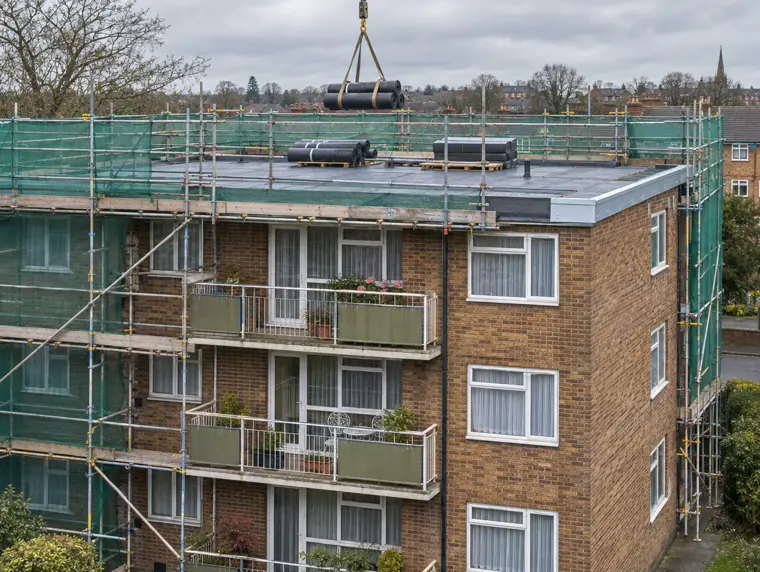
| Block of flats (150 m²), felt + insulation + scaffold | £17,100–£29,900 |
| Commercial roof (100 m²), single-ply + insulation | £14,550–£23,950 |
Which flat roofs are common in West Sussex?
Flat roofs in West Sussex sit on 1930s semis with flat-roofed garages and kitchen extensions, 1960s and 1970s link-detached houses with flat-roofed garages and porches and bungalows with flat-roofed side extensions and dormers. Much of the South East sits in the drier Thames catchment at roughly 730 mm of rain a year, so the usual failures are at joints, upstands and outlets rather than from sheer volume of rain. Approximate 1991–2020 regional averages based on Met Office data.
Building regulations in England
Replacing more than half of a roof over a heated room usually counts as renovating a thermal element, so it is insulated to current standards and notified to building control. Renovated roofs over heated rooms are insulated to around 0.16 W/m²K where that's feasible, and new extension roofs are built to 0.15 W/m²K. In West Sussex the application goes to Crawley Borough Council, Worthing Borough Council, Arun District Council and 4 other councils. More on the rules.
How does Section 20 consultation affect roof works?
In England and Wales, if leaseholders pay for roof works through the service charge and any one leaseholder's share will be over the statutory threshold, the freeholder or managing agent must consult them under Section 20 of the Landlord and Tenant Act 1985 before the work is contracted.
The consultation is run by the freeholder or agent, not by us. It usually involves a notice of intention and then estimates shared with leaseholders, each stage with time for comments, and missing a step can limit what can be recovered through the service charge. Take advice from your agent or a specialist adviser if you are unsure; we don't give legal advice.
What we provide is an itemised written quote that is easy to share and compare: system and build-up, roof area, scaffold and access, insulation, outlets, upstands and trims, waste disposal, provisional sums for hidden defects such as deck repairs, and VAT shown clearly. We can price more than one system on the same scope, so leaseholders are comparing like with like.
Which roofing systems last longest on a block of flats?
Mastic asphalt, EPDM, single-ply and high-performance built-up felt all give long service lives on block roofs; the right choice depends on the deck, how the roof is used, the details and the whole-life cost.
- Mastic asphalt: 30–60 years with maintenance, common on concrete-decked blocks and walkways. See mastic asphalt roofing.
- EPDM: 25–50 years, laid in large sheets with few joins.
- Single-ply: 25–35+ years, quick to lay on larger roofs, with welded laps. See single-ply roofing.
- Built-up felt: 15–25 years for modern torch-on systems and longer for high-performance systems, robust where maintenance teams walk the roof.
- Liquid-applied: 10–25+ years by product, useful as an overlay on a sound roof with complex details.
The cheapest roof today is not always the cheapest over the life of the building. A longer-life system, with tapered insulation to cure ponding, can mean fewer reactive repairs and fewer rounds of consultation. These lives are indicative and assume good specification and regular maintenance.
Which towns in West Sussex do we cover?
- Crawley
- Worthing
- Bognor Regis
- Littlehampton
- Horsham
- Haywards Heath
- Chichester
- Burgess Hill
- East Grinstead
- Shoreham-by-Sea
- Lancing
Flats, HMOs and block roofs in West Sussex: questions
Which towns in West Sussex do you cover?
All of West Sussex. The main towns have their own pages below, and if yours isn't listed we still cover it: send your postcode and we'll confirm.
How much does a block or HMO roof cost in West Sussex?
£17,100–£29,900 for a 150 m² block-of-flats roof in felt with insulation and scaffold, at South East guide rates including VAT. The fixed price comes after a free survey for new and replacement roofs.
Which postcode areas do you cover in West Sussex?
All of West Sussex, including the BN, PO, RH postcode areas. Send your full postcode and we'll confirm.
Do residents need to move out during a re-roof?
No. Block roofs are normally replaced with residents in place, and if we need to check a ceiling inside a top-floor flat, access is arranged through the agent or landlord.
Can you quote for more than one roofing system?
Yes. We can price two or more systems on the same scope, for example built-up felt and single-ply, so leaseholders and the freeholder can compare cost against expected service life.
Can a block roof be replaced in phases?
Yes. Larger roofs can be split into sections over one or more budget years, with each phase priced separately and each section left watertight before the team leaves site.
Everything about flats, HMOs and block roofs → · All flat roofing in West Sussex →