Ashton in Makerfield at a glance
- Postcode districts
- WN4
- Population
- about 26,380 (GeoNames)
- Council area
- Wigan Council
- Building approval
- Wigan Council building control, or a registered building control approver
- Nearest main town
- St Helens, about 4 miles
- Guide price region
- North West (−5% on West Midlands rates)
Why choose a green roof in Ashton in Makerfield?
Homeowners in Ashton in Makerfield building a new extension may find a green roof can help with a planning application, as some councils encourage them for biodiversity and slower rainwater run-off. It is worth raising early with your designer, before the roof structure is drawn up, so the joists can be sized for the extra weight.
Ashton in Makerfield's flat roofs are mostly on low-rise post-war blocks of flats, with plenty on bungalows with flat-roofed side extensions and dormers too. The North West is one of England's wetter regions, averaging roughly 1,290 mm of rain a year, so falls, outlets and well-detailed upstands matter more than the membrane colour.
How much does a green roof cost in Ashton in Makerfield?
Guide price in Ashton in Makerfield: £4,200–£7,700 for a 20 m² insulated extension roof finished as a sedum green roof, including VAT at North West rates. The fixed price comes after a free survey for new and replacement roofs.
| Job | Guide price inc VAT |
|---|---|
| Extension (20 m²), EPDM with sedum green roof | £4,200–£7,700 |
| Extension (20 m²), EPDM, new deck + insulation | £2,650–£4,650 |
How is a green roof built on top of a flat roof?
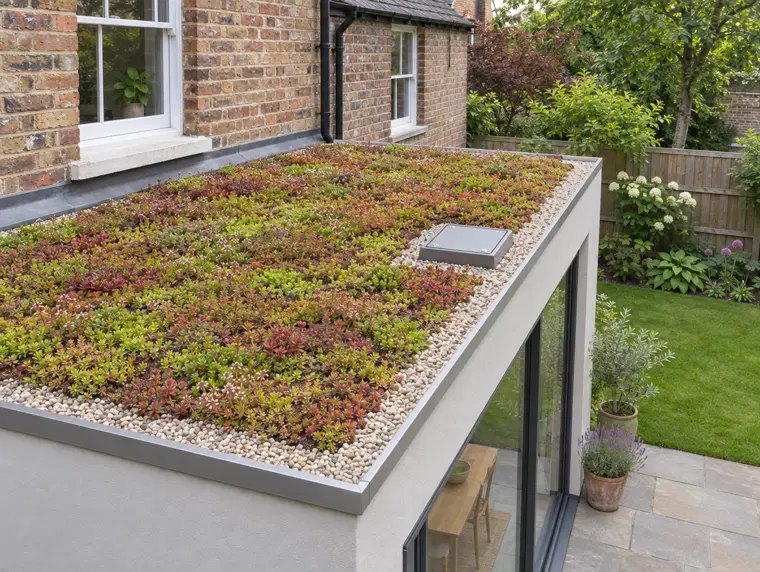
From the bottom up, a green roof is a deck, a waterproofing system with root protection, then drainage, filter, growing medium and plants. The waterproofing does the job of keeping water out. The green layers sit above it.
- Warm roof build-up: vapour control layer, insulation and waterproof membrane on the deck, then the green layers on top. This is the usual choice on a home extension being re-roofed.
- Inverted build-up: waterproofing on the deck, then insulation boards designed to sit above it, then the green layers. This is common on terraces and some commercial roofs.
- Root barrier: roots will exploit any weakness, so the membrane needs to be root-resistant. Some membranes are tested as root-resistant; others need a separate root barrier laid on top.
- Drainage and edges: a drainage layer carries surplus water to outlets, and a gravel or pebble strip is usually left around edges, outlets, upstands and rooflights to keep them clear and accessible.
Upstands still need to rise around 150 mm above the finished surface, which on a green roof means above the top of the growing medium. We check that at the survey, alongside the external fire performance of the build-up where the roof is close to a boundary.
What's included?
- Drainage layer, filter and lightweight growing medium
- Root-resistant membrane or separate root barrier
- Gravel strips kept clear around edges and outlets
- Pre-grown sedum blankets laid and watered in
Building regulations in England
Replacing more than half of a flat roof over a heated room usually counts as renovating a thermal element, so the roof is insulated to around 0.16 W/m²K where that's technically and economically feasible, and the work is notified to building control: the council or a registered building control approver, unless a registered competent person self-certifies it. A roof on a new extension is built to 0.15 W/m²K. Patch repairs, and most unheated detached garages, don't trigger the upgrade. Structural changes, or a new covering that adds 15% or more to the roof's weight, also need approval. More on the rules.
Which nearby areas do we also cover?
Green and sedum roofs in Ashton in Makerfield: questions
Do you cover Ashton in Makerfield?
Yes. Ashton in Makerfield is part of our Greater Manchester coverage, including postcode districts WN4. Surveys and roofs are carried out by vetted roofing teams working under S&K Property Investments and Improvement Ltd.
Who checks building regulations for a flat roof in Ashton in Makerfield?
Where the work needs approval it goes to Wigan Council building control, or a registered building control approver. We tell you at the survey whether your job needs it and deal with the paperwork as part of the quote.
How much does a green roof cost in Ashton in Makerfield?
£4,200–£7,700 for a 20 m² insulated extension roof finished as a sedum green roof, at North West guide rates including VAT. The fixed price comes after a free survey for new and replacement roofs.
Do I need to water a sedum roof?
Usually only in the first season, during long dry spells, while the blankets establish. After that, sedum copes with dry weather well.
Can a green roof have a rooflight in it?
Yes. The rooflight sits on a raised upstand with a gravel strip around it, so the planting stays clear of the glazing and the upstand stays visible and dry.