- Guide price
- £4,300–£7,900
- Survey
- Free for new and replacement roofs
- Quote
- Fixed, in writing
- Coverage
- England, Wales, Scotland, NI
Lincolnshire at a glance
- Largest towns
- Lincoln, Grimsby, Scunthorpe, Boston
- Postcode areas
- DN, LN, NG, PE
- Building control
- City of Lincoln Council, North East Lincolnshire Council, North Lincolnshire Council and 6 other councils
- Neighbouring areas
- Nottinghamshire · East Riding of Yorkshire · South Yorkshire · Derbyshire
- Guide price region
- East Midlands (−2% on West Midlands rates)
How much does a green roof cost in Lincolnshire?
Guide prices including VAT at East Midlands rates. The fixed price comes after a free survey for new and replacement roofs.
| Job | Guide price inc VAT |
|---|---|
| Extension (20 m²), EPDM with sedum green roof | £4,300–£7,900 |
| Extension (20 m²), EPDM, new deck + insulation | £2,750–£4,800 |
Which flat roofs are common in Lincolnshire?
Flat roofs in Lincolnshire sit on terraced streets with flat-roofed rear kitchens and bathrooms, newer estates where the first extension roofs are now being replaced and 1930s semis with flat-roofed garages and kitchen extensions. The East Midlands is drier than the west of Britain, so most flat roofs here fail through age, UV and poor detailing at upstands rather than sheer rainfall. Approximate 1991–2020 regional averages based on Met Office data.
Building regulations in England
Replacing more than half of a roof over a heated room usually counts as renovating a thermal element, so it is insulated to current standards and notified to building control. Renovated roofs over heated rooms are insulated to around 0.16 W/m²K where that's feasible, and new extension roofs are built to 0.15 W/m²K. In Lincolnshire the application goes to City of Lincoln Council, North East Lincolnshire Council, North Lincolnshire Council and 6 other councils. More on the rules.
Can my flat roof take the weight of a green roof?
Not every roof can, which is why we check the structure before quoting. A sedum roof is light compared with an intensive garden, but its growing medium holds water, and a saturated build-up adds significant weight to the roof.
We look at the joist sizes, spans and spacing, the condition of the deck and what the roof sits on. On a recently built extension with generously sized joists, an extensive green roof may be straightforward. On an older garage or a roof with undersized or rotten timbers, the structure may need strengthening, or a structural engineer's calculation may be needed before we can go ahead.
In England, a new roof covering that adds 15% or more to the weight of the roof triggers building control approval, and a green roof will often fall into that category. We handle building control where it is needed. The building regulations page covers the approval routes in each nation.
How is a green roof built on top of a flat roof?
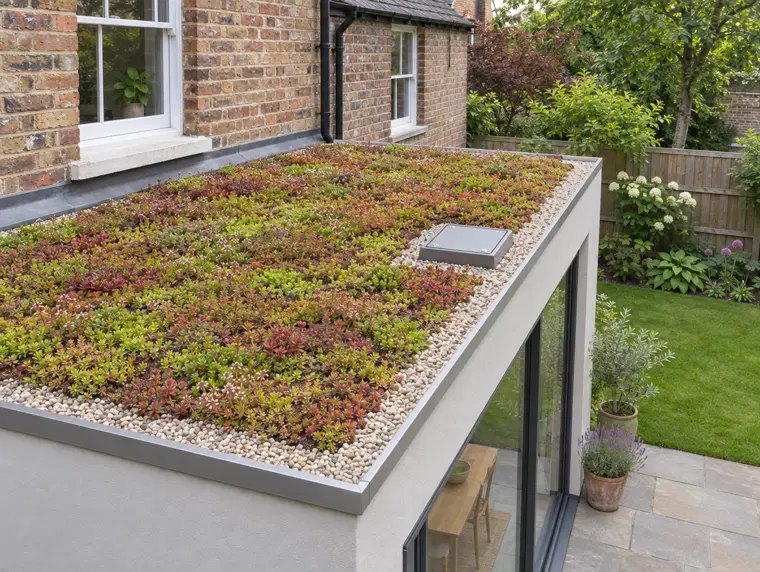
From the bottom up, a green roof is a deck, a waterproofing system with root protection, then drainage, filter, growing medium and plants. The waterproofing does the job of keeping water out. The green layers sit above it.
- Warm roof build-up: vapour control layer, insulation and waterproof membrane on the deck, then the green layers on top. This is the usual choice on a home extension being re-roofed.
- Inverted build-up: waterproofing on the deck, then insulation boards designed to sit above it, then the green layers. This is common on terraces and some commercial roofs.
- Root barrier: roots will exploit any weakness, so the membrane needs to be root-resistant. Some membranes are tested as root-resistant; others need a separate root barrier laid on top.
- Drainage and edges: a drainage layer carries surplus water to outlets, and a gravel or pebble strip is usually left around edges, outlets, upstands and rooflights to keep them clear and accessible.
Upstands still need to rise around 150 mm above the finished surface, which on a green roof means above the top of the growing medium. We check that at the survey, alongside the external fire performance of the build-up where the roof is close to a boundary.
Which towns in Lincolnshire do we cover?
Green and sedum roofs in Lincolnshire: questions
Which towns in Lincolnshire do you cover?
All of Lincolnshire. The main towns have their own pages below, and if yours isn't listed we still cover it: send your postcode and we'll confirm.
How much does a green roof cost in Lincolnshire?
£4,300–£7,900 for a 20 m² insulated extension roof finished as a sedum green roof, at East Midlands guide rates including VAT. The fixed price comes after a free survey for new and replacement roofs.
Which council handles building control for a flat roof in Lincolnshire?
It depends on where the roof is: in Lincolnshire that's City of Lincoln Council, North East Lincolnshire Council, North Lincolnshire Council and 6 other councils. Replacing more than half of a roof over a heated room usually counts as renovating a thermal element, so it is insulated to current standards and notified to building control. We confirm which applies at the survey.
Can you put a sedum roof on a garage?
Often, yes, if the structure is strong enough. Many older garage roofs have light timbers, so a structural check comes first and strengthening may be needed.
Can you put a green roof on a pitched roof?
We install green roofs on flat roofs only. Sloping green roofs need extra restraint to stop the growing medium slipping, and they are a specialist job outside our work.
Can I walk on a green roof?
Only for maintenance, and only where it is safe. Most extensive green roofs on homes aren't designed as roof terraces, and a terrace generally needs planning permission and edge protection.
Everything about green and sedum roofs → · All flat roofing in Lincolnshire →