- Guide price
- £4,200–£7,700
- Survey
- Free for new and replacement roofs
- Quote
- Fixed, in writing
- Coverage
- England, Wales, Scotland, NI
Merseyside at a glance
- Largest towns
- Liverpool, Birkenhead, St Helens, Southport
- Postcode areas
- CH, L, PR, WA
- Building control
- Liverpool City Council, Wirral Council, St Helens Borough Council and 2 other councils
- Neighbouring areas
- Cheshire · Greater Manchester · Lancashire · Shropshire
- Guide price region
- North West (−5% on West Midlands rates)
How much does a green roof cost in Merseyside?
Guide prices including VAT at North West rates. The fixed price comes after a free survey for new and replacement roofs.
| Job | Guide price inc VAT |
|---|---|
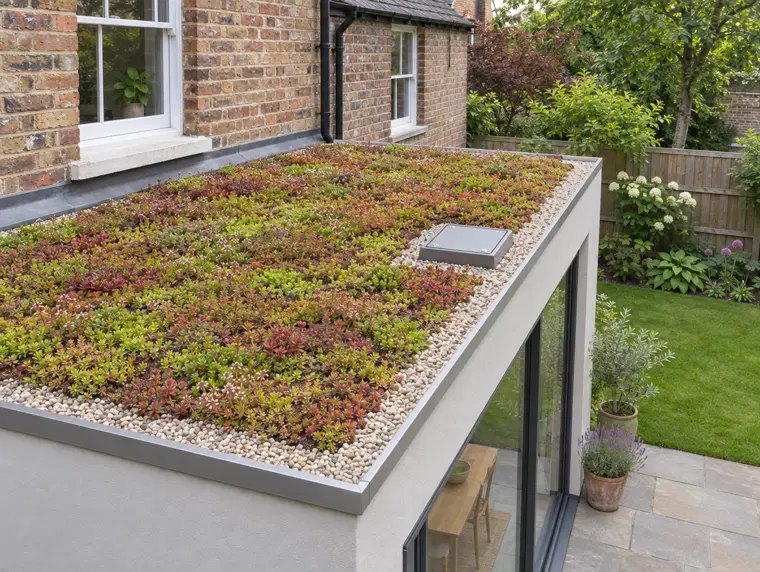
| Extension (20 m²), EPDM with sedum green roof | £4,200–£7,700 |
| Extension (20 m²), EPDM, new deck + insulation | £2,650–£4,650 |
Which flat roofs are common in Merseyside?
Flat roofs in Merseyside sit on 1960s and 1970s link-detached houses with flat-roofed garages and porches, 1930s semis with flat-roofed garages and kitchen extensions and newer estates where the first extension roofs are now being replaced. The North West is one of England's wetter regions, averaging roughly 1,290 mm of rain a year, so falls, outlets and well-detailed upstands matter more than the membrane colour. Approximate 1991–2020 regional averages based on Met Office data.
Building regulations in England
Replacing more than half of a roof over a heated room usually counts as renovating a thermal element, so it is insulated to current standards and notified to building control. Renovated roofs over heated rooms are insulated to around 0.16 W/m²K where that's feasible, and new extension roofs are built to 0.15 W/m²K. In Merseyside the application goes to Liverpool City Council, Wirral Council, St Helens Borough Council and 2 other councils. More on the rules.
How is a green roof built on top of a flat roof?
From the bottom up, a green roof is a deck, a waterproofing system with root protection, then drainage, filter, growing medium and plants. The waterproofing does the job of keeping water out. The green layers sit above it.
- Warm roof build-up: vapour control layer, insulation and waterproof membrane on the deck, then the green layers on top. This is the usual choice on a home extension being re-roofed.
- Inverted build-up: waterproofing on the deck, then insulation boards designed to sit above it, then the green layers. This is common on terraces and some commercial roofs.
- Root barrier: roots will exploit any weakness, so the membrane needs to be root-resistant. Some membranes are tested as root-resistant; others need a separate root barrier laid on top.
- Drainage and edges: a drainage layer carries surplus water to outlets, and a gravel or pebble strip is usually left around edges, outlets, upstands and rooflights to keep them clear and accessible.
Upstands still need to rise around 150 mm above the finished surface, which on a green roof means above the top of the growing medium. We check that at the survey, alongside the external fire performance of the build-up where the roof is close to a boundary.
How long does a green roof last and how much maintenance does it need?
A well-built extensive green roof needs one or two maintenance visits a year, and the plant layer can help protect the membrane from sunlight and temperature swings.
Typical maintenance means pulling out weeds and tree seedlings before they root, clearing outlets and the gravel strips around edges, filling in any bare patches, and adding a slow-release feed if the sedum looks thin. Sedum is drought-tolerant once established, but newly laid blankets may need watering in a long dry spell during the first season.
The waterproofing underneath has the same expected life as on any other roof of that system. A green roof also slows down rainwater run-off from the roof and, when sedum flowers, attracts bees and other insects. Some councils encourage green roofs for those reasons, so it is worth mentioning one in a planning application for a new extension. Our maintenance guide covers routine checks.
Which towns in Merseyside do we cover?
- Liverpool
- Birkenhead
- St Helens
- Southport
- Wallasey
- Bootle
- Bebington
- Huyton
- Kirkby
- Prescot
- Heswall
- Maghull
- Newton-le-Willows
- Formby
- Garston
- Speke
- Norris Green
- Kirkdale
- Moreton
- Haydock
- Belle Vale
- Old Swan
- Allerton
Green and sedum roofs in Merseyside: questions
Which towns in Merseyside do you cover?
All of Merseyside. The main towns have their own pages below, and if yours isn't listed we still cover it: send your postcode and we'll confirm.
How much does a green roof cost in Merseyside?
£4,200–£7,700 for a 20 m² insulated extension roof finished as a sedum green roof, at North West guide rates including VAT. The fixed price comes after a free survey for new and replacement roofs.
Which postcode areas do you cover in Merseyside?
All of Merseyside, including the CH, L, PR, WA postcode areas. Send your full postcode and we'll confirm.
Does a green roof leak more than a normal flat roof?
No, as long as it is built correctly. The waterproofing beneath is what keeps water out, and the green layers protect it from sun and weather. The main risk is building it on a weak or ageing membrane.
Do I need to water a sedum roof?
Usually only in the first season, during long dry spells, while the blankets establish. After that, sedum copes with dry weather well.
Can I walk on a green roof?
Only for maintenance, and only where it is safe. Most extensive green roofs on homes aren't designed as roof terraces, and a terrace generally needs planning permission and edge protection.
Everything about green and sedum roofs → · All flat roofing in Merseyside →