Sunbury-on-Thames at a glance
- Postcode districts
- TW16
- Population
- about 27,784 (GeoNames)
- Council area
- Spelthorne Borough Council
- Building approval
- Spelthorne Borough Council building control, or a registered building control approver
- Nearest main town
- Woking, about 8 miles
- Guide price region
- South East (+10% on West Midlands rates)
Why choose a green roof in Sunbury-on-Thames?
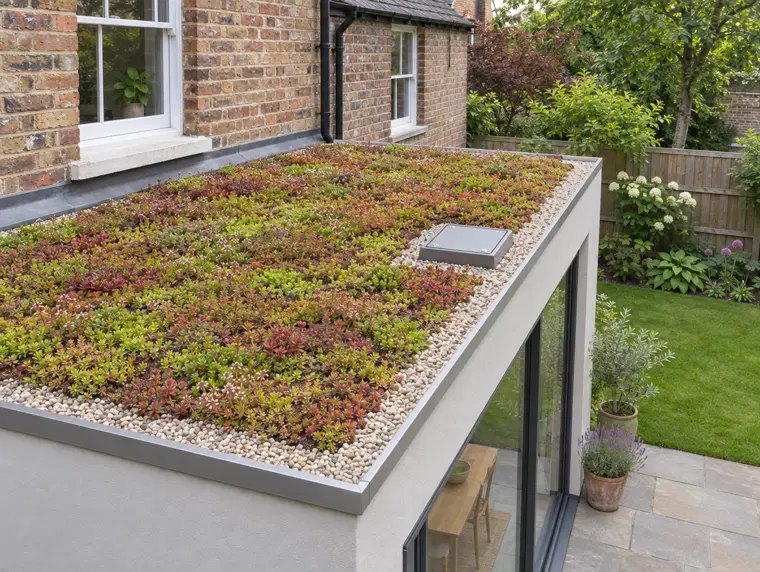
Rainwater from flat roofs in Sunbury-on-Thames runs off quickly in heavy showers. A green roof holds some of that water back and releases it more slowly, which is one reason some owners and developers choose one. The flowering sedum also draws in bees and other insects.
In a town like Sunbury-on-Thames, flat roofs are commonly found on terraced streets with flat-roofed rear kitchens and bathrooms or 1960s and 1970s link-detached houses with flat-roofed garages and porches. Much of the South East sits in the drier Thames catchment at roughly 730 mm of rain a year, so the usual failures are at joints, upstands and outlets rather than from sheer volume of rain.
How much does a green roof cost in Sunbury-on-Thames?
At South East guide rates, a 20 m² insulated extension roof finished as a sedum green roof comes to £4,850–£8,900 including VAT. The fixed price comes after a free survey for new and replacement roofs.
| Job | Guide price inc VAT |
|---|---|
| Extension (20 m²), EPDM with sedum green roof | £4,850–£8,900 |
| Extension (20 m²), EPDM, new deck + insulation | £3,100–£5,350 |
How is a green roof built on top of a flat roof?
From the bottom up, a green roof is a deck, a waterproofing system with root protection, then drainage, filter, growing medium and plants. The waterproofing does the job of keeping water out. The green layers sit above it.
- Warm roof build-up: vapour control layer, insulation and waterproof membrane on the deck, then the green layers on top. This is the usual choice on a home extension being re-roofed.
- Inverted build-up: waterproofing on the deck, then insulation boards designed to sit above it, then the green layers. This is common on terraces and some commercial roofs.
- Root barrier: roots will exploit any weakness, so the membrane needs to be root-resistant. Some membranes are tested as root-resistant; others need a separate root barrier laid on top.
- Drainage and edges: a drainage layer carries surplus water to outlets, and a gravel or pebble strip is usually left around edges, outlets, upstands and rooflights to keep them clear and accessible.
Upstands still need to rise around 150 mm above the finished surface, which on a green roof means above the top of the growing medium. We check that at the survey, alongside the external fire performance of the build-up where the roof is close to a boundary.
What's included?
- Structural check of joists, deck and supports
- Root-resistant membrane or separate root barrier
- Warm or inverted build-up to suit the roof
- Drainage layer, filter and lightweight growing medium
Building regulations in England
Replacing more than half of a flat roof over a heated room usually counts as renovating a thermal element, so the roof is insulated to around 0.16 W/m²K where that's technically and economically feasible, and the work is notified to building control: the council or a registered building control approver, unless a registered competent person self-certifies it. A roof on a new extension is built to 0.15 W/m²K. Patch repairs, and most unheated detached garages, don't trigger the upgrade. Structural changes, or a new covering that adds 15% or more to the roof's weight, also need approval. More on the rules.
Which nearby areas do we also cover?
- West Molesey · 2 mi
- Ashford, Surrey · 3 mi
- Weybridge · 3 mi
- Esher · 3 mi
- Chertsey · 4 mi
- Staines-upon-Thames · 4 mi
Green and sedum roofs in Sunbury-on-Thames: questions
Do you cover Sunbury-on-Thames?
Yes. Sunbury-on-Thames is part of our Surrey coverage, including postcode districts TW16. Surveys and roofs are carried out by vetted roofing teams working under S&K Property Investments and Improvement Ltd.
Who checks building regulations for a flat roof in Sunbury-on-Thames?
Where the work needs approval it goes to Spelthorne Borough Council building control, or a registered building control approver. We tell you at the survey whether your job needs it and deal with the paperwork as part of the quote.
How much does a green roof cost in Sunbury-on-Thames?
£4,850–£8,900 for a 20 m² insulated extension roof finished as a sedum green roof, at South East guide rates including VAT. The fixed price comes after a free survey for new and replacement roofs.
What happens if a green roof needs repairing?
The green layers are lifted around the problem area, the membrane is repaired, and the layers are relaid. Building on a sound, long-life membrane in the first place keeps that to a minimum.
Do I need to water a sedum roof?
Usually only in the first season, during long dry spells, while the blankets establish. After that, sedum copes with dry weather well.