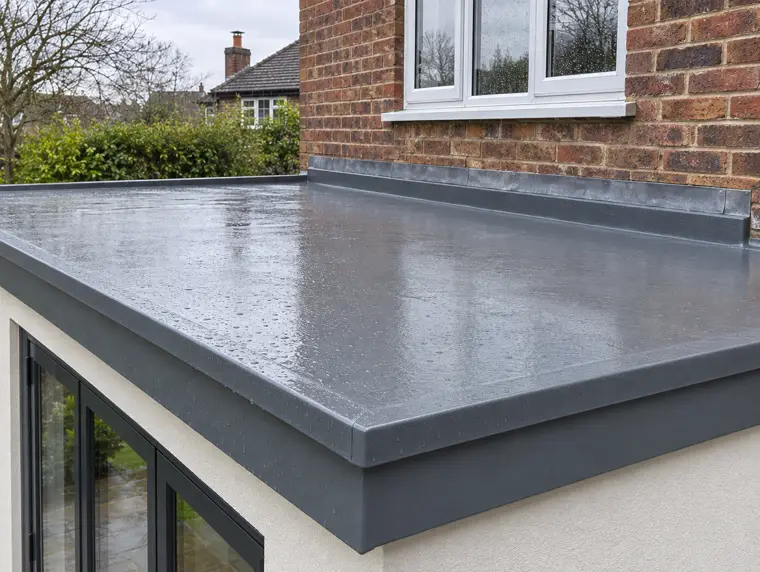
- Price per m²
- £71–£133
- Typical life
- 20–40 years
- Manufacturer guarantees
- 20–25 year material warranties on specified systems
- Typical garage roof
- £1,700–£3,100
Cumbria at a glance
- Largest towns
- Carlisle, Barrow-in-Furness, Kendal, Whitehaven
- Postcode areas
- CA, LA
- Building control
- Cumberland Council and Westmorland and Furness Council
- Neighbouring areas
- Lancashire · County Durham · Tyne and Wear · Northumberland
- Guide price region
- North West (−5% on West Midlands rates)
How much does a GRP fibreglass roof cost in Cumbria?
Guide prices including VAT at North West rates. The fixed price comes after a free survey for new and replacement roofs.
| Job | Guide price inc VAT |
|---|---|
| Extension (20 m²), GRP, new deck + insulation | £2,850–£5,100 |
| Dormer (8 m²), GRP, scaffold | £1,350–£2,500 |
| Single garage (18 m²), GRP fibreglass | £1,700–£3,100 |
| Single garage (18 m²), EPDM rubber | £1,500–£2,650 |
| Extension (20 m²), EPDM, new deck + insulation | £2,650–£4,650 |
Which flat roofs are common in Cumbria?
Flat roofs in Cumbria sit on lock-up garage blocks on estates, bungalows with flat-roofed side extensions and dormers and shops with flat-roofed rear stores below flats. The North West is one of England's wetter regions, averaging roughly 1,290 mm of rain a year, so falls, outlets and well-detailed upstands matter more than the membrane colour. Approximate 1991–2020 regional averages based on Met Office data.
Building regulations in England
Replacing more than half of a roof over a heated room usually counts as renovating a thermal element, so it is insulated to current standards and notified to building control. Renovated roofs over heated rooms are insulated to around 0.16 W/m²K where that's feasible, and new extension roofs are built to 0.15 W/m²K. In Cumbria the application goes to Cumberland Council and Westmorland and Furness Council. More on the rules.
Will a new GRP roof need extra insulation to meet building regulations?
If the roof is over a heated room and you are replacing more than half of it, usually yes. In England, Wales and Northern Ireland that counts as renovating a thermal element, and in Scotland the council's building standards service will say whether a building warrant applies.
GRP pairs well with a warm roof because the new deck boards it needs can sit on top of the insulation. The result is thicker, so we check at survey that there is room under door cills and wall flashings, and that the upstands can finish around 150 mm above the new surface. Where approval is needed we arrange it with building control or building standards.
Unheated, detached garages normally sit outside the thermal rules. See the building regulations page for each nation, or the warm vs cold roof guide for why we avoid cold roofs where we can.
Is GRP better than EPDM, felt or a liquid roof?
GRP is the better choice when you want a rigid, walkable finish, a neat look on a visible roof, or crisp moulded details on a complicated shape. It is not automatically better on a plain garage that nobody steps on.
Strengths: hard surface that takes occasional foot traffic; jointless finish with no laps; trims, kerbs and upstands moulded as part of the roof; choice of topcoat colours; small repairs can be laminated in.
Weaknesses: sensitive to weather while laying; rigid, so it can crack where the structure moves; usually needs a new deck; styrene smell during application; skill-dependent, so workmanship matters more than with sheet systems.
For a simple roof, EPDM rubber is often quicker to lay and more forgiving of movement. Torch-on felt is usually cheaper per square metre. A liquid-applied roof can go over a sound existing surface, larger commercial roofs tend to suit single-ply, and older buildings may already have mastic asphalt worth keeping. The EPDM vs GRP vs felt guide compares the three most common choices.
Which towns in Cumbria do we cover?
GRP fibreglass roofing in Cumbria: questions
Which towns in Cumbria do you cover?
All of Cumbria. The main towns have their own pages below, and if yours isn't listed we still cover it: send your postcode and we'll confirm.
How much does a GRP fibreglass roof cost in Cumbria?
£2,850–£5,100 for a 20 m² extension roof in GRP with a new deck and insulation, at North West guide rates including VAT. The fixed price comes after a free survey for new and replacement roofs.
Which postcode areas do you cover in Cumbria?
All of Cumbria, including the CA, LA postcode areas. Send your full postcode and we'll confirm.
Does GRP smell when it is being laid?
Yes, the resin gives off a strong styrene smell while it cures. It usually fades within a day or so, and we advise keeping nearby windows closed while the team works.
Can a cracked GRP roof be repaired?
Often, yes. The area is ground back, cleaned and re-laminated with fresh mat and topcoat. If cracks keep returning along joints, the deck or detailing usually needs attention rather than another patch.
Is GRP suitable for a dormer roof?
Yes, GRP is commonly used on dormers because the trims can be moulded neatly and the finish looks tidy from the ground. Scaffold is normally needed, which we include in the quote.
Everything about GRP fibreglass roofing → · All flat roofing in Cumbria →