Southend-on-Sea at a glance
- Postcode districts
- SS0, SS1, SS2, SS3, SS9
- Population
- about 295,310 (GeoNames)
- Council area
- Southend-on-Sea City Council
- Building approval
- Southend-on-Sea City Council building control, or a registered building control approver
- Guide price region
- East of England (+5% on West Midlands rates)
Why choose GRP fibreglass roofing in Southend-on-Sea?
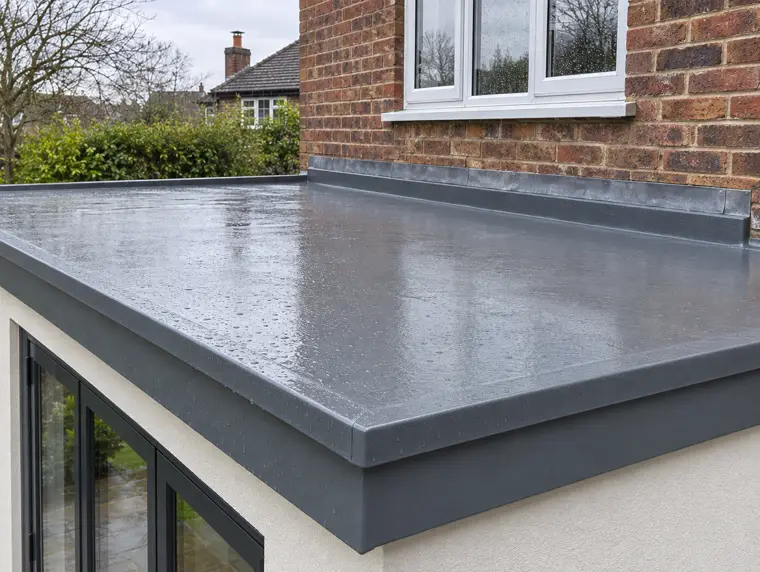
Landlords and small businesses in Southend-on-Sea often favour GRP on roofs that contractors need to access for plant, aerials or gutter clearance. The surface resists scuffs better than a soft membrane, and small damage can usually be ground back and re-laminated without disturbing the rest of the roof.
Southend-on-Sea's flat roofs are mostly on bungalows with flat-roofed side extensions and dormers, with plenty on shops with flat-roofed rear stores below flats too. The East of England is the driest part of Britain, with parts of the Anglian region around 630 mm a year, so summer heat and UV, not rainfall, do most of the ageing on a felt roof.
How much does a GRP fibreglass roof cost in Southend-on-Sea?
Guide price in Southend-on-Sea: £3,150–£5,650 for a 20 m² extension roof in GRP with a new deck and insulation, including VAT at East of England rates. The fixed price comes after a free survey for new and replacement roofs.
| Job | Guide price inc VAT |
|---|---|
| Extension (20 m²), GRP, new deck + insulation | £3,150–£5,650 |
| Dormer (8 m²), GRP, scaffold | £1,450–£2,800 |
| Single garage (18 m²), GRP fibreglass | £1,850–£3,400 |
| Single garage (18 m²), EPDM rubber | £1,700–£2,950 |
| Extension (20 m²), EPDM, new deck + insulation | £2,950–£5,150 |
Is GRP better than EPDM, felt or a liquid roof?
GRP is the better choice when you want a rigid, walkable finish, a neat look on a visible roof, or crisp moulded details on a complicated shape. It is not automatically better on a plain garage that nobody steps on.
Strengths: hard surface that takes occasional foot traffic; jointless finish with no laps; trims, kerbs and upstands moulded as part of the roof; choice of topcoat colours; small repairs can be laminated in.
Weaknesses: sensitive to weather while laying; rigid, so it can crack where the structure moves; usually needs a new deck; styrene smell during application; skill-dependent, so workmanship matters more than with sheet systems.
For a simple roof, EPDM rubber is often quicker to lay and more forgiving of movement. Torch-on felt is usually cheaper per square metre. A liquid-applied roof can go over a sound existing surface, larger commercial roofs tend to suit single-ply, and older buildings may already have mastic asphalt worth keeping. The EPDM vs GRP vs felt guide compares the three most common choices.
What's included?
- Resin and glass-mat laminate with taped and reinforced joints
- New OSB3 or plywood deck, fixed at close centres
- Warm-roof insulation and vapour control layer where the room below is heated
- Coloured UV-stable topcoat, with anti-slip finish on request
Building regulations in England
Replacing more than half of a flat roof over a heated room usually counts as renovating a thermal element, so the roof is insulated to around 0.16 W/m²K where that's technically and economically feasible, and the work is notified to building control: the council or a registered building control approver, unless a registered competent person self-certifies it. A roof on a new extension is built to 0.15 W/m²K. Patch repairs, and most unheated detached garages, don't trigger the upgrade. Structural changes, or a new covering that adds 15% or more to the roof's weight, also need approval. More on the rules.
Which nearby areas do we also cover?
GRP fibreglass roofing in Southend-on-Sea: questions
Do you cover Southend-on-Sea?
Yes. Southend-on-Sea is part of our Essex coverage, including postcode districts SS0, SS1, SS2, SS3, SS9. Surveys and roofs are carried out by vetted roofing teams working under S&K Property Investments and Improvement Ltd.
Who checks building regulations for a flat roof in Southend-on-Sea?
Where the work needs approval it goes to Southend-on-Sea City Council building control, or a registered building control approver. We tell you at the survey whether your job needs it and deal with the paperwork as part of the quote.
How much does a GRP fibreglass roof cost in Southend-on-Sea?
£3,150–£5,650 for a 20 m² extension roof in GRP with a new deck and insulation, at East of England guide rates including VAT. The fixed price comes after a free survey for new and replacement roofs.
What colours does a GRP roof come in?
Topcoats are typically available in greys, greens, black and some other shades. Lighter colours absorb less heat, and an anti-slip finish can be added where people will walk on the roof.
Can you walk on a GRP roof?
Yes, a correctly laid GRP roof takes occasional foot traffic, such as cleaning windows or maintaining plant. For a regular walkway or terrace, an anti-slip topcoat and a suitable specification are needed.