- Price per m²
- £86–£133
- Typical life
- 10–25+ years by product
- Manufacturer guarantees
- 10, 15 or 20-year guarantees by named system
- Typical garage roof
- £1,950–£3,100
Argyll and Bute at a glance
- Largest towns
- Helensburgh, Dunoon, Oban
- Postcode areas
- G, PA
- Building standards
- Argyll and Bute Council
- Neighbouring areas
- West Dunbartonshire · East Dunbartonshire · Glasgow City · East Renfrewshire
- Guide price region
- Scotland (−5% on West Midlands rates)
How much does a liquid-applied roof cost in Argyll and Bute?
Guide prices including VAT at Scotland rates. The fixed price comes after a free survey for new and replacement roofs.
| Job | Guide price inc VAT |
|---|---|
| Single garage (18 m²), liquid-applied | £1,950–£3,100 |
| Balcony (12 m²), liquid-applied, scaffold | £1,800–£3,100 |
| Single garage (18 m²), EPDM rubber | £1,500–£2,650 |
| Extension (20 m²), EPDM, new deck + insulation | £2,650–£4,650 |
Which flat roofs are common in Argyll and Bute?
Flat roofs in Argyll and Bute sit on terraced streets with flat-roofed rear kitchens and bathrooms, 1960s and 1970s link-detached houses with flat-roofed garages and porches and low-rise post-war blocks of flats. Scotland averages roughly 1,570 mm of rain a year, with the west far wetter than the east, so drainage, falls and wind uplift are part of every specification we write. Approximate 1991–2020 regional averages based on Met Office data.
Building standards in Scotland
In Scotland a building warrant is usually needed for alterations, structural work and new roofs; like-for-like repairs to a covering can be exempt. Section 6 of the technical handbooks sets a domestic roof benchmark of 0.12 W/m²K, applied as far as reasonably practicable on an existing roof. In Argyll and Bute the application goes to Argyll and Bute Council (building standards). More on the rules.
When is a liquid roof the best option, and when is it not?
A liquid roof is often the best option for roofs crowded with pipes, vents and upstands, for balconies and walkways, and for overlaying a structurally sound roof that is starting to fail. It is the wrong choice when the deck is rotten, the insulation is wet or the falls are badly wrong.
Advantages: continuous finish with no laps; forms details around pipes and odd shapes easily; cold-applied with no flame; can often go over felt, asphalt or concrete; some systems take foot traffic.
Disadvantages: higher cost per square metre than felt or EPDM; needs dry weather and careful thickness control; only as good as the surface it is bonded to; product quality varies widely across the market.
For a straightforward re-roof on a fresh deck, EPDM or GRP may offer better value. Larger flat areas suit torch-on felt or single-ply. On a sound mastic asphalt roof, a compatible liquid system can sometimes be applied over it. See also our guide to overlay or strip.
Which towns in Argyll and Bute do we cover?
Liquid-applied roofing in Argyll and Bute: questions
Which towns in Argyll and Bute do you cover?
All of Argyll and Bute. The main towns have their own pages below, and if yours isn't listed we still cover it: send your postcode and we'll confirm.
How much does a liquid-applied roof cost in Argyll and Bute?
£1,950–£3,100 for a typical 18 m² garage roof in a liquid-applied system, at Scotland guide rates including VAT. The fixed price comes after a free survey for new and replacement roofs.
Which council handles building standards for a flat roof in Argyll and Bute?
It depends on where the roof is: in Argyll and Bute that's Argyll and Bute Council. In Scotland a building warrant is usually needed for alterations, structural work and new roofs; like-for-like repairs to a covering can be exempt. We confirm which applies at the survey.
Is liquid roofing the same as a roof paint?
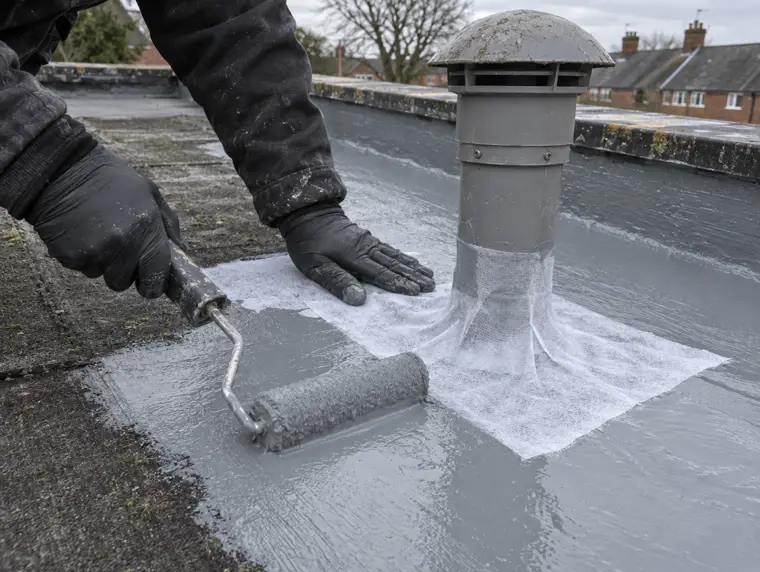
No. A proper liquid-applied membrane is built to a specified thickness and usually reinforced with fleece, while roof paints and simple coatings are much thinner and mainly used to extend the life of an existing covering.
How long does a liquid roof take to cure?
That depends on the product and the weather. Some systems are rain-resistant within an hour or so, others take longer, and full cure can take a day or more in cool weather.
Does a liquid roof smell when it is applied?
Some systems, particularly PMMA, have a strong odour during application, while many polyurethane and water-based products are milder. We tell you what to expect and plan around windows and vents.
Everything about liquid-applied roofing → · All flat roofing in Argyll and Bute →