- Price per m²
- £95–£147
- Typical life
- 10–25+ years by product
- Manufacturer guarantees
- 10, 15 or 20-year guarantees by named system
- Typical garage roof
- £2,150–£3,400
Bedfordshire at a glance
- Largest towns
- Luton, Bedford, Dunstable, Leighton Buzzard
- Postcode areas
- LU, MK, SG
- Building control
- Luton Borough Council, Bedford Borough Council and Central Bedfordshire Council
- Neighbouring areas
- Hertfordshire · Buckinghamshire · Northamptonshire · Cambridgeshire
- Guide price region
- East of England (+5% on West Midlands rates)
How much does a liquid-applied roof cost in Bedfordshire?
Guide prices including VAT at East of England rates. The fixed price comes after a free survey for new and replacement roofs.
| Job | Guide price inc VAT |
|---|---|
| Single garage (18 m²), liquid-applied | £2,150–£3,400 |
| Balcony (12 m²), liquid-applied, scaffold | £2,000–£3,400 |
| Single garage (18 m²), EPDM rubber | £1,700–£2,950 |
| Extension (20 m²), EPDM, new deck + insulation | £2,950–£5,150 |
Which flat roofs are common in Bedfordshire?
Flat roofs in Bedfordshire sit on low-rise post-war blocks of flats, 1930s semis with flat-roofed garages and kitchen extensions and newer estates where the first extension roofs are now being replaced. The East of England is the driest part of Britain, with parts of the Anglian region around 630 mm a year, so summer heat and UV, not rainfall, do most of the ageing on a felt roof. Approximate 1991–2020 regional averages based on Met Office data.
Building regulations in England
Replacing more than half of a roof over a heated room usually counts as renovating a thermal element, so it is insulated to current standards and notified to building control. Renovated roofs over heated rooms are insulated to around 0.16 W/m²K where that's feasible, and new extension roofs are built to 0.15 W/m²K. In Bedfordshire the application goes to Luton Borough Council, Bedford Borough Council and Central Bedfordshire Council. More on the rules.
When is a liquid roof the best option, and when is it not?
A liquid roof is often the best option for roofs crowded with pipes, vents and upstands, for balconies and walkways, and for overlaying a structurally sound roof that is starting to fail. It is the wrong choice when the deck is rotten, the insulation is wet or the falls are badly wrong.
Advantages: continuous finish with no laps; forms details around pipes and odd shapes easily; cold-applied with no flame; can often go over felt, asphalt or concrete; some systems take foot traffic.
Disadvantages: higher cost per square metre than felt or EPDM; needs dry weather and careful thickness control; only as good as the surface it is bonded to; product quality varies widely across the market.
For a straightforward re-roof on a fresh deck, EPDM or GRP may offer better value. Larger flat areas suit torch-on felt or single-ply. On a sound mastic asphalt roof, a compatible liquid system can sometimes be applied over it. See also our guide to overlay or strip.
Can a liquid roof go over my existing roof, and what preparation is needed?
Yes, if the existing roof is dry, firmly bonded and sitting on a sound deck. A liquid membrane is only as good as what lies beneath it, so we test the old roof before agreeing to overlay it.
At survey we check for:
- Trapped moisture: soft spots, blisters or wet insulation mean the roof should be stripped, because water sealed in will cause new blisters and decay.
- Deck condition: any sponginess or deflection needs repair first.
- Adhesion: on felt and asphalt, loose areas are cut out and patched, and the existing surface must take the primer properly.
- Falls and ponding: a coating follows the roof as it is. If water ponds now, it will pond on the new surface too unless the falls are corrected.
Preparation then follows: loose chippings removed, the surface cleaned and left to dry, blisters cut back and repaired, cracks filled, and the right primer applied. On older felt, mineral surfaces may need extra cleaning to give a good bond. Where the tests fail, we say so plainly and quote for a strip and re-roof. Read more on ponding water.
Which towns in Bedfordshire do we cover?
Liquid-applied roofing in Bedfordshire: questions
Which towns in Bedfordshire do you cover?
All of Bedfordshire. The main towns have their own pages below, and if yours isn't listed we still cover it: send your postcode and we'll confirm.
How much does a liquid-applied roof cost in Bedfordshire?
£2,150–£3,400 for a typical 18 m² garage roof in a liquid-applied system, at East of England guide rates including VAT. The fixed price comes after a free survey for new and replacement roofs.
Which council handles building control for a flat roof in Bedfordshire?
It depends on where the roof is: in Bedfordshire that's Luton Borough Council, Bedford Borough Council and Central Bedfordshire Council. Replacing more than half of a roof over a heated room usually counts as renovating a thermal element, so it is insulated to current standards and notified to building control. We confirm which applies at the survey.
Can liquid roofing be applied in the rain?
No. The surface must be dry, and most systems need a dry window while they cure. Some fast-curing products shorten that window, but the team will not apply onto a damp roof.
Is liquid roofing the same as a roof paint?
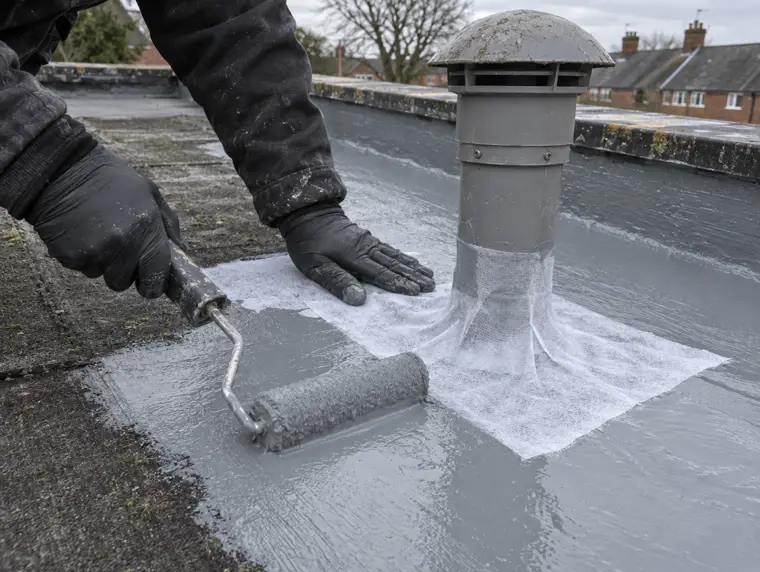
No. A proper liquid-applied membrane is built to a specified thickness and usually reinforced with fleece, while roof paints and simple coatings are much thinner and mainly used to extend the life of an existing covering.
How long does a liquid roof take to cure?
That depends on the product and the weather. Some systems are rain-resistant within an hour or so, others take longer, and full cure can take a day or more in cool weather.
Everything about liquid-applied roofing → · All flat roofing in Bedfordshire →