Southampton at a glance
- Postcode districts
- SO14, SO15, SO16, SO17, SO18, SO19
- Population
- about 269,781 (GeoNames)
- Council area
- Southampton City Council
- Building approval
- Southampton City Council building control, or a registered building control approver
- Guide price region
- South East (+10% on West Midlands rates)
Why choose a liquid-applied roof in Southampton?
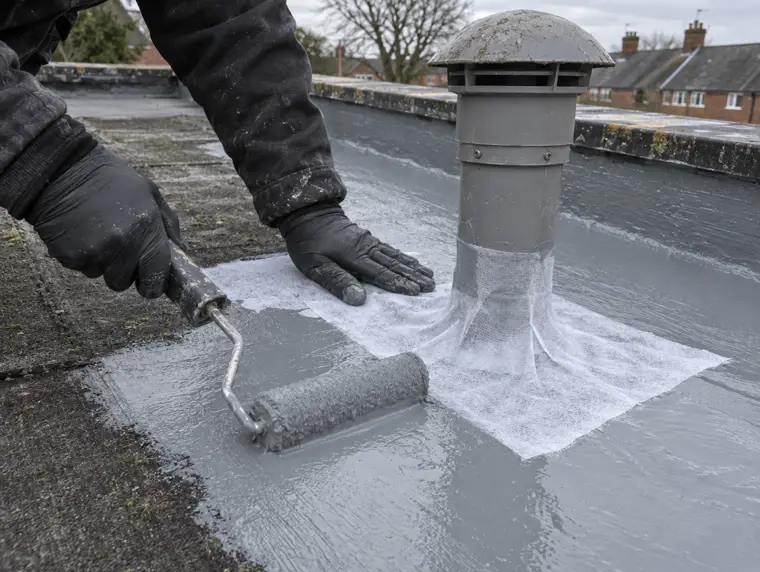
Liquid systems suit balconies and walkways in Southampton because they form neatly at door thresholds, railings and drains, and some products are designed to take foot traffic. Converting a roof into a new terrace is a different matter, and usually needs planning permission first.
In and around Southampton, flat roofs are typically found on 1960s and 1970s link-detached houses with flat-roofed garages and porches, and on 1930s semis with flat-roofed garages and kitchen extensions. Much of the South East sits in the drier Thames catchment at roughly 730 mm of rain a year, so the usual failures are at joints, upstands and outlets rather than from sheer volume of rain.
How much does a liquid-applied roof cost in Southampton?
At South East guide rates, a typical 18 m² garage roof in a liquid-applied system comes to £2,250–£3,600 including VAT. The fixed price comes after a free survey for new and replacement roofs.
| Job | Guide price inc VAT |
|---|---|
| Single garage (18 m²), liquid-applied | £2,250–£3,600 |
| Balcony (12 m²), liquid-applied, scaffold | £2,100–£3,600 |
| Single garage (18 m²), EPDM rubber | £1,750–£3,100 |
| Extension (20 m²), EPDM, new deck + insulation | £3,100–£5,350 |
When is a liquid roof the best option, and when is it not?
A liquid roof is often the best option for roofs crowded with pipes, vents and upstands, for balconies and walkways, and for overlaying a structurally sound roof that is starting to fail. It is the wrong choice when the deck is rotten, the insulation is wet or the falls are badly wrong.
Advantages: continuous finish with no laps; forms details around pipes and odd shapes easily; cold-applied with no flame; can often go over felt, asphalt or concrete; some systems take foot traffic.
Disadvantages: higher cost per square metre than felt or EPDM; needs dry weather and careful thickness control; only as good as the surface it is bonded to; product quality varies widely across the market.
For a straightforward re-roof on a fresh deck, EPDM or GRP may offer better value. Larger flat areas suit torch-on felt or single-ply. On a sound mastic asphalt roof, a compatible liquid system can sometimes be applied over it. See also our guide to overlay or strip.
What's included?
- Detailing of upstands, outlets, pipes and corners before the main area
- Top coat with optional anti-slip finish, and guarantee registration where available
- Surface cleaning, repairs and removal of loose material
- Primer matched to the substrate
Building regulations in England
Replacing more than half of a flat roof over a heated room usually counts as renovating a thermal element, so the roof is insulated to around 0.16 W/m²K where that's technically and economically feasible, and the work is notified to building control: the council or a registered building control approver, unless a registered competent person self-certifies it. A roof on a new extension is built to 0.15 W/m²K. Patch repairs, and most unheated detached garages, don't trigger the upgrade. Structural changes, or a new covering that adds 15% or more to the roof's weight, also need approval. More on the rules.
Which nearby areas do we also cover?
Liquid-applied roofing in Southampton: questions
Do you cover Southampton?
Yes. Southampton is part of our Hampshire coverage, including postcode districts SO14, SO15, SO16, SO17, SO18, SO19. Surveys and roofs are carried out by vetted roofing teams working under S&K Property Investments and Improvement Ltd.
Who checks building regulations for a flat roof in Southampton?
Where the work needs approval it goes to Southampton City Council building control, or a registered building control approver. We tell you at the survey whether your job needs it and deal with the paperwork as part of the quote.
How much does a liquid-applied roof cost in Southampton?
£2,250–£3,600 for a typical 18 m² garage roof in a liquid-applied system, at South East guide rates including VAT. The fixed price comes after a free survey for new and replacement roofs.
Is liquid roofing the same as a roof paint?
No. A proper liquid-applied membrane is built to a specified thickness and usually reinforced with fleece, while roof paints and simple coatings are much thinner and mainly used to extend the life of an existing covering.
Is liquid roofing good for balconies?
Often, yes. It forms neatly around railings, door thresholds and drains, and some systems take foot traffic. A new balcony or roof terrace generally needs planning permission, so check before converting a roof.