Liverpool at a glance
- Postcode districts
- L1, L2, L3, L4, L5, L6, L7, L8 and 15 more
- Population
- about 496,770 (GeoNames)
- Council area
- Liverpool City Council
- Building approval
- Liverpool City Council building control, or a registered building control approver
- Guide price region
- North West (−5% on West Midlands rates)
Why choose a liquid-applied roof in Liverpool?
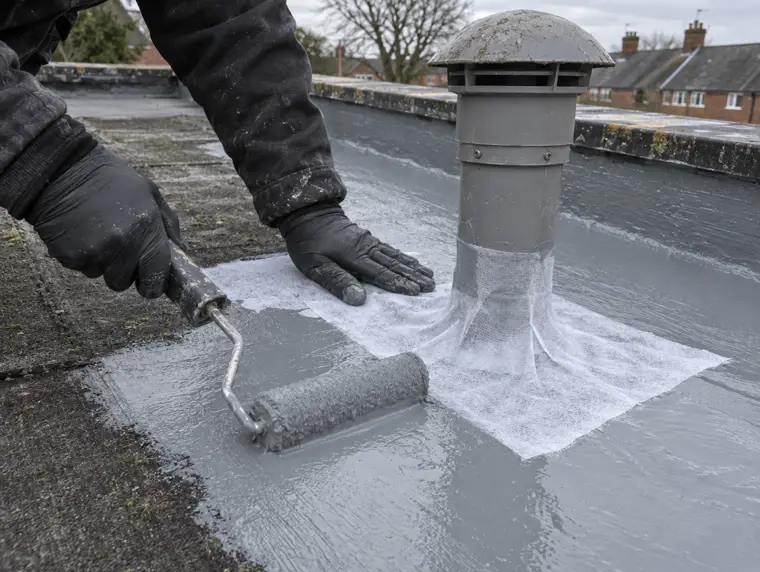
If a flat roof in Liverpool is ageing but still dry, firmly bonded and on a sound deck, a reinforced liquid system can be applied over it. That avoids the cost and mess of a full strip-out, provided the moisture and adhesion checks at survey show the existing roof is fit to build on.
Around Liverpool, flat roofs are common on shops with flat-roofed rear stores below flats and on 1960s and 1970s link-detached houses with flat-roofed garages and porches. The North West is one of England's wetter regions, averaging roughly 1,290 mm of rain a year, so falls, outlets and well-detailed upstands matter more than the membrane colour.
How much does a liquid-applied roof cost in Liverpool?
At North West guide rates, a typical 18 m² garage roof in a liquid-applied system comes to £1,950–£3,100 including VAT. The fixed price comes after a free survey for new and replacement roofs.
| Job | Guide price inc VAT |
|---|---|
| Single garage (18 m²), liquid-applied | £1,950–£3,100 |
| Balcony (12 m²), liquid-applied, scaffold | £1,800–£3,100 |
| Single garage (18 m²), EPDM rubber | £1,500–£2,650 |
| Extension (20 m²), EPDM, new deck + insulation | £2,650–£4,650 |
Can a liquid roof go over my existing roof, and what preparation is needed?
Yes, if the existing roof is dry, firmly bonded and sitting on a sound deck. A liquid membrane is only as good as what lies beneath it, so we test the old roof before agreeing to overlay it.
At survey we check for:
- Trapped moisture: soft spots, blisters or wet insulation mean the roof should be stripped, because water sealed in will cause new blisters and decay.
- Deck condition: any sponginess or deflection needs repair first.
- Adhesion: on felt and asphalt, loose areas are cut out and patched, and the existing surface must take the primer properly.
- Falls and ponding: a coating follows the roof as it is. If water ponds now, it will pond on the new surface too unless the falls are corrected.
Preparation then follows: loose chippings removed, the surface cleaned and left to dry, blisters cut back and repaired, cracks filled, and the right primer applied. On older felt, mineral surfaces may need extra cleaning to give a good bond. Where the tests fail, we say so plainly and quote for a strip and re-roof. Read more on ponding water.
What's included?
- Top coat with optional anti-slip finish, and guarantee registration where available
- Primer matched to the substrate
- Survey of the existing roof, including moisture and adhesion checks
- Fleece-reinforced liquid membrane applied to the specified thickness
Building regulations in England
Replacing more than half of a flat roof over a heated room usually counts as renovating a thermal element, so the roof is insulated to around 0.16 W/m²K where that's technically and economically feasible, and the work is notified to building control: the council or a registered building control approver, unless a registered competent person self-certifies it. A roof on a new extension is built to 0.15 W/m²K. Patch repairs, and most unheated detached garages, don't trigger the upgrade. Structural changes, or a new covering that adds 15% or more to the roof's weight, also need approval. More on the rules.
Which nearby areas do we also cover?
Liquid-applied roofing in Liverpool: questions
Do you cover Liverpool?
Yes. Liverpool is part of our Merseyside coverage, including postcode districts L1, L2, L3, L4, L5, L6 and 17 more. Surveys and roofs are carried out by vetted roofing teams working under S&K Property Investments and Improvement Ltd.
Who checks building regulations for a flat roof in Liverpool?
Where the work needs approval it goes to Liverpool City Council building control, or a registered building control approver. We tell you at the survey whether your job needs it and deal with the paperwork as part of the quote.
How much does a liquid-applied roof cost in Liverpool?
£1,950–£3,100 for a typical 18 m² garage roof in a liquid-applied system, at North West guide rates including VAT. The fixed price comes after a free survey for new and replacement roofs.
Can liquid roofing stop a leak on a flat roof?
It can, if the leak is at a detail or the membrane is worn but the roof beneath is sound. If water has soaked the insulation or deck, coating over it will not cure the problem.
Is liquid roofing the same as a roof paint?
No. A proper liquid-applied membrane is built to a specified thickness and usually reinforced with fleece, while roof paints and simple coatings are much thinner and mainly used to extend the life of an existing covering.