Woking at a glance
- Postcode districts
- GU21, GU22
- Population
- about 103,900 (GeoNames)
- Council area
- Woking Borough Council
- Building approval
- Woking Borough Council building control, or a registered building control approver
- Nearest main town
- Slough, about 13 miles
- Guide price region
- South East (+10% on West Midlands rates)
Why choose a liquid-applied roof in Woking?
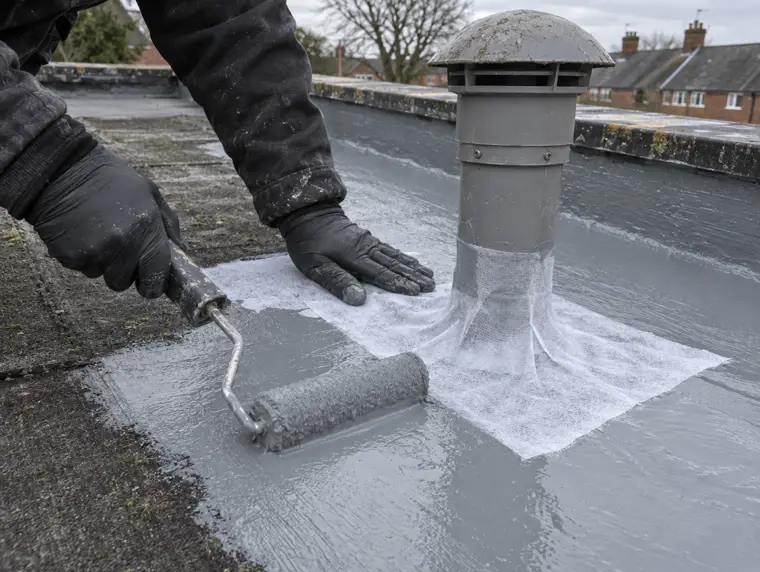
Liquid roofing suits a roof in Woking that is full of penetrations, such as soil pipes, vents, aerial brackets and rooflights, because the liquid flows around each one and cures into a single skin. There are no cut pieces or taped corners to work loose over time.
Woking's flat roofs are mostly on 1930s semis with flat-roofed garages and kitchen extensions, with plenty on low-rise post-war blocks of flats too. Much of the South East sits in the drier Thames catchment at roughly 730 mm of rain a year, so the usual failures are at joints, upstands and outlets rather than from sheer volume of rain.
How much does a liquid-applied roof cost in Woking?
For Woking we use South East rates: £2,250–£3,600 is the guide for a typical 18 m² garage roof in a liquid-applied system, VAT included. The fixed price comes after a free survey for new and replacement roofs.
| Job | Guide price inc VAT |
|---|---|
| Single garage (18 m²), liquid-applied | £2,250–£3,600 |
| Balcony (12 m²), liquid-applied, scaffold | £2,100–£3,600 |
| Single garage (18 m²), EPDM rubber | £1,750–£3,100 |
| Extension (20 m²), EPDM, new deck + insulation | £3,100–£5,350 |
Can a liquid roof go over my existing roof, and what preparation is needed?
Yes, if the existing roof is dry, firmly bonded and sitting on a sound deck. A liquid membrane is only as good as what lies beneath it, so we test the old roof before agreeing to overlay it.
At survey we check for:
- Trapped moisture: soft spots, blisters or wet insulation mean the roof should be stripped, because water sealed in will cause new blisters and decay.
- Deck condition: any sponginess or deflection needs repair first.
- Adhesion: on felt and asphalt, loose areas are cut out and patched, and the existing surface must take the primer properly.
- Falls and ponding: a coating follows the roof as it is. If water ponds now, it will pond on the new surface too unless the falls are corrected.
Preparation then follows: loose chippings removed, the surface cleaned and left to dry, blisters cut back and repaired, cracks filled, and the right primer applied. On older felt, mineral surfaces may need extra cleaning to give a good bond. Where the tests fail, we say so plainly and quote for a strip and re-roof. Read more on ponding water.
What's included?
- Top coat with optional anti-slip finish, and guarantee registration where available
- Surface cleaning, repairs and removal of loose material
- Primer matched to the substrate
- Detailing of upstands, outlets, pipes and corners before the main area
Building regulations in England
Replacing more than half of a flat roof over a heated room usually counts as renovating a thermal element, so the roof is insulated to around 0.16 W/m²K where that's technically and economically feasible, and the work is notified to building control: the council or a registered building control approver, unless a registered competent person self-certifies it. A roof on a new extension is built to 0.15 W/m²K. Patch repairs, and most unheated detached garages, don't trigger the upgrade. Structural changes, or a new covering that adds 15% or more to the roof's weight, also need approval. More on the rules.
Which nearby areas do we also cover?
Liquid-applied roofing in Woking: questions
Do you cover Woking?
Yes. Woking is part of our Surrey coverage, including postcode districts GU21, GU22. Surveys and roofs are carried out by vetted roofing teams working under S&K Property Investments and Improvement Ltd.
Who checks building regulations for a flat roof in Woking?
Where the work needs approval it goes to Woking Borough Council building control, or a registered building control approver. We tell you at the survey whether your job needs it and deal with the paperwork as part of the quote.
How much does a liquid-applied roof cost in Woking?
£2,250–£3,600 for a typical 18 m² garage roof in a liquid-applied system, at South East guide rates including VAT. The fixed price comes after a free survey for new and replacement roofs.
Is liquid roofing good for balconies?
Often, yes. It forms neatly around railings, door thresholds and drains, and some systems take foot traffic. A new balcony or roof terrace generally needs planning permission, so check before converting a roof.
Does a liquid roof smell when it is applied?
Some systems, particularly PMMA, have a strong odour during application, while many polyurethane and water-based products are milder. We tell you what to expect and plan around windows and vents.