- Price per m²
- £83–£147
- Typical life
- 30–60 years
- Manufacturer guarantees
- 15-year material, up to 25-year system guarantees
- 30 m² roof
- £3,400–£6,100
Leicestershire at a glance
- Largest towns
- Leicester, Loughborough, Hinckley, Coalville
- Postcode areas
- LE
- Building control
- Leicester City Council, Charnwood Borough Council, Hinckley and Bosworth Borough Council and 5 other councils
- Neighbouring areas
- Warwickshire · Northamptonshire · Nottinghamshire · West Midlands
- Guide price region
- East Midlands (−2% on West Midlands rates)
How much does mastic asphalt roofing cost in Leicestershire?
Guide prices including VAT at East Midlands rates. The fixed price comes after a free survey for new and replacement roofs.
| Job | Guide price inc VAT |
|---|---|
| Mastic asphalt roof (30 m²), scaffold | £3,400–£6,100 |
| Localised patch repair | £150–£490 |
| Single garage (18 m²), EPDM rubber | £1,550–£2,750 |
| Extension (20 m²), EPDM, new deck + insulation | £2,750–£4,800 |
Which flat roofs are common in Leicestershire?
Flat roofs in Leicestershire sit on 1960s and 1970s link-detached houses with flat-roofed garages and porches, low-rise post-war blocks of flats and 1930s semis with flat-roofed garages and kitchen extensions. The East Midlands is drier than the west of Britain, so most flat roofs here fail through age, UV and poor detailing at upstands rather than sheer rainfall. Approximate 1991–2020 regional averages based on Met Office data.
Building regulations in England
Replacing more than half of a roof over a heated room usually counts as renovating a thermal element, so it is insulated to current standards and notified to building control. Renovated roofs over heated rooms are insulated to around 0.16 W/m²K where that's feasible, and new extension roofs are built to 0.15 W/m²K. In Leicestershire the application goes to Leicester City Council, Charnwood Borough Council, Hinckley and Bosworth Borough Council and 5 other councils. More on the rules.
Is mastic asphalt still a good choice, or should I switch systems?
Mastic asphalt is still a good choice on concrete roofs, heritage and older buildings, and roofs that carry heavy foot traffic or plant. On lightweight timber roofs, garages and most modern extensions, another system is usually more practical.
Benefits: very long typical life; jointless and fully bonded; takes foot traffic well, especially with a paving finish; matches the original roof on many older buildings; local repairs blend into the existing surface.
Drawbacks: heavy, so the structure must be able to carry it; higher cost; needs specialist labour and hot works with molten material; can crack in cold if not well maintained, and softens in strong sun without a reflective finish.
If the structure is lightweight or the budget tight, torch-on felt or EPDM are common replacements. A compatible liquid-applied system can sometimes be laid over sound asphalt. On larger roofs, single-ply may be considered, and GRP suits smaller roofs needing a hard finish. Our repair or replace guide helps with the decision.
Should an old asphalt roof be repaired, overlaid or replaced, especially on a heritage building?
If the asphalt is sound apart from local cracks or blisters, repair it; if it is crazed and tired but dry and well bonded, consider an overlay; if it is leaking widely, sitting on a wet or failing deck, or full of trapped moisture, replace it. A survey, sometimes with a leak trace, tells you which applies.
- Repairs: blisters are cut out, cracks opened up and fresh asphalt worked in by a specialist, so the repair fuses with the existing roof.
- Overlay: a compatible system, often a reinforced liquid membrane, is bonded over the old asphalt after cleaning and priming. This keeps the old asphalt as a solid base and avoids heavy strip-out.
- Replacement: the old asphalt is broken out and the roof rebuilt, either in new asphalt or in another system the structure can carry, with insulation where required.
On heritage and older buildings, matching the original material and detailing often matters as much as waterproofing. New asphalt skirtings and aprons can follow the existing lines, and any change of material on a listed building should be agreed with the conservation officer before work starts.
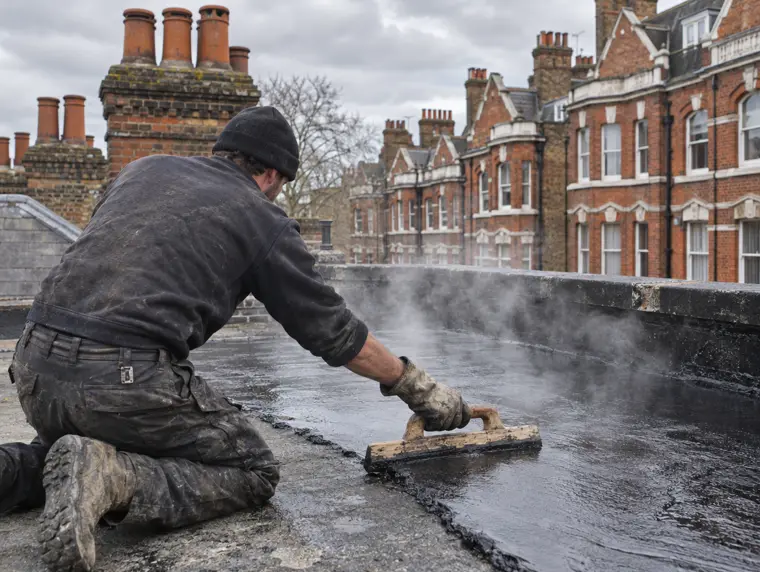
Asphalt work is a specialist trade. It needs mixers or boilers on site, trained asphalters and strict hot-works control, so we plan these jobs around access, the building's occupants and the weather.
Which towns in Leicestershire do we cover?
- Leicester
- Loughborough
- Hinckley
- Coalville
- Wigston
- Melton Mowbray
- Market Harborough
- Oadby
- Earl Shilton
- Humberstone
- Mountsorrel
- Glen Parva
Mastic asphalt roofing in Leicestershire: questions
Which towns in Leicestershire do you cover?
All of Leicestershire. The main towns have their own pages below, and if yours isn't listed we still cover it: send your postcode and we'll confirm.
How much does mastic asphalt roofing cost in Leicestershire?
£3,400–£6,100 for a 30 m² mastic asphalt roof including scaffold, at East Midlands guide rates including VAT. The fixed price comes after a free survey for new and replacement roofs.
Which postcode areas do you cover in Leicestershire?
All of Leicestershire, including the LE postcode areas. Send your full postcode and we'll confirm.
Why are mastic asphalt roofs painted silver or white?
The reflective coating keeps the asphalt cooler in sun, reducing softening and slowing the surface ageing that leads to crazing. It usually needs renewing every few years as part of maintenance.
Is mastic asphalt the same as tarmac?
No. Both contain bitumen, but mastic asphalt is a dense, voidless mix with fine limestone aggregate, made to be fully waterproof, while road surfacing is a different material.
How heavy is a mastic asphalt roof?
Considerably heavier than felt, rubber or single-ply, which is why it is usually laid on concrete or strong timber decks. We check the structure before recommending asphalt on any roof.
Everything about mastic asphalt roofing → · All flat roofing in Leicestershire →