- Guide price
- £2,650–£4,600
- Survey
- Free for new and replacement roofs
- Quote
- Fixed, in writing
- Coverage
- England, Wales, Scotland, NI
County Antrim at a glance
- Largest towns
- Lisburn, Newtownabbey, Carrickfergus, Ballymena
- Postcode areas
- BT
- Building control
- Lisburn and Castlereagh City Council, Antrim and Newtownabbey Borough Council, Mid and East Antrim Borough Council and 1 other council
- Neighbouring areas
- Belfast · County Down · County Armagh · County Londonderry
- Guide price region
- Northern Ireland (−12% on West Midlands rates)
How much does a rooflight upstand cost in County Antrim?
Guide prices including VAT at Northern Ireland rates. The fixed price comes after a free survey for new and replacement roofs.
| Job | Guide price inc VAT |
|---|---|
| Extension (20 m²), EPDM, insulation + 1 rooflight upstand | £2,650–£4,600 |
| Extension (20 m²), EPDM, new deck + insulation | £2,450–£4,300 |
| Extension (20 m²), EPDM with sedum green roof | £3,900–£7,100 |
Which flat roofs are common in County Antrim?
Flat roofs in County Antrim sit on 1930s semis with flat-roofed garages and kitchen extensions, terraced streets with flat-roofed rear kitchens and bathrooms and bungalows with flat-roofed side extensions and dormers. Northern Ireland averages roughly 1,150 mm of rain a year, spread over many wet days, so a roof that sheds water quickly to clear outlets lasts far longer than one that holds puddles. Approximate 1991–2020 regional averages based on Met Office data.
Building control in Northern Ireland
In Northern Ireland, renovating or replacing a roof over a heated room usually means meeting Technical Booklet F1, and building control should be contacted before work starts. Technical Booklet F1 sets roof insulation at 0.18 W/m²K when a roof over a heated room is renovated or newly built, where feasible. In County Antrim the application goes to Lisburn and Castlereagh City Council, Antrim and Newtownabbey Borough Council, Mid and East Antrim Borough Council and 1 other council. More on the rules.
Do rooflights in flat roofs need building regulations approval?
Usually, yes, for a new opening, because cutting through the roof and trimming joists is a structural alteration. Approval may also be needed because the roof itself is being re-covered.
New rooflights need to meet the energy efficiency standards for glazing, so that the unit doesn't become a weak point in an insulated roof. Many rooflights have a laminated inner pane, so that if the glass breaks it stays in place rather than falling into the room, which is worth asking for over kitchens, living spaces and stairs. Close to a boundary, the fire performance of the roof, including any rooflights, can matter under the fire safety rules.
Whether you need planning permission depends on the property and the unit. A raised lantern changes the roofline more than a flat rooflight, and listed buildings and conservation areas have stricter rules, which also differ between the four nations. We handle building control or building standards where it is needed. The building regulations page and the planning guide explain more.
Should I choose a fixed or an opening rooflight, or a lantern?
Choose a fixed rooflight if you only want daylight, an opening one if the room needs ventilation, and a lantern if you want a raised, pitched glazed feature over a larger space.
- Fixed flat rooflights are the simplest and usually the cheapest option. They have the fewest moving seals, and the upstand detail is straightforward.
- Opening rooflights can be manual or electric, and electric units often include a rain sensor that closes them automatically. They need a power supply planned in before the ceiling is finished. Some are designed as hatches to give access to the roof.
- Roof lanterns have a framed, pitched glazed top that brings in more light and adds height to the room. They are heavier and larger, so the upstand has to be strong, level and square, and the joists around the opening may need strengthening.
Whatever you choose, it helps to settle on the unit before the roof is built, so the upstand can be made to the maker's sizes. If you've already chosen one, we build the upstand to suit it.
Which towns in County Antrim do we cover?
Rooflights in flat roofs in County Antrim: questions
Which towns in County Antrim do you cover?
All of County Antrim. The main towns have their own pages below, and if yours isn't listed we still cover it: send your postcode and we'll confirm.
How much does a rooflight upstand cost in County Antrim?
£2,650–£4,600 for a 20 m² insulated EPDM extension roof with one rooflight upstand, at Northern Ireland guide rates including VAT. The fixed price comes after a free survey for new and replacement roofs.
Which council handles building control for a flat roof in County Antrim?
It depends on where the roof is: in County Antrim that's Lisburn and Castlereagh City Council, Antrim and Newtownabbey Borough Council, Mid and East Antrim Borough Council and 1 other council. In Northern Ireland, renovating or replacing a roof over a heated room usually means meeting Technical Booklet F1, and building control should be contacted before work starts. We confirm which applies at the survey.
How high should a flat rooflight upstand be?
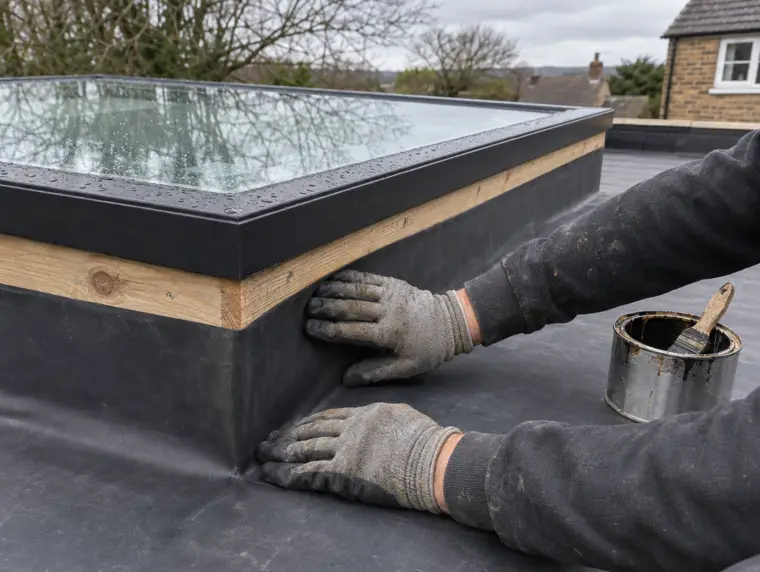
Usually at least 150 mm from the finished roof surface to the top of the waterproofing, so the joint stays above standing water. Some rooflight makers specify more.
Can I walk on a flat rooflight?
No, unless it is a unit specifically designed and rated for foot traffic. Treat standard rooflights and the roof around them as fragile.
Can a lantern go on a warm roof?
Yes. The upstand is built and insulated to the full height of the warm roof build-up, so the lantern sits at the right level above the finished surface.
Everything about rooflights in flat roofs → · All flat roofing in County Antrim →