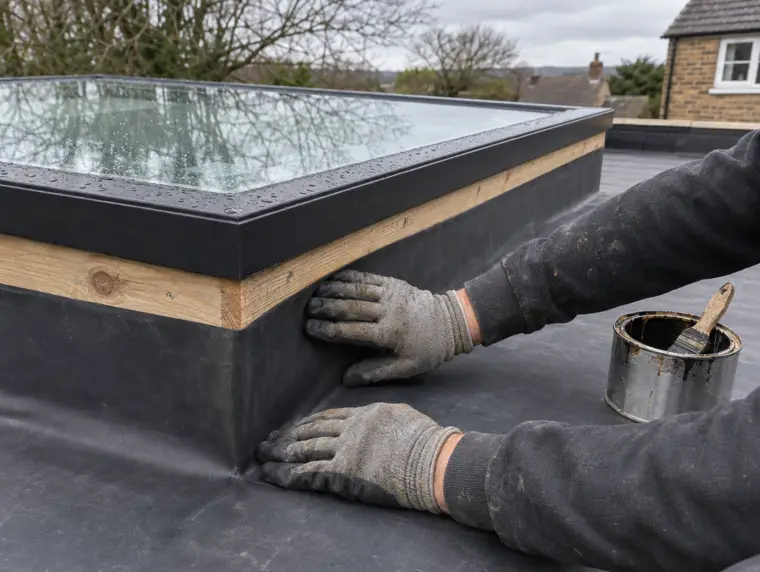
- Guide price
- £3,600–£6,300
- Survey
- Free for new and replacement roofs
- Quote
- Fixed, in writing
- Coverage
- England, Wales, Scotland, NI
London at a glance
- Largest towns
- Westminster, Camden, Islington, Haringey
- Postcode areas
- BR, CR, DA, E, EC, EN, HA, IG, KT, N
- Building control
- City of Westminster, London Borough of Camden, London Borough of Islington and 29 other councils
- Neighbouring areas
- Surrey · Hertfordshire · Buckinghamshire · Berkshire
- Guide price region
- London (+20% on West Midlands rates)
How much does a rooflight upstand cost in London?
Guide prices including VAT at London rates. The fixed price comes after a free survey for new and replacement roofs.
| Job | Guide price inc VAT |
|---|---|
| Extension (20 m²), EPDM, insulation + 1 rooflight upstand | £3,600–£6,300 |
| Extension (20 m²), EPDM, new deck + insulation | £3,350–£5,850 |
| Extension (20 m²), EPDM with sedum green roof | £5,300–£9,700 |
Which flat roofs are common in London?
Flat roofs in London sit on mansard and dormer loft conversions, mansion blocks and purpose-built flats with large flat roofs and shops with flat-roofed stores below flats above. The Thames basin is one of the drier parts of Britain at roughly 730 mm of rain a year, but summer heat is the bigger test here: dark membranes on south-facing roofs swing a long way in temperature. Approximate 1991–2020 regional averages based on Met Office data.
Building regulations in England
Replacing more than half of a roof over a heated room usually counts as renovating a thermal element, so it is insulated to current standards and notified to building control. Renovated roofs over heated rooms are insulated to around 0.16 W/m²K where that's feasible, and new extension roofs are built to 0.15 W/m²K. In London the application goes to City of Westminster, London Borough of Camden, London Borough of Islington and 29 other councils. More on the rules.
Do rooflights in flat roofs need building regulations approval?
Usually, yes, for a new opening, because cutting through the roof and trimming joists is a structural alteration. Approval may also be needed because the roof itself is being re-covered.
New rooflights need to meet the energy efficiency standards for glazing, so that the unit doesn't become a weak point in an insulated roof. Many rooflights have a laminated inner pane, so that if the glass breaks it stays in place rather than falling into the room, which is worth asking for over kitchens, living spaces and stairs. Close to a boundary, the fire performance of the roof, including any rooflights, can matter under the fire safety rules.
Whether you need planning permission depends on the property and the unit. A raised lantern changes the roofline more than a flat rooflight, and listed buildings and conservation areas have stricter rules, which also differ between the four nations. We handle building control or building standards where it is needed. The building regulations page and the planning guide explain more.
Should I choose a fixed or an opening rooflight, or a lantern?
Choose a fixed rooflight if you only want daylight, an opening one if the room needs ventilation, and a lantern if you want a raised, pitched glazed feature over a larger space.
- Fixed flat rooflights are the simplest and usually the cheapest option. They have the fewest moving seals, and the upstand detail is straightforward.
- Opening rooflights can be manual or electric, and electric units often include a rain sensor that closes them automatically. They need a power supply planned in before the ceiling is finished. Some are designed as hatches to give access to the roof.
- Roof lanterns have a framed, pitched glazed top that brings in more light and adds height to the room. They are heavier and larger, so the upstand has to be strong, level and square, and the joists around the opening may need strengthening.
Whatever you choose, it helps to settle on the unit before the roof is built, so the upstand can be made to the maker's sizes. If you've already chosen one, we build the upstand to suit it.
Which towns in London do we cover?
- Westminster
- Camden
- Islington
- Haringey
- Hounslow
- Barnet
- Bexley
- Lambeth
- Croydon
- Havering
- Lewisham
- Redbridge
- Southwark
- Bromley
- Ealing
- Hammersmith and Fulham
- Harrow
- Kensington and Chelsea
- Barking and Dagenham
- Brent
- Greenwich
- Hillingdon
- Kingston upon Thames
- Richmond upon Thames
- Sutton
- Waltham Forest
- Enfield
- Hackney
- Newham
- Tower Hamlets
- Merton
- Wandsworth
Rooflights in flat roofs in London: questions
Which towns in London do you cover?
All of London. The main towns have their own pages below, and if yours isn't listed we still cover it: send your postcode and we'll confirm.
How much does a rooflight upstand cost in London?
£3,600–£6,300 for a 20 m² insulated EPDM extension roof with one rooflight upstand, at London guide rates including VAT. The fixed price comes after a free survey for new and replacement roofs.
Which postcode areas do you cover in London?
All of London, including the BR, CR, DA, E, EC, EN, HA, IG postcode areas. Send your full postcode and we'll confirm.
Why does my rooflight drip in winter?
If it only drips in cold weather and not when it rains, it is probably condensation on a cold, poorly insulated upstand or older glazing. Better ventilation helps, and an insulated kerb and modern unit usually fix it.
Can a rooflight be added to an existing flat roof?
Yes, if the structure allows it. The opening is cut, the joists are trimmed and an upstand is built and waterproofed into the existing covering. On an older roof, it is often better to do it as part of a replacement.
Can I walk on a flat rooflight?
No, unless it is a unit specifically designed and rated for foot traffic. Treat standard rooflights and the roof around them as fragile.
Everything about rooflights in flat roofs → · All flat roofing in London →