Banchory at a glance
- Postcode districts
- AB31
- Population
- about 7,440 (GeoNames)
- Council area
- Aberdeenshire Council
- Building approval
- Aberdeenshire Council building standards
- Nearest main town
- Aberdeen, about 16 miles
- Guide price region
- Scotland (−5% on West Midlands rates)
Why choose single-ply roofing in Banchory?
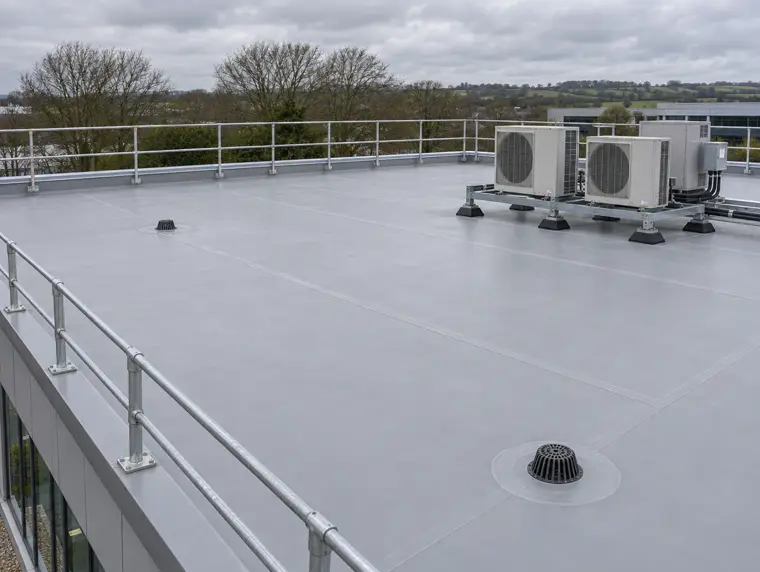
Single-ply is a common choice for medium and large flat roofs in Banchory because it covers big areas quickly, is light on the structure and has a long typical life. Wide rolls mean fewer seams, and those seams are welded and probed rather than glued.
Banchory's flat roofs are mostly on 1930s semis with flat-roofed garages and kitchen extensions, with plenty on 1960s and 1970s link-detached houses with flat-roofed garages and porches too. Scotland averages roughly 1,570 mm of rain a year, with the west far wetter than the east, so drainage, falls and wind uplift are part of every specification we write.
How much does a single-ply roof cost in Banchory?
For Banchory we use Scotland rates: £12,550–£20,700 is the guide for a 100 m² commercial roof in single-ply with insulation, VAT included. The fixed price comes after a free survey for new and replacement roofs.
| Job | Guide price inc VAT |
|---|---|
| Commercial roof (100 m²), single-ply + insulation | £12,550–£20,700 |
| Single garage (18 m²), single-ply | £1,950–£3,150 |
| Single garage (18 m²), EPDM rubber | £1,500–£2,650 |
| Extension (20 m²), EPDM, new deck + insulation | £2,650–£4,650 |
How long does a single-ply roof last, and what guarantee comes with it?
A well-installed single-ply roof typically lasts 25 to 35 years or more. Its life depends mostly on the quality of the welds, the fixing pattern, protection from foot traffic and keeping outlets clear.
Signs of trouble on an older single-ply roof include seams lifting at the edges, shrinkage pulling at upstands and corners, punctures near plant, and loose fixings under the membrane on windy sites.
Manufacturer guarantees are available on many specified single-ply systems, and they often depend on a registered build-up, an inspection and sometimes an approved installer. Where the system allows, we complete that registration on your behalf. On every re-roof you also receive our written workmanship guarantee, with the length set out in the quote, and you can ask about insurance-backed options. See the guarantees guide and maintenance guide for more.
What's included?
- PVC, TPO or FPO membrane, mechanically fixed, adhered or ballasted
- Edge protection on every job and walkway protection around plant
- Vapour control layer and warm-roof or tapered insulation as specified
- Hot-air welded seams, each probed along its full length
Building standards in Scotland
In Scotland the building standards technical handbooks (Section 6 for energy) apply, and the council's building standards service decides whether a building warrant is needed. Like-for-like repairs to a roof covering can be exempt; alterations, structural work and new roofs usually need a warrant before work starts. The domestic roof benchmark is 0.12 W/m²K, applied as far as reasonably practicable on an existing roof. More on the rules.
Which nearby areas do we also cover?
Single-ply membrane roofing in Banchory: questions
Do you cover Banchory?
Yes. Banchory is part of our Aberdeenshire coverage, including postcode districts AB31. Surveys and roofs are carried out by vetted roofing teams working under S&K Property Investments and Improvement Ltd.
Who checks building standards for a flat roof in Banchory?
Where the work needs approval it goes to Aberdeenshire Council building standards. We tell you at the survey whether your job needs it and deal with the paperwork as part of the quote.
How much does a single-ply roof cost in Banchory?
£12,550–£20,700 for a 100 m² commercial roof in single-ply with insulation, at Scotland guide rates including VAT. The fixed price comes after a free survey for new and replacement roofs.
Can single-ply roofing be laid over an existing roof?
Sometimes, if the existing roof and deck are dry and sound, often with a separation layer or new insulation on top. Wet insulation or a damaged deck means stripping first.
What is the difference between PVC and TPO roofing?
Both are thermoplastic single-ply membranes welded with hot air. PVC contains plasticisers and usually needs separating from bitumen, while TPO and FPO are polyolefin-based; the right one depends on the roof and the system specified.