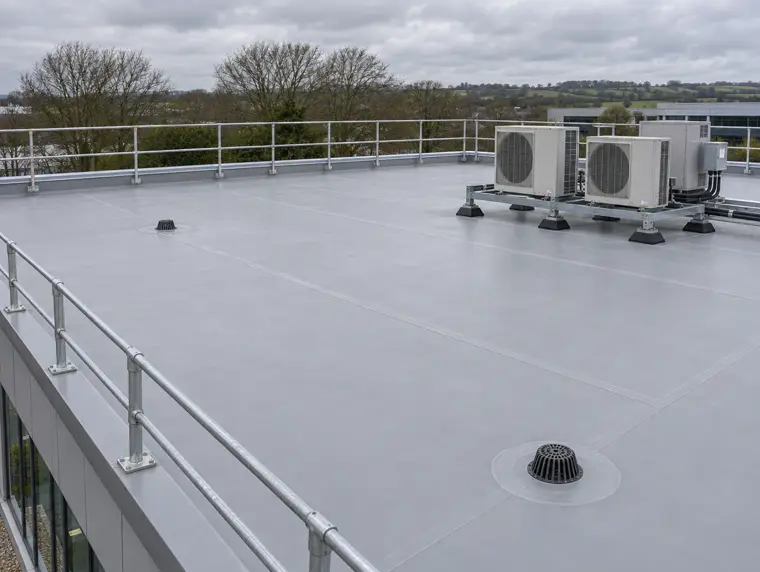
- Price per m²
- £95–£152
- Typical life
- 25–35+ years
- Manufacturer guarantees
- 20–25 year guarantees on specified systems
- Typical garage roof
- £2,150–£3,500
Bedfordshire at a glance
- Largest towns
- Luton, Bedford, Dunstable, Leighton Buzzard
- Postcode areas
- LU, MK, SG
- Building control
- Luton Borough Council, Bedford Borough Council and Central Bedfordshire Council
- Neighbouring areas
- Hertfordshire · Buckinghamshire · Northamptonshire · Cambridgeshire
- Guide price region
- East of England (+5% on West Midlands rates)
How much does a single-ply roof cost in Bedfordshire?
Guide prices including VAT at East of England rates. The fixed price comes after a free survey for new and replacement roofs.
| Job | Guide price inc VAT |
|---|---|
| Commercial roof (100 m²), single-ply + insulation | £13,900–£22,850 |
| Single garage (18 m²), single-ply | £2,150–£3,500 |
| Single garage (18 m²), EPDM rubber | £1,700–£2,950 |
| Extension (20 m²), EPDM, new deck + insulation | £2,950–£5,150 |
Which flat roofs are common in Bedfordshire?
Flat roofs in Bedfordshire sit on lock-up garage blocks on estates, newer estates where the first extension roofs are now being replaced and low-rise post-war blocks of flats. The East of England is the driest part of Britain, with parts of the Anglian region around 630 mm a year, so summer heat and UV, not rainfall, do most of the ageing on a felt roof. Approximate 1991–2020 regional averages based on Met Office data.
Building regulations in England
Replacing more than half of a roof over a heated room usually counts as renovating a thermal element, so it is insulated to current standards and notified to building control. Renovated roofs over heated rooms are insulated to around 0.16 W/m²K where that's feasible, and new extension roofs are built to 0.15 W/m²K. In Bedfordshire the application goes to Luton Borough Council, Bedford Borough Council and Central Bedfordshire Council. More on the rules.
How long does a single-ply roof last, and what guarantee comes with it?
A well-installed single-ply roof typically lasts 25 to 35 years or more. Its life depends mostly on the quality of the welds, the fixing pattern, protection from foot traffic and keeping outlets clear.
Signs of trouble on an older single-ply roof include seams lifting at the edges, shrinkage pulling at upstands and corners, punctures near plant, and loose fixings under the membrane on windy sites.
Manufacturer guarantees are available on many specified single-ply systems, and they often depend on a registered build-up, an inspection and sometimes an approved installer. Where the system allows, we complete that registration on your behalf. On every re-roof you also receive our written workmanship guarantee, with the length set out in the quote, and you can ask about insurance-backed options. See the guarantees guide and maintenance guide for more.
Should a single-ply roof be mechanically fixed or adhered, and how are the seams welded?
Most commercial single-ply roofs are mechanically fixed, while adhered systems suit decks that cannot take fixings or roofs where a smooth finish is wanted. The choice depends on the deck, the wind exposure of the site and the manufacturer's specification.
| Method | How it works | Typical use |
|---|---|---|
| Mechanically fixed | Fasteners and plates hold the membrane through the insulation into the deck, hidden under the lap of the next sheet | Metal, timber and concrete decks on commercial roofs |
| Adhered | Membrane bonded to the insulation or deck with adhesive | Domestic roofs, roofs where fixings are unsuitable |
| Ballasted | Loose-laid and held down by paving, gravel or a green roof | Inverted roofs, terraces, green roofs |
Fixing patterns are worked out for the site, with more fasteners at corners and perimeters, where wind uplift is strongest.
Seams are welded by hot-air machines and hand tools that melt the overlapping edges so they fuse. Each seam is then probed along its length to find any gaps, and test welds are made at the start of the day to set the machine for the weather. On commercial jobs we also check that walkways protect the membrane around plant.
Which towns in Bedfordshire do we cover?
Single-ply membrane roofing in Bedfordshire: questions
Which towns in Bedfordshire do you cover?
All of Bedfordshire. The main towns have their own pages below, and if yours isn't listed we still cover it: send your postcode and we'll confirm.
How much does a single-ply roof cost in Bedfordshire?
£13,900–£22,850 for a 100 m² commercial roof in single-ply with insulation, at East of England guide rates including VAT. The fixed price comes after a free survey for new and replacement roofs.
Which council handles building control for a flat roof in Bedfordshire?
It depends on where the roof is: in Bedfordshire that's Luton Borough Council, Bedford Borough Council and Central Bedfordshire Council. Replacing more than half of a roof over a heated room usually counts as renovating a thermal element, so it is insulated to current standards and notified to building control. We confirm which applies at the survey.
Can single-ply roofing be laid over an existing roof?
Sometimes, if the existing roof and deck are dry and sound, often with a separation layer or new insulation on top. Wet insulation or a damaged deck means stripping first.
Can single-ply be used on a house?
Yes. It can be used on garages, extensions and dormers, usually adhered rather than mechanically fixed. On small domestic roofs, though, EPDM or GRP is often more economical.
How long does a commercial single-ply roof take?
A roof of around 100 m² typically takes several days, depending on strip-out, insulation, details and weather. Work is phased so the building stays weathertight and occupied areas are protected.
Everything about single-ply membrane roofing → · All flat roofing in Bedfordshire →